i got this error control frame timeout in my sxt client what is this ?
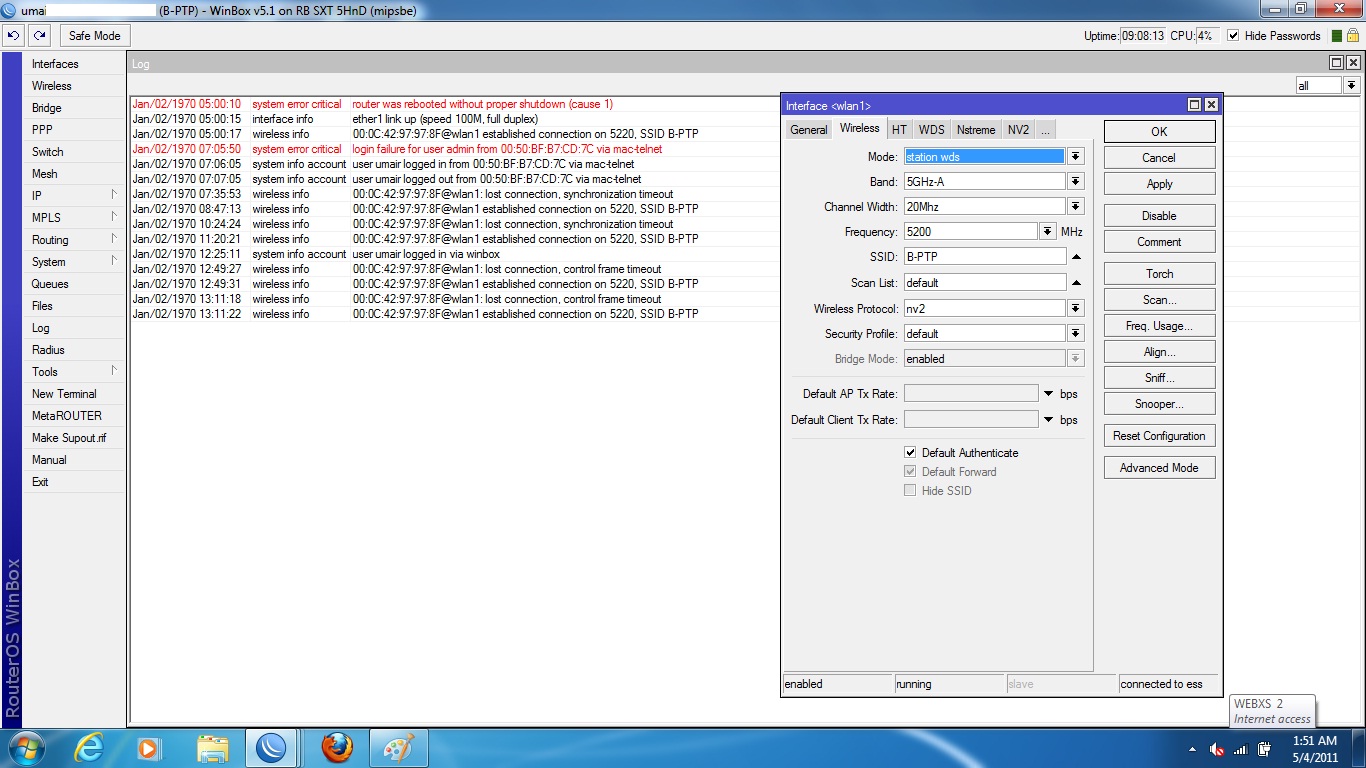
Weak radio link or/and interference from other networks.
I’ve seen frequent (2-3 times per hour) “lost connection, control frame timeout” or “lost connection, medium-access timeout” on a almost perfect link with -60 signal when it was idle. If only 1Mbit bothway traffic pass through it and no more “lost connection…” . But your link might have some issues.
i have -79 signal with 60% ccq
How far are your links, have you measured them? what do you have set in the “Distance” setting on both radios under the advanced wireless tab? what about your NV2 cell radius?
maybe post your configuration too. 
For normal 802.11 this is marginal signal, for nv2 I would say it is poor and insufficient.
i think should your channel is using by other wireless or your signal is not good
Yes this is true, but i have a very stable link with NV2 at -83/-80 dB. & 68/45 CCQ I get about 15 megabits each direction, and i dont have connection drop problems. Although i use NV2 A Mode. Its faster than N at those signal levels, i do only have single chain on the AP side. (Client is an SXT Single chain mode)
perhaps there is more to the story.
-Brad
15Mb in each direction? Not at the same time I presume (that’s impossible) and at what cost? Your latency will be very high and voip on such a link will be very poor at best. (too many packages get lost and too many delays for the ones that make it…)
I don’t know if N would perform worse under such signal levels. The whole design is that with same distance/signals levels N protocol should almost be able to quadruple the throughput. Or, with the same throughput as goal the reachable distance can be much further to still have a communication going on.
But each technology used needs its fine tuning to get the best out of the available parameter settings.
It is not that one protocol can be exchanged for another to see the difference in capacity between the two.
Like a F1 car won’t bring you faster from one city to another than the average car. [One of the changes you probably would have to make to the F1 is put it on higher suspension to at least make it able to run faster on the average road!]
In other words, each protocol has its own adjustments to the environment it is set to work in to get the best out of it…