For sure, for one thing I know more than you, you certainly know another thing more than me… 
Duel of titans 
Thank you both for teaching us so many useful things.
BR.
Added some functions here, can be useful:
http://forum.mikrotik.com/t/rextended-fragments-of-snippets/151033/15
Could you guys include OVPN failed login into this Script, please? I tried to replicate it from your Script. However, I was not able to. Added IP is 0.0.0.0 at the created address list.
Thank you :d.
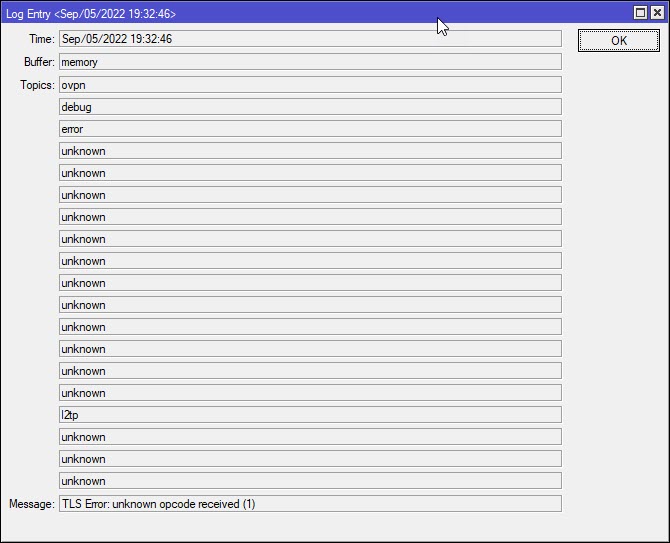
TLS Error: unknown opcode received (1)
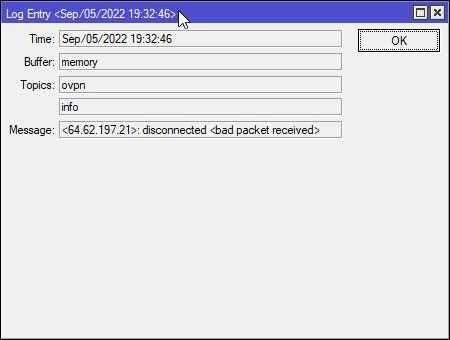
<64.62.197.21>: disconnected <bad packet received>
I have another script to share:
# Created by Anton BORODA Borodyuk 2023
#
# This script adds users who end up with "parsing packet failed, possible cause: wrong password" message during
# VPN connection more then $maxTryCount times to the $listName for 7 days,
# This should be a good riddance for VPN password guessers.
#
# Losely based on Jotne && rextended 2022 v1.5 script.

:local listName "IPSEC"
:local maxTryCount 21;

:local offenders ({})

/log
:foreach i in=[find where message~"possible cause: wrong password"] do={
    :local logMessage [get $i message]

    :local ipString [:pick $logMessage 0 [:find $logMessage " "]]

    :if ($offenders->$ipString != nil) do={
        :set ($offenders->$ipString) ([:tonum ($offenders->$ipString)] + 1)
    } else={
        :set ($offenders->$ipString) 1
    }
}
:foreach key,value in=$offenders do {
    :local tryCount [:tonum ($value)]
    :if ($tryCount > $maxTryCount) do={
        :local logIp [:toip $key]
        :if ([:len [/ip fire addr find where list=$listName address=$logIp]] < 1) do={
            /ip fire addr add address=$logIp list=$listName timeout=7d
            :log info message="script=IPSEC_failed src_ip=$logIp why=Password guesser"
        }
    }
}
This works a little differently.
I had a lot of false-positives with the scripts above, so I modified this to include only actual failed password attempts.
This counts the number of incorrect password messages and if it’s more than 21 (iOS client retries 7 times before throwing an “unable to connect message”, so it’s giving a user 3 attempts in total), the user is added to the list.
Do not use ({}) for define empty array, the correct way is :local arrayvar [:toarray ""]
I myself used that method once suggested by another user, but it backfired because, although I don't quite remember now how,
it had unwanted effects that backfired on me in programming.
IT SEEMS to work, then it messes up...
Missing a space between do and {
:foreach key,value in=$offenders do {
The script is wrong on this line:
:if ($offenders->$ipString != nil) do={
You can not compare one array field with the string "nil".
Nil is not a reserved word usable for compare something on this way.
Nil is just a string, you can write anything, and for just a coincidence work.
Instead the "nothing" keyword exist, but you can not compare two nothing or two nil....
:global test [:toarray ""]
:global isnil [:pick "" 0 1]
:global notnil ":)"
:put [:typeof $test]
:put [:typeof $isnil]
:put [:typeof $notnil]
:if ($isnil != nil) do={:put "not nil"} else={:put "is nil"}
:if ($notnil != nil) do={:put "not nil"} else={:put "is nil"}
:if ($test->$isnil != nil) do={:put "not nil"} else={:put "is nil"}
:if ($test->$notnil != nil) do={:put "not nil"} else={:put "is nil"}
:set ($test->$isnil) "is-nil"
:set ($test->$notnil) "not-nil"
:put [:typeof $test]
:put [:typeof $isnil]
:put [:typeof $notnil]
:if ($test->$isnil != nil) do={:put "not nil"} else={:put "is nil"}
:if ($test->$notnil != nil) do={:put "not nil"} else={:put "is nil"}
:put [:typeof ($test->$isnil)]
:put [:typeof ($test->$notnil)]
:if ($test->$isnil != anystring) do={:put "not nil"} else={:put "is nil"}
:if ($test->$notnil != anystring) do={:put "not nil"} else={:put "is nil"}
:if (($test->$isnil) != [:nothing]) do={:put "not nothing"} else={:put "is nothing"}
:if (($test->$notnil) != [:nothing]) do={:put "not nothing"} else={:put "is nothing"}
The correct way is with ( ) and use :typeof, and is nothing the undefined "nil" on array:
:if ([:typeof ($offenders->$ipString)] != "nothing") do={
Created by Anton BORODA Borodyuk 2023
v1.0.r
fixed and revised by rextended
This script adds users who end up with "parsing packet failed, possible cause: wrong password" message during
VPN connection more then $maxTryCount times to the $listName for 7 days,
This should be a good riddance for VPN password guessers.
Losely based on Jotne && rextended 2022 v1.5 script.
:local listName "IPSEC"
:local maxTryCount 21
:local offenders [:toarray ""]
/log
:foreach i in=[find where message~"possible cause: wrong password"] do={
:local logMessage [get $i message]
:local ipString [:pick $logMessage 0 [:find $logMessage " "]]
:if ([:typeof ($offenders->$ipString)] = "nothing") do={
    :set ($offenders->$ipString) 1
} else={
    :set ($offenders->$ipString) (($offenders->$ipString) + 1)
}
}
/ip firewall address-list
:foreach key,value in=$offenders do={
:local tryCount [:tonum ($value)]
:if ($tryCount > $maxTryCount) do={
:local logIp [:toip $key]
:if ([:len [find where list=$listName and address=$logIp]] < 1) do={
add address=$logIp list=$listName timeout=7d
:log info "script=IPSEC_failed src_ip=$logIp why=Password guesser"
}
}
}
Testing in Ros 6.49.7 some scripts (written using functions stored as array members), I have found that using ({}) to initialize a variable (even local) with an empty array, sometimes doesn't clear it and persists the value assigned in the previous execution of the function, so if each execution adds 3 items to the (in theory) empty array, the first execution will return 3 items, the second will duplicate it and return 6 items, the third will return 9, ...
Those scripts worked well in Ros 7.7, so it seems that some script bugs where solved in v7.
I now use exclusively [:toarray ""]
Thanks, I do not remember precisely why, but I remember that updating one array defined with ({}) cause later a mess with other arrays defined on same way…
My script!
add chain=input action=drop
add chain=forward action=drop
That was easy.
You forget to add first the admin access 
Thanks for all the improvements and corrections.
I'm far from good in writing mikrotik scripts tbh, so the corrections are most welcome.
Hello, I modified the code but I have problems with “phase1 negotiation failed\.”
# Created Jotne && rextended 2022 v1.5
#
# This script add ip of user who with "IPSEC negotiation failed", "SPI* not registered" and "Invalid exchange" to a block list for 7 days
# Schedule the script to run every 5 min
# It should run on all routerOS version
# 1.3 added "Invalid exchange"
# 1.4 added dot behind "negotiation failed" to get only lines with IP
# 1.4 made all inn to one loop, based on idea by rextended
# 1.5 Fixed typo

:local logMessage ""
:local logIp ""
:local cont1 0
:local cont2 0
:local cont3 0
/log

:foreach i in=[find where message~"phase1 negotiation failed\\." or message~"SPI.*not regist" or message~"Invalid exchange"] do={
    :set logMessage [get $i message]

    :if ($logMessage~"phase1 negotiation failed\\.") do={
        :set $cont1 ($cont1 + 1)
        }
    :if ($logMessage~"SPI.*not regist") do={
        :set $cont2 ($cont2 + 1)
        }
    :if ($logMessage~"Invalid exchange") do={
        :set $cont3 ($cont3 + 1)
        }


    :if (($logMessage~"phase1 negotiation failed\\.") && ($cont1 > 2)) do={
        :set logIp [:toip [:pick $logMessage -1 [:find $logMessage " "]]]
        :if ([:len [/ip fire addr find where list=IPSEC address=$logIp]] < 1) do={
            /ip fire addr add address=$logIp list=IPSEC timeout=7d
            :log info message="Script=IPSEC - src_ip=$logIp Motivo=negotiation_failed"
        }
    }

    :if (($logMessage~"SPI .* not registered for") && ($cont2 > 2)) do={
        :set logIp [:toip [:pick $logMessage ([:find $logMessage "for "]+4) [:find $logMessage "["]]]
        :if ([:len [/ip fire addr find where list=IPSEC address=$logIp]] < 1) do={
            /ip fire addr add address=$logIp list=IPSEC timeout=7d
	:log info message="Script=IPSEC - src_ip=$logIp Motivo=SPI.*not regist"
        }
    }
#:log info message="ipsec changed script settings by gleguizamon."
    :if (($logMessage~"Invalid exchange") && ($cont3 > 2)) do={
        :set logIp [:toip [:pick $logMessage ([:find $logMessage "from "]+5) [:find $logMessage "["]]]
        :if ([:len [/ip fire addr find where list=IPSEC address=$logIp]] < 1) do={
            /ip fire addr add address=$logIp list=IPSEC timeout=7d
	:log info message="Script=IPSEC - src_ip=$logIp Motivo=Invalid exchange"

        }
    }
}
Here is my variant that also reports abuse
:local listName "portscanner"
:local logMessage ""
:local logIp ""
/log
:foreach i in=[find where message~"phase1 negotiation failed\\." or message~"phase1 negotiation failed due to time up "] do={
    :set logMessage [get $i message]

    :if ($logMessage~"phase1 negotiation failed\\.") do={
        :set logIp [:toip [:pick $logMessage -1 [:find $logMessage " "]]]
    }

    :if ($logMessage~"phase1 negotiation failed due to time up ") do={
       :local temp [:pick $logMessage ([:find $logMessage ">"]+1) 999]
       :set logIp [:pick $temp 0 [:find $temp "["]]
    }


   :if ([:len [/ip fire addr find where list=$listName address=$logIp]] < 1) do={
      /ip fire addr add address=$logIp list=$listName timeout=7d


      :local data "ip=$logIp&comment=Port%20scanning&categories=14%2C15"
      :local result ([/tool fetch mode=https url="https://api.abuseipdb.com/api/v2/report" http-method=post http-data=$data http-header-field="key: [API_KEY],Accept: application/json,Content-Type: application/x-www-form-urlencoded" as-value output=user])
   }
}
Hello,
this line dont work
can you help me pls.
I added this so that it only looks at todays logs. Otherwise it will report old logs after timeout period. I use the fact that todays logs only have time not date
:if ([:len [get $i time]] = 8 and [:len [/ip fire addr find where list=$listName address=$logIp]] < 1) do={
Be advised, that assumption might become wrong.
It looks like they are moving towards standardized date/time formatting.
See latest change log on 7.10b5.
The time format alone is not changed,
this still valid until do not fix the “friendly” time on logs.
its a shame mikrotik log doesnt have a proper datetime data type
i have 6.48.6
My code you are trying to execute on your router was written on 7.8 - 7.9