That's exactly the catch: CLAT only becomes as ubiquitous as NAT if vendors like MikroTik build it in. And doing it on the ISP's first box before your router means ISP gear doing CLAT at your place, which sounds a lot like the locked down setup you didn't want. Having it built into your own router is the option that keeps you in control.
I totally agree. Mabye I did not explain myself in the best way.
But I was hoping that someone maybe received an answer from Mikrotik over a "Feature request" ticket.
We will open one, for CLAT as you explained. this is the part that is missing and in the end it gives the "Enduser" more freedome, becuase he/she can choose what ISP get. IPv6 only dual-stack or IPv4. Having the option is always the better way.
No worries, my post wasn't really aimed at you, it just happened to land right after yours. And yes, opening a support ticket is exactly the right move.
Worth adding to the ticket: most mobile operators that go IPv6-only deliver IPv4 through 464XLAT, but the only IPv4-over-IPv6 options you can run on ROS v7 today are DS-Lite and MAP-E with some manual work, both using an ipipv6 tunnel. There's no 464XLAT CLAT at all, and that’s the gap that needs fixing in ROS.
Thanks for the fuller explanation.
I stick with my position that I defend the router as mine and the ONT as nothing to do with me. So yes, I would take CLAT on the router, if it were baked in across the market. ie not an extra module to download for RouterOS and if it just worked like NAT without configuration or intervention.
I assume you are not suggesting CGNAT on IPv6 [ ]. IPv6 provides the public addressing I want and I would be quite happy to see my IPv4 go to CGNAT, although my ISP provides a static IPv4 address. It seems to me that the time is right for ISPs to get a little tough on this and transition fully to CGNAT on IPv4 and tell customers who want static addresses that they can only have them on IPv6
No, not at all. IPv6 stays public with no NAT as usual.
It's the ISP side that runs the NAT64 for the IPv4 traffic, and that service basically works just like a CGNAT.
So we're pretty much on the same page. Your idea of IPv4 on CGNAT and static addresses only on IPv6 is close to what 464XLAT gives you. The difference is that with 464XLAT the ISP doesn't have to run IPv4 in the access network at all. And yes, CLAT built in and working out of the box like NAT is exactly what we're asking MikroTik for. Have you opened a support ticket about it too? The more real use cases they get, the better.
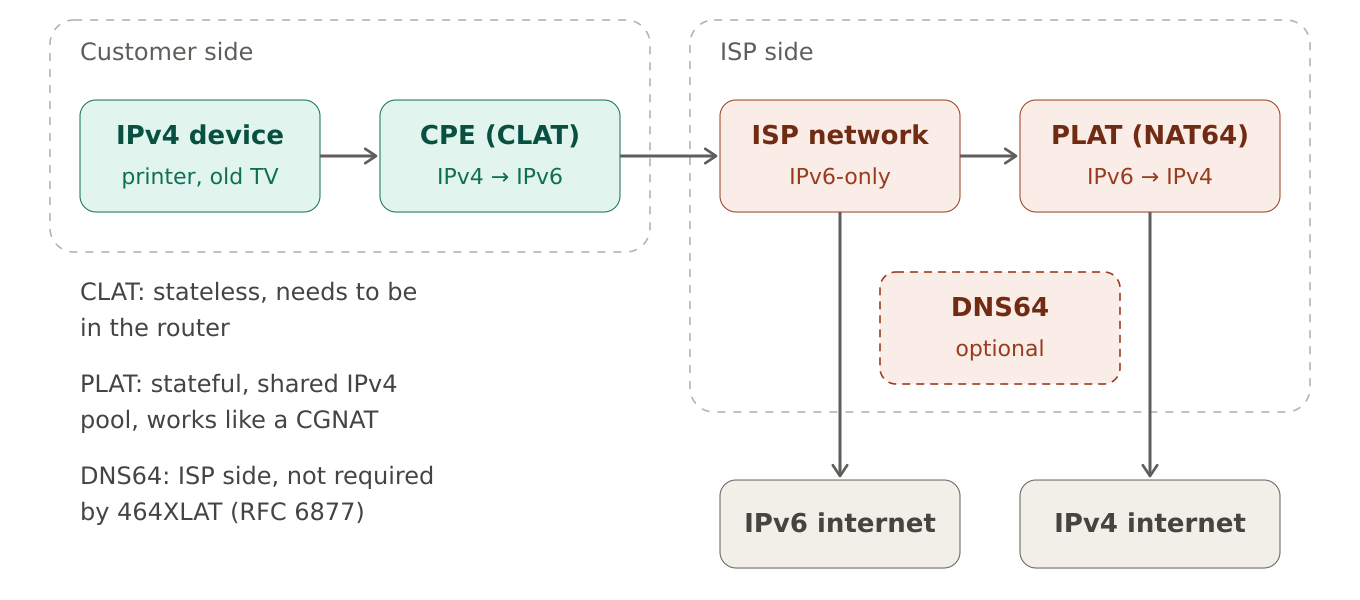
Picture of the 464XLAT topology: where CLAT (CPE) and PLAT (ISP) actually sit:
Someone else could also explain better, but architecturally nothing stops an IPv4 public from transiting to end-customer, so a customer could still have a fixed IPv4 address. It just not a common way these things are deployed.
And it's the DNS64 part that often the objection, since plain IP address usage does not work (except on dual-stack devices). With the DNS64 part might be thornier part for RouterOS than pure 464XLAT side of it.
DNS64 and NAT64 both live on the ISP side, so neither is something ROS needs to run as a CPE.
The breakage you mention, IPv4 literals and IPv4-only apps not working, happens only when the ISP runs NAT64/DNS64 and the customer has no CLAT. The CLAT fixes exactly that by giving the LAN a local IPv4 path and translating it to IPv6, so IPv4 literals work without any DNS64 trickery.
RFC 6877 says the same: 464XLAT doesn't require DNS64. In the diagram I posted earlier, the CLAT is the CPE box on the customer side, while NAT64 (the PLAT) sits on the ISP side, which is also where DNS64 lives.
So the key thing missing in ROS as a CPE is the CLAT itself, and all it needs from the ISP is the NAT64 prefix, e.g. via PREF64 in the RA (RFC 8781) or by asking the ISP's DNS64 (RFC 7050).
As for a fixed public IPv4 (#46): possible, but that's an ISP-side mapping in the PLAT, nothing the CPE has to care about.
And honestly, a CLAT is about the easiest piece of the whole 464XLAT puzzle: simple stateless translation, with open source implementations that have been around for years. It shouldn't be rocket science for MikroTik to build that, and with more operators going IPv6-only every year, having it in place before the real demand shows up beats scrambling to catch up later.
True, 464XLAT not needed in RouterOS, with big assumption that an ISP does not want to use a MikroTik routers, only their CPEs 
Right, and that's exactly the split I mean. ROS as an ISP router would need the PLAT side (NAT64 + DNS64), which is basically a CGNAT with translation and a much bigger job. But the PLAT can live on other gear, the CLAT can't.
ROS as a CPE only needs the CLAT 
I guess my opinion is there is security value in forcing LAN apps to always use DNS for IPv4. Although that's the thing that breaks some apps in some IPv6 translations... that people don't like. But forcing everything through DNS allows at least a check of the domain name, and flushes out thing that don't work with IPv6 so it IPv4 can be "retired". With added benifit any security tools folks use can live on the IPv6 side if there is not IPv4 allowed at boarders. Not where the world is at, but that why "something" in this direction in RouterOS be good.
Maybe I misread you here, but for your own LAN that makes sense.
But for an ISP whose CPEs have to deliver working IPv4 to customers, breaking IPv4-only devices and IPv4 literals on purpose is probably not a viable option. That’s exactly why 464XLAT exists: plain NAT64/DNS64 wasn’t enough, which is what the CLAT fixes on the CPE.
I was speaking more aspirationally if only that were possible.
And, there is nothing on RouterOS for hope on this direction. Other than containers.
Well, maybe not right away, but I'm pretty sure MikroTik will have to come around on CLAT sooner or later. Though I'd happily see them sort out all the MLAG issues first 
An update on the standards side. draft-ietf-v6ops-claton has been approved by the IESG and is now in the RFC Editor queue: https://datatracker.ietf.org/doc/draft-ietf-v6ops-claton/
It updates RFC 8585. A CE router that supports 464XLAT MUST now learn the NAT64 prefix from PREF64 in Router Advertisements (RFC 8781). It SHOULD send PREF64 on the LAN and handle DHCP option 108.
RouterOS already does the LAN side: PREF64 in RAs since 7.8, and option 108 on the DHCPv4 server since 7.25. What it lacks is the translation itself. There is no CLAT and no PLAT, and containers don't run on MIPS or TILE.
I've put the whole case in one place, with sources:
It has:
- a requirements table mapping RFC 8585, the claton draft, RFC 6146 and RFC 6147 against RouterOS 7.25.1;
- a test you can run on your own CPE once RouterOS has a PLAT, with no ISP involvement (PLAT on the CPE, IPv6-mostly LAN);
- answers to the objections raised in this thread;
- a support ticket template.
DNS64 is optional in the request. Where it is used, DNSSEC validation has to run upstream of it.
Larsa is right that another +1 here won't move anything. If you need this, please open a ticket at help.mikrotik.com/servicedesk using the template, and describe your network:
464xlat_mikrotik/TICKET-TEMPLATE.md at main · IEISI-ORG/464xlat_mikrotik · GitHub
Corrections are welcome as issues on the repo.
You're lumping CLAT and PLAT together again, both in the post and on GitHub. As I wrote earlier, the PLAT is heavy ISP infrastructure (in practice a CGNAT) and CLAT is the thin CPE translation layer.
As for the new draft you're making a big fuss about, the part you highlight, how a CLAT should find its prefix, is only a minor implementation change.
In general (and I say this kindly), what you want to say drowns in all the text and tables, which is typical when you let an AI decide the layout, so a tip for next time is to decide the structure yourself.
Good feeback. I'll break down the ask to CPE with CLAT and CCRs with PLAT.