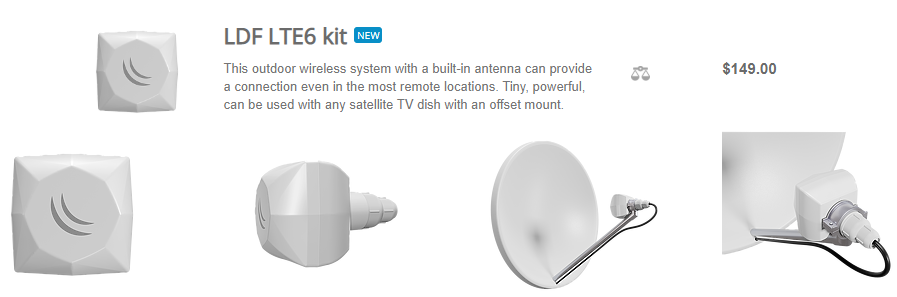
from differ $ price shelf? S8 in my country is start at least $416 and more.
You should buy adequately modem like ~200$ Telit LM960 Cat.18 and install 2x (MIMO 2x2 LTE external antennas) dedicated to specific your band’s and that way create best possible devices with your LtAP who can be buy without KIT for ~$100 .
MikroTik just create new and new LTE devices (Chateau with Quectel EG12) and yes, the Mobile world are faster and faster and you can buy better/faster LTE Cat devices but MikroTik in this time not offer it. Just not offer it yet.
You should write here, “Please create new LTE modem’s” like Samsung S8 who have LTE-Advanced Cat.16 in 2017 ( 3 years ago ) and more because you should write more specific.
Please create Modems with >Cat.14 who have got the “Dual Connectivity” means DL stream are from two differ eNB ! This will be perfect feature request.
At MUM EUROPE Prague we will sea what devices will be brings with 5G. This I hope will be point when we see about 4G new LTE modems too. I hope so.
I was referring to the performance problem of the current LTE kit utilizing the embedded LTE module (edited and made my previous answer more accurate). But I’m also looking forward to see what MT has to offer when it comes to 5G. And I really hope they managed to add a GBE LAN-port to the unit this time!
Yes SiB, im comparing because these is NEW MT product which is useless from beginning, in real world all CAT18 or better devices take almost all bandwidth form cell tower and CAT6 doesn’t have chance even firmware is OK. I do not understand why a product is released that does not have a chance to apply to which it naturally belongs (automotive).
I personally have no problem with the cost and that the router costs $ 500 but it works, otherwise we all lose money and time completely unnecessarily.
If RoS has supported drivers for say Telit modems, why not point it out.
I personally have no problem paying for something that is good, but I have a problem when I realize that I have purchased a product that has not been sufficiently tested.
and to return now, to the original subject; any device below the CAT20 doesn’t make sense, specifically I think 5G is still a long way off and will have a number of obstacles before it comes to life like 4G, mobile manufacturers have shown that 4G can do a lot more.
so MT, please support at least 1 honest LTE modem CAT20 does not matter which manufacturer it is
Right now I can buy Huawei b818 it is year old product with CAT19 for like 190usd. Mikrotik Chateau just relesed has CAT 12 and cost 215usd.I really like mikrotik but we really need some series product.
After spending the last two weeks doing 6km round-trips to my interent relay, I’ve noticed several things with my SXTR
when reception is poor, the R11e-LTE is slow and drops packets - EC25 reports similar reception stats but is 10+Mbps faster and doesn’t drop packets.
depsite the SXTR having better (still not great) gain for 700MHz than an iPhone (https://forums.macrumors.com/threads/antenna-gain.2198382/), SXTR cannot connect to a tower 10km away via B28. Locking the EC25 to B28 and the modem is stuck searching for the network, yet an iPhone 6S without doing CA can get 40Mbps with 2 bars.
pointing the SXT 50-60 degrees away from a tower has zero noticable performance drops
It’d be nice if MikroTik tweak the SXT models to have a much better antenna for lower frequencies. I’ve also got an LHGR for testing and it isn’t really any better (plus hasn’t got another PoE out which I need).
How about going from 8T8R(MIMO) to 16T16R? How about making Cell Index Offset more advance where the network itself adjusts the handover margins at relation level? How about changing LTE handovers from hard to soft, as soft handovers are the better one among the two.
How about going from 8T8R(MIMO) to 16T16R? How about making Cell Index Offset more advance where the network itself adjusts the handover margins at relation level? How about changing LTE handovers from hard to soft, as soft handovers are the better one among the two.
I’m not sure that’s standardised by 3GPP yet. Even if it is, massive MIMO (MxN where M or N > 4) requires active antenna array ant those are not peanuts to operate. Hence complicated antennae are usually used on eNodeBs for MU-MIMO (multi-user MIMO) by means of beam-forming.
The first requirement is already possible but very much relies on some form of SON (self-optimising network) which is currently implemented by having dedicated HW and SW in MNOs core network (SW analyses signalling from mobile devices in near-realtime and adjusts configuration of eNodeBs). However, this is not a required feature and I suspect not every MNO is running SON in this form (basic SON only offers automatic provisioning of newly built eNodeBs).
The second requirement: hard handovers are built into basic LTE standard and change is not going to happen.
We’ve had soft handovers in 3G (UMTS/WCDMA) and indeed worked great for legacy services (CS: voice, video telephony and legacy CS data), however it did not work that great for new PS services (HSPA) … it was about excessive use of NodeB resources when mobile terminal was in soft handover. Additionally: soft handover works nice for moving terminal but sucks for stationary one. And most terminals in fixed MBB (typical use of MT devices) are fairly stationary.
Anyway, the two requests can not be fulfilled by equipment vendor (neither network nor terminal)
because all terminals must comply to standards.
All major, Orange, T-mobile, Play, Plus. No caps in plans for enterprise or some consumer tarrifs in terms of speed or transfer! Need gigabit ethernet here for SXT and others.
I guess we need simple bridge mode in LTE products so that LTE products are still manageable from our routers but not from internet and acting as a bridge - public IP on other device than LTE product.
We need QAM256 also. Already in Poland you can break 300Mbps barrier with 4x4 MIMO, 3CA in cities and many upgraded BTS are outside of big cities too.
Are there any plans or roadmaps for new products? Since that post we have seen, LHG CAT6, SXT CAT6 emerge (with 2CA, unfortunately 100Mbps ethernet), Chateau CAT12 (3CA, MIMO 4x4), whats coming next?
It would be nice to have some 5G - ready products as we see first 5G networks appearing in Poland.
Some nice tools in software to analyze performance on each of the bands and in combination with 2CA,3CA would be great. Not it has to be done manually and is a serious pain, it is also tricky to identify BTS they are connected to for basic users.
We would like to know our customer wishes and use cases on what kind of future LTE technology would be interested in?
Which LTE Category you are interested in most - CAT6, CAT7, CAT9, CAT11, CAT12, CAT16 or some other?
Which LTE bands and which Carrier Aggregation combinations should be supported?
Should it also support Legacy technology like 3G or 2G?
Which World/Region/Country would you use it?
Which LTE carrier provider you are interested connecting and is there speed/monthly cap for the subscription plans?
Definitely CAT6, CAT7, CAT12, CAT16
Its time to have more than single LTE chain and to have 2-3-4 available modems with ability to be set in FT/LB modes. We can’t let the yachts and vessels still to go mostly for Peplink and Meridian. Marine/Vehicle models have to be rugerised and with GPS.
2G - no, 3G - maybe. In most case this is not a single device and redundant can be set for obsolete technology. Maybe USB with enough space under the cover will let backup 3G USB modem to be used. I personally prefer empty slot where a mini-PCIe card can be set - this will give chance for additional 3G or LoRa.
Europe and International.
I don’t really get the reason for this question. Most mobile providers have speed cap / monthly traffic cap even they do not announce it.
Using more than one active LTE modems simultaneously give a lot of option this issue to be mitigated by prioritising, fault tolerance or load balance - nothing that good script cannot do.
We’re looking for highly-manageable SOHO devices for customers, and most of the new LTE gear (especially Chateau) would be ideal if it supported US carriers and included some active PoE ports. With VoIP phones being a thing, running them off of PoE saves a ton of troubleshooting time and effort, and allows customers to keep all of their critical connectivity gear up and running with a single UPS if they choose that option. Right now we use separate PoE switches, which is just one more device to deploy and manage. Passive PoE is annoying because it gives us no device / consumption feedback information which let us infer quite a bit about the environment without sending a tech on-site.