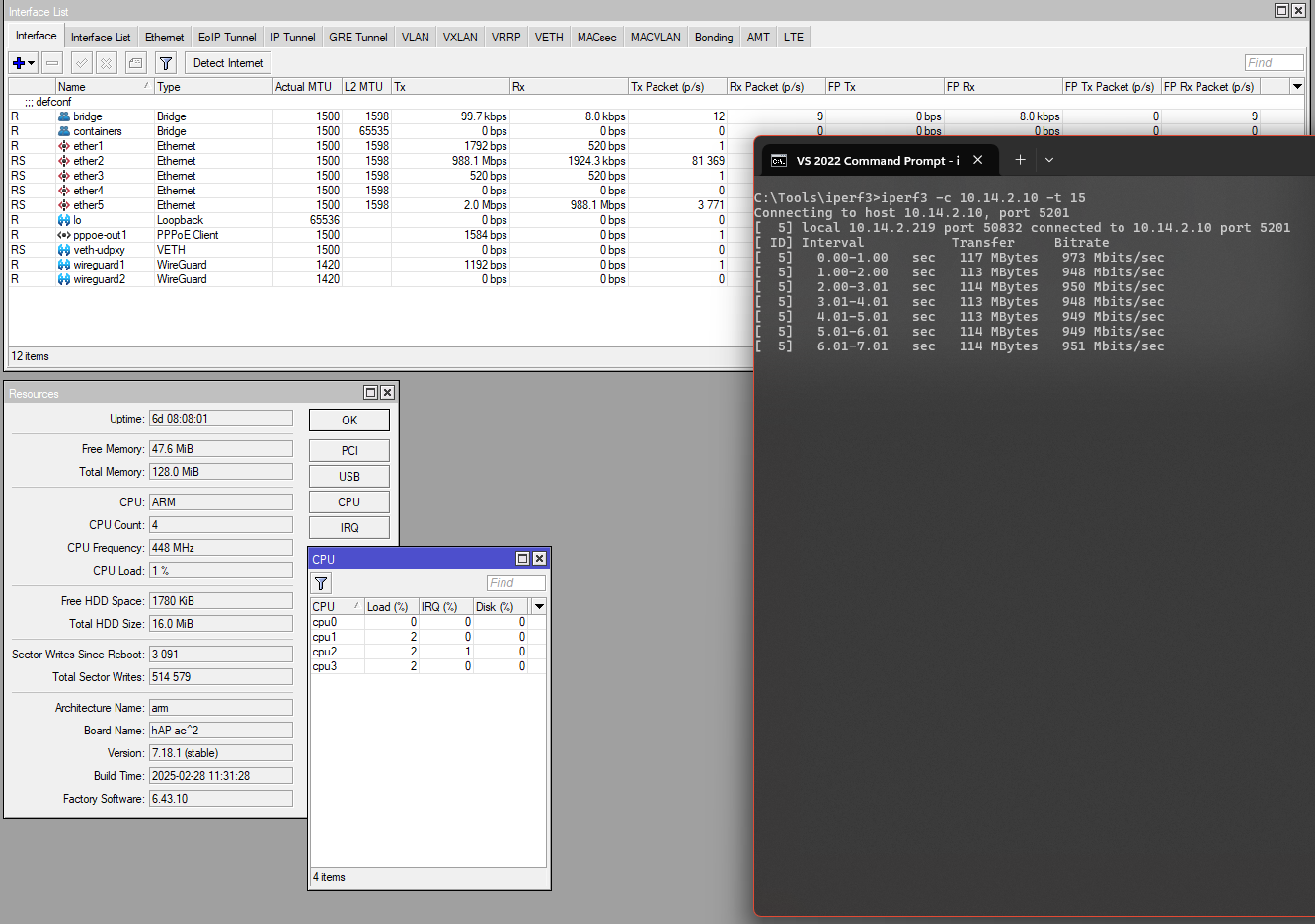
As promised, here are some test results from my hAP ac². Two wired PCs are connected directly to ports ether2 and ether5 of the router and run iperf3 (in one direction).
- First the bridge as configured by defconf is used. No VLAN is configured. 10.14.2.0/24 is the subnet of the bridge. CPU usage is minimal (not used for the transfer):
- Next, a vlan312 interface is configured with Bridge VLAN Filtering, by just setting PVID on the ports, setting Frame Types, and turning on VLAN filtering on the main bridge. 10.3.12.0/24 is the subnet of the VLAN interface:
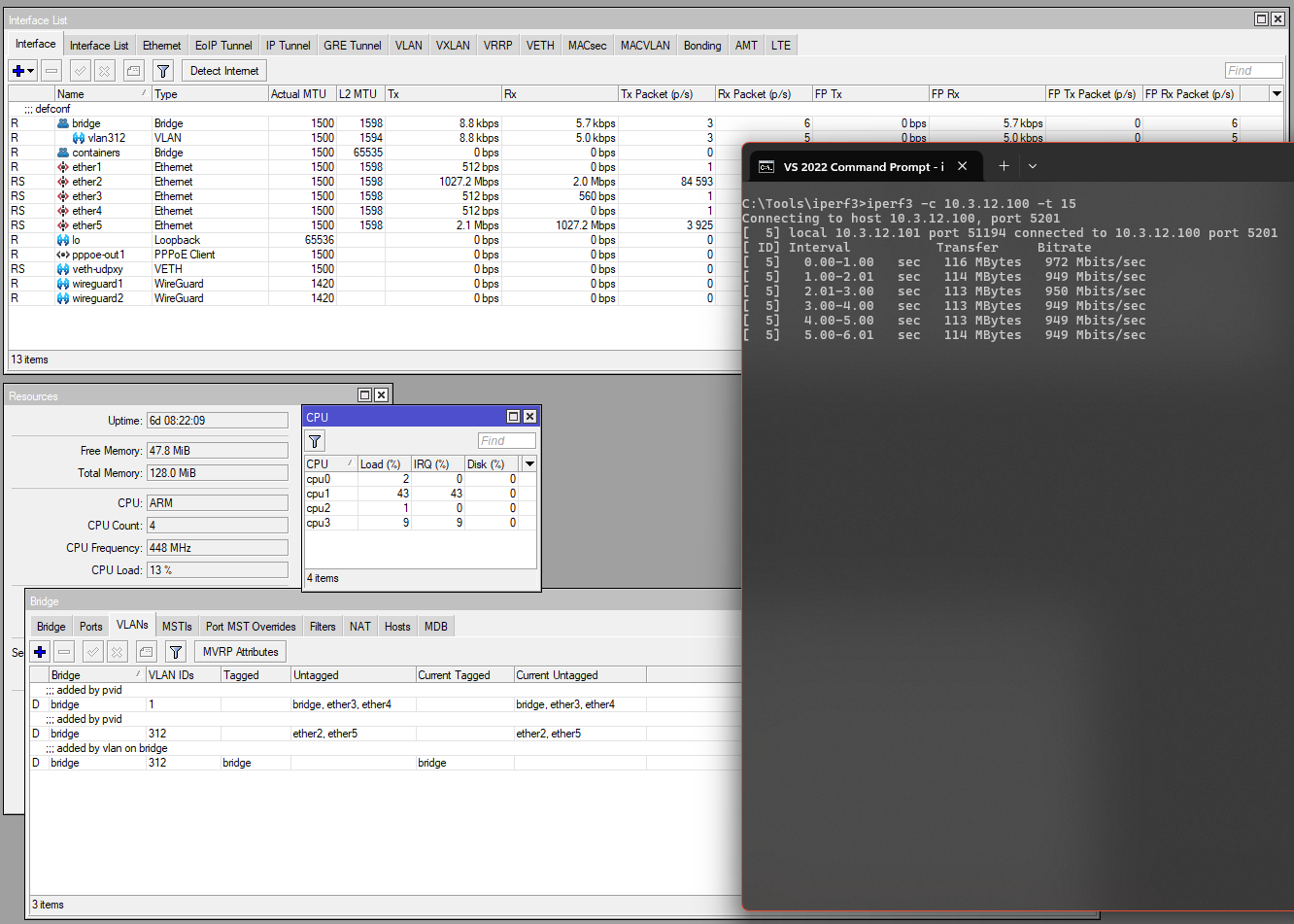
iperf3 throughput is maintained at 950Mbps without problem, but we can see that half of a core are now used (13% = 1/8 of 4 cores) because switching is now done by the main CPU. The CPU frequency is only at 50% (448MHz from 896MHz) though.
- Finally, Bridge VLAN Filtering is removed. VLAN 312 is now configured with /interface ethernet switch:
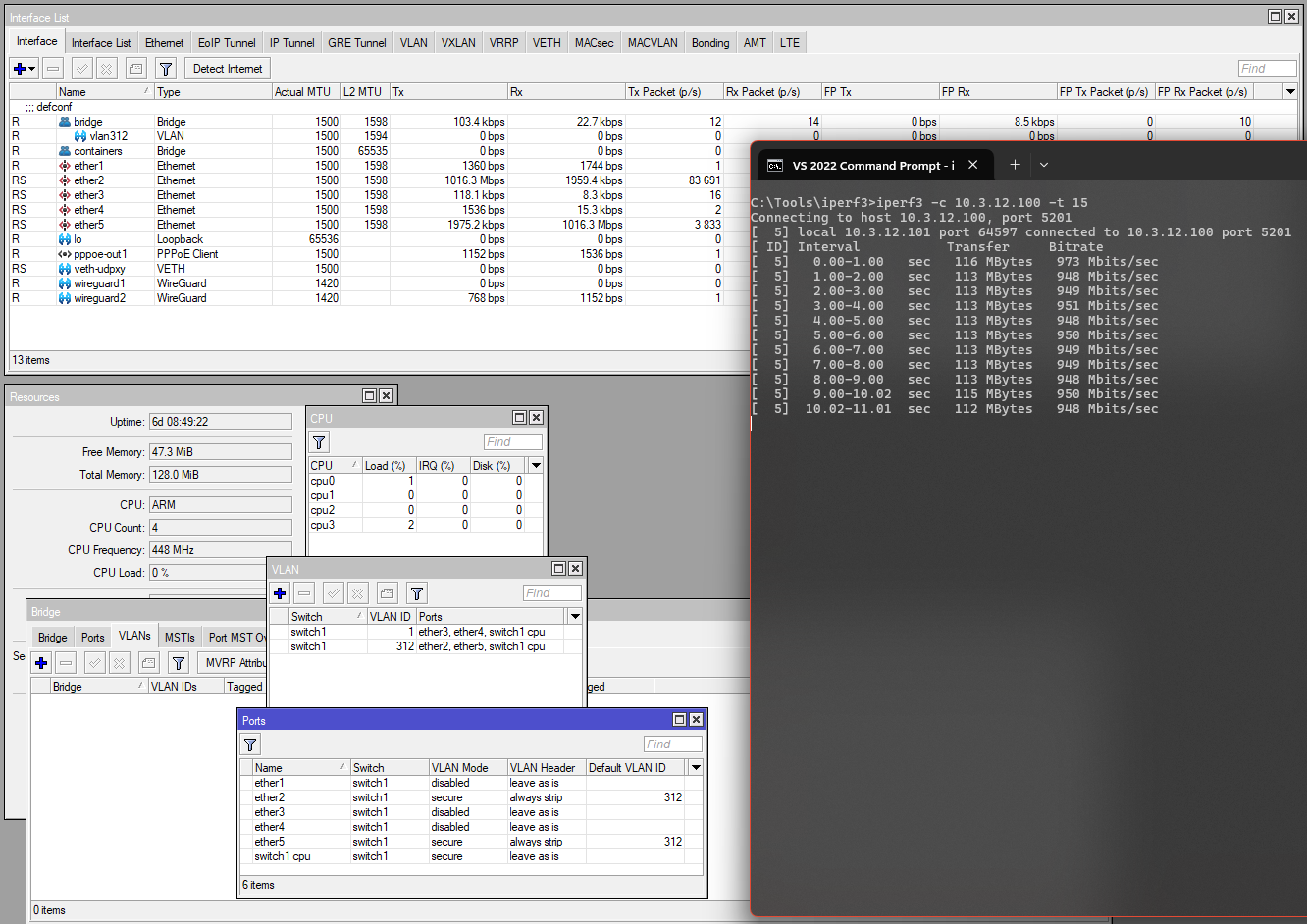
CPU usage is again negligible, because now everything is handled by the switch chip again.
The hAP ac² has a quad-core ARM32 CPU @ max 896MHz, but the hEX PoE from OP only has a single core MIPSBE @ 800MHz. Assuming that MIPSBE is efficient as the ARM in the hAP ac² (can do the same amount of work per MHz, which I don’t think it’s the case), we can interpolate that not using hardware offload for VLAN on the hEX PoE may push the CPU load to
13% * 4 cores * 448MHz / 800MHz ≈ 29%
for a half-duplex 1Gbps throughput between two ports. If OP want to use his hEX PoE as a VLAN capable switch, using all 5 ethernet ports, he should definitely use /interface ethernet switch submenu for configuration. Otherwise switching will be limited by of the only available 1Gbps link between the CPU and the switch chip (this effectively only allows wire speed switching between at most two ports at the same time), and will also waste a lot of CPU.