+1.
Also, in the world of ever increasing security threats, IS-IS runs at Layer 2 and not Layer 3 to form IGP adjacencies, so it is much harder to DDoS the control plane when it doesn’t use L3.
I would imagine that we won’t see this even considered until ros7 comes out..
This shouldnt be the answer from official support team!
OSPF suuuuucks for wireless networks, company acquisitions and companies with rapid expansion. It’s ok for university campuses or businesses that generally don’t change much with a fairly fixed topology, but not for service providers or many modern companies that expand in unpredictable ways
Having to have everything connect to Area0 and no Area-Area connectivity is a rubbish design for them. IS-IS is much better suited just because you don’t need those 2 rules and hence you don’t need to constantly redesign the network, often in suboptimal ways just to not break connectivity and keep the logical topology under control
+1 for IS-IS
ISIS would be a nice feature to have. I’m using eBGP as an iBGP to overcome the slowness and other oddities with OSPF and complexity of dual stack with OSPF. ISIS would be a welcome add for sure.
+1
In most ISIS is require as part of underlay when integrate bellow Access leaf layer. I found ROS 7rc6 works with iBGP and VRF which make mikrotik perfect part for stitching between sites where are ISIS as underlay.
I’m 100% sure that IS-IS would be better solution than RIP.
As you mentioned above “OSPF which is also coooool protocol  ”.
”.
So why RIP is still existing?
OSPF is more popular and supported in general, but IS-IS is much preferred in the service provider space. +1 for IS-IS
RIP still exists because it was in all the older ROS versions and there are clients that still use it.
Our main priority at this point is to make currently implemented protocols stable enough and only then we can consider adding something new that never existed in ROS.
A lot of companies use RIP because they have older Cisco devices with licenses that only allow for RIP and do not allow for the use of more standard protocols like OSPF. Eventually as those devices are replaced, hopefully RIP will no longer be necessary.
So if you want IS-IS support, start testing RouterOS v7 routing functionality and providing reports back to Mikrotik. This will help RouterOS v7 stabilize more quickly, so the devs can move on to cool new stuff like IS-IS.
Agree 100%
I’ve been a huge proponent of getting IS-IS and SR-MPLS into MikroTik because the service provider and data center worlds are rapidly moving away from LDP for MPLS and OSPF as an underlay IGP. (http://forum.mikrotik.com/t/segment-routing-and-is-is/145810/14)
Also, since MikroTik has added VxLAN to the list of supported protocols, there is a natural fit with IS-IS and/or SR-MPLS if protocols like EVPN get added to BGP. There aren’t many inexpensive devices that can be used in an EVPN/VxLAN or EVPN/MPLS fabric and MikroTik routers and switches would be perfect for this.
That said, I’ve also done a ton of testing and development work on ROSv7 and recognize that we have to get v7 stable and in prod - then push for protocols like IS-IS and SR-MPLS.
I ran into the gentleman responsible for configuring the google network. He was X Digital, which I believe is where Is-IS came from. Google is all IS-IS.
haha … EIGRP … would be fun yes. would be GREAT yes.
but i guess that will never happen (but IF so … i could replace about 30-50 routers at my company)
Only part of EIGRP was released to open source because Cisco holds patents on some other parts and they can’t easily open source it. But to be fair to Cisco, they openly offered EIGRP to the IETF as a standard back in the 90s and the response from the IETF was “we already have enough IGPs” which is incredibly short sighted. So it wasn’t really Cisco that held it back but rather the IETF.
Honestly, i’d like to see both EIGRP and IS-IS make it into MikroTik because it would allow for interop into so many other networks. Cisco customers that have large EIGRP networks and want to use MikroTik could more easily add it to the network without the complexity of redistribution.
The same is true for IS-IS. It’s the preferred IGP of large datacenter networks, cloud operators, large enterprise EVPN fabrics and pretty much any service provider that uses SR-MPLS.
Let’s get more MIkroTik boxes in more networks by supporting all mainstream routing protocols. We already have BGP, OSPF and RIP.
Just two more to go 
ISIS is underlay always, because of traffic engineering and scalability. Also security as protocol match higher than OSPF. Should be no brainer toward ISIS.
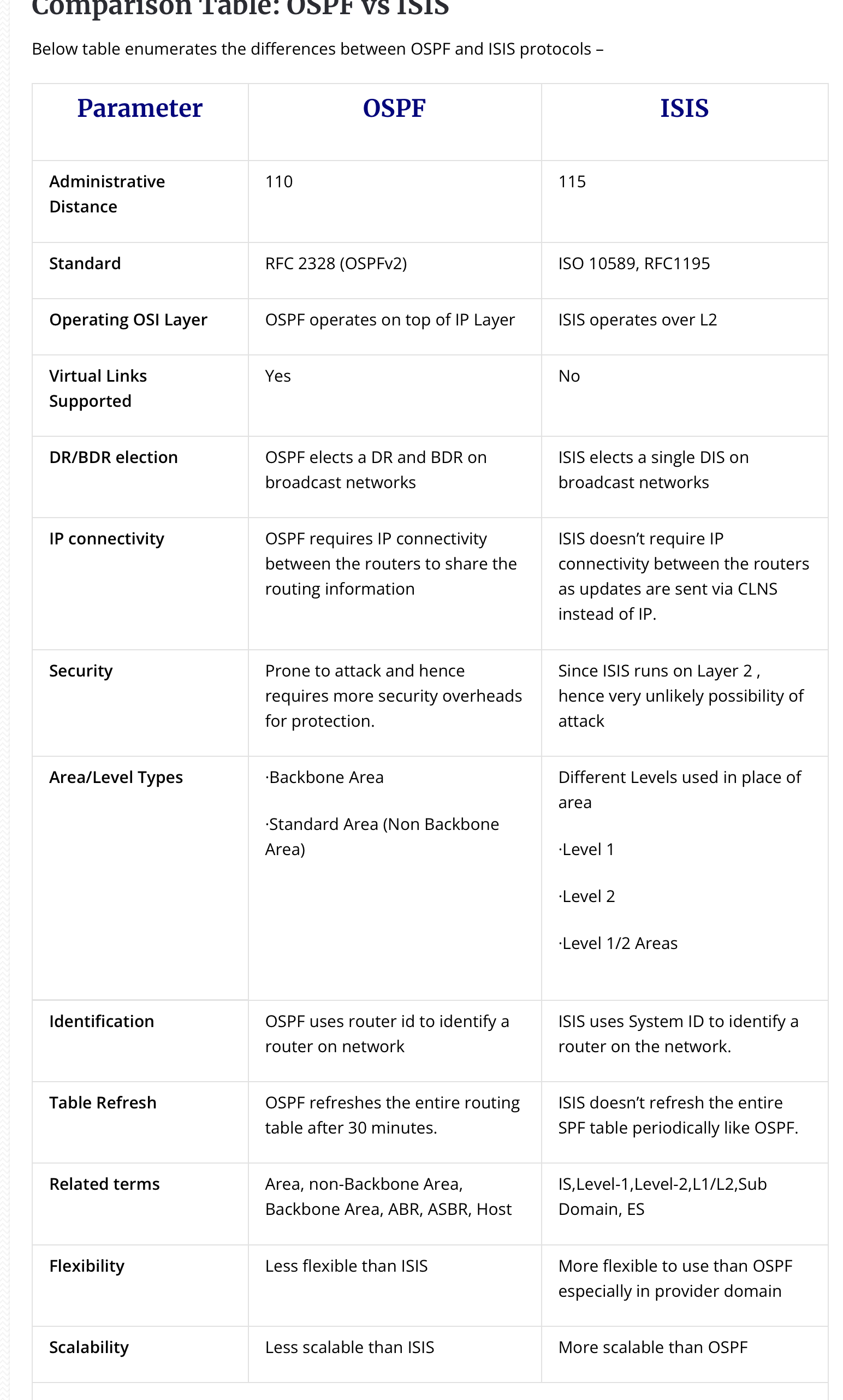
Differences between OSPF and ISIS
OSPF operates on the top of IP layer whereas ISIS operates over Layer 2.
OSPF can support virtual links but ISIS can not support (as it operates on Layer 2 directly).
OSPF elects a DR and BDR on broadcast networks which can not be pre-empted however, ISIS elects a single DIS which can be pre-empted.
IP connectivity between the routers to share the routing information is required in case of OSPF, while ISIS doesn’t require IP connectivity as the updates are sent via CLNS instead of IP.
OSPF is prone to attacks hence security overheads are required for protection. The possibility of attacks is very less in case of ISIS as it runs over Layer 2.
OSPF designates a backbone area and standard or non-backbone area for inter-area advertisements whereas ISIS organizes the domain into different levels.
To identify a router on the network, OSPF uses Router ID and ISIS uses System ID.
OSPF is less flexible with more strict requirements for forming neighbor adjacencies. The hello and dead intervals, and the subnet mask must match (except on point-to-point links).
please please please implement IS-IS.
Not only is this foundational tech for other things we all want, but it reduces design complexity.
layer2 saves all those OSPF ptp subnets and routing table filled with them. it’s more secure, and it doesn’t have to update the entire table all the time and scales much better.
I’d rather like to see IPSEC VTI in ROS. Shouldn’t be too much of an issue since it is possible with the Kernel currently used in ROS 7…