To be clear - your use of the word “nonsense” - you mean just strapping two HGO on the top of the unit, is dumb - as in HGO are ok, just spread them out and mount correctly - yes?
You won’t find diagrams for the NetMetal, the radiation pattern is a characteristic of the antenna (or antenna system.) The NetMetal’s responsibility ends at the coaxial connector.
Mikrotik only sells the most basic antennas. They are no better or worse than other generic types. I’d look around in the catalogue of an a company who specializes in antennas. You will find all the diagrams you want  Here we usually look at Alfa, but what companies actually have distributors varies widely by region, so look for something that has a good local reseller.
I’d probably go for an omni antenna with a medium gain of around the 9 dBi mark. (Or maybe 7.5?) I wouldn’t worry too much about the directly-under coverage. Those devices are necessarily near the antenna anyway and that should compensate for the limited gain in their direction. @jaclaz’s suggestion about tilting the antennas somewhat is spot-on. As to the distance, yes 50cm (20-30cm on either side of a pole) would be a good position.
Yep.
If you get similar antennas but with a joint, you could mount them directly and orient them at 45 degrees diverging, set aside the weatherproofing issues they may work.
The hgo-out are “normal” antennas, I don’t think they are better or worse than other similar ones, if set apart enough will work just fine.
The typical radiation pattern of these kind of antennas Is a toroid (a doughnut) that Is fatter for lower gain antennas and thinner for higher gain ones.
See:
http://forum.mikrotik.com/t/does-size-of-antenna-matter/177500/1
Ok, awesome.
Appreciate all the thoughts/experience.
I will likly be building a mount from UV rated PVC, so I can drill the holes for the antennae bottoms, at whatever angle we all decide is best, and then just run cable up, attach, seal, pull back into PVC hole, and it will be there forever. (50cm apart)
Love that metric use, by the way… tired of converting for online NA posts… 
For the medium gain antennas I mentioned, the usual tilt is around 22.5 deg (from vertical) and away from each other - assuming level ground in the area to be covered.
EDIT: Again, these antennas I’m on about go for around EUR 15-20 each, so I’d definitely go for something a bit more antenna-like if you1re going to this much trouble already.
Yes, Mikrotik HGO Ant are $12 here. *($9 EU?)
But if I go, I will explore ant opttions first, before just grabbing a pair of HGO.
And up until 5G (even in LTE) these systems used FDD - Frequency Division Duplex … with duplex gab large enough for any kind of hardware band-pass filters to be effective enough.
Yes, operating TDD networks (typically higher frequency bands for LTE and 5G) does involve time sync (can be PtP as well, no need for GPS) and fixed ratio between Tx and Rx air time … the later can be a bummer since some base stations can have pretty different traffic ratio than the rest and this fixed ratio in such case does limit base station capacity.
Ok, so I think I’m going to give it a go with the NetMetal AX, and a pair of those HGO antennas, and will make my own mount.
Appreciate the 22.5 degree angle advice, and the 50cm separation.
Since I am making the mount myself, 22.5 degres is easy to drill/create.
On the 50cm distance - is that best measured at the bottom of the antenna where it passes through the mount tube? (I might as well be precise, since I can cut that to any length)
Promise to report back on success/failure!
It looks like Mikrotik also makes a fancier antenna:
Omni-2.4-5-680419113 ?
(desc: 2.4GHz/5GHz AP/Backbone/CPE, N-male connector, includes 2.4GHz/5GHz 6dBi Omni Antenna)
No  , the 50 cm need to be measured exactly (+/- 0.1 mm) on the center of radio gravity of each HGO antenna.
Just joking , anything between 38 and 50 cm at the base (in roughly 3 cm steps) will do nicely, so 38/41/44/47/50 will all do, it is not exact science.
The real problem is the 45° angle (2x22.5°), it is not that easy to obtain on a pipe, you will need a couple of specially crafted washers for each antenna.
Typically you can make them by drilling a very thick pipe at the right angle (22.5°) with a cup drill bit/hole saw the same size of the main tube or use a half round file and a lot of patience.
It would probably be simpler to use two 67.5° curves and two plugs at the end of the main pipe.
Those antennas are, if I am not mistaken, the ones that go with the Groove.
Be careful with the pigtail/cable you choose, those are N connector, the Netmetal has SMA ones.
I’m always a supporter of “projects” - nice to hear you’re going forward with it.
Regarding the 50cm separation: it doesn’t actually matter. In fact with inclined antennas it would be expected to ask where exactly it should be measured. In this instance the exact and thorough answer is: who cares, doesn’t make a difference.
At the risk of being tiresome (which I absolutely am in real life), consider using a proper antenna. I would suggest ones rated at 9/12 (2.4/%GHz) dBi; most have an “N” type connector.
Re-Angle…
Not to worry, have drill press with angular adjustable table and vice on it… 22.5, here we come.
Plan to make pass-through holes at the angle, and then simply adhere them in place with UV stable silicone/eurethane.
Locating parts now… the NetMetal AX, for some reason… suppliers in Toronto are telling me is “not desireable” in canada, and so they don’t stock it.
Yet, I sense that he’s game to see how I make it work.
Well, you still IMHO need something co-planar to tighten correctly the nuts of the pigtails, so maybe you can get away with pouring something that hardens enough (fiberglass, fiber reinforced epoxy or similar).
Agreed.
Will wait until the parts are in my hands, and then work that out.
thanks to all!
So… NetMetal AX is here.
BIG yellow sticker over the ethernet port, saying “do not power on without antenna connected”… is that true?
I have seen this before, in the past, on unrelated devices, but I thought that without antennae, this unit still has a functional pattern, ie: safe to power on…?
Or, doth the sticker speak the truth?
What the sticker sayeth is the truth. The device is designed to be terminated into a load of 50 ohms (50R) at the antenna connectors. If the emitted RF power of the transmitter is not absorbed external to the device, the power is reflected back, which causes excess dissipation (EE speak for fries) the TX amplifier. The resulting standing wave patterns may also load the LNA (low noise amplifier, on the RX side) beyond its design limits (again, fry)
Antennas of course are coupled to the free space at . I know, shocking… - an impedance of 50 ohms.
Without antennas the proper way to test these things is with a 50 ohm (yea, that word again) dummy load. Sold separately
In may experience WiFi kit is fairly rugged, however whatever damage occurs may not be easy to detect - rarely do these components fail totally, but what you will experience would be loss of TX power, loss of RX sensitivity, increased RX nonlinearity and noise (SNR+D).
I would not turn the device on without a termination or an antenna attached to all RF outputs. Sorry, could have mentioned this earlier in the thread, but in my mind this is something “everyone already knows.” Assumptions always come to bite you
just a little EDIT: If you decide to purchase termination, they are usually rated for power (Watts) - any of them will do. The ones you usually see sold in Western countries are mainly for measurement use, so they are exact to at least 0.1%, and priced accordingly. For this application of course this is unnecessary, so turn to whatever the local equivalent of aliexpress/banggood is. I haven’t purchased from them directly, but have seen them many with all of the usual wifi connectors.
Anything outdoor over any distance why not https://mikrotik.com/product/wireless_wire
or the superior https://mikrotik.com/product/wireless_wire_cube_pro
I’d only use the wapax for local coverage (not ptp stuff)
kk, thanks.
Package arrived with NetMetal AX, but they send the wrong cables for the HGO-OUT antennas… 
it was a case of a last minute swap, as they advised me that the flex-guide cable wouldn’t go between the antenna and the unit.
So threy sent someting else… male to male… which of course doesn’t connect at either end.
The top of the NetMetal - has std brass outer threads, plus male pin in the middle - as in, HGO-OUT will screw on.
HGO-OUT has female centre, wit outer threads collar.
Flex-Guide, in photos I could find, and still find, LOOKS like female-female - so they were right that it would not have worked either…?
https://www.batna24.com/en/p/mikrotik-flexguide-rf-pigtail-ohtnj
attached is a picture of what I am facing…
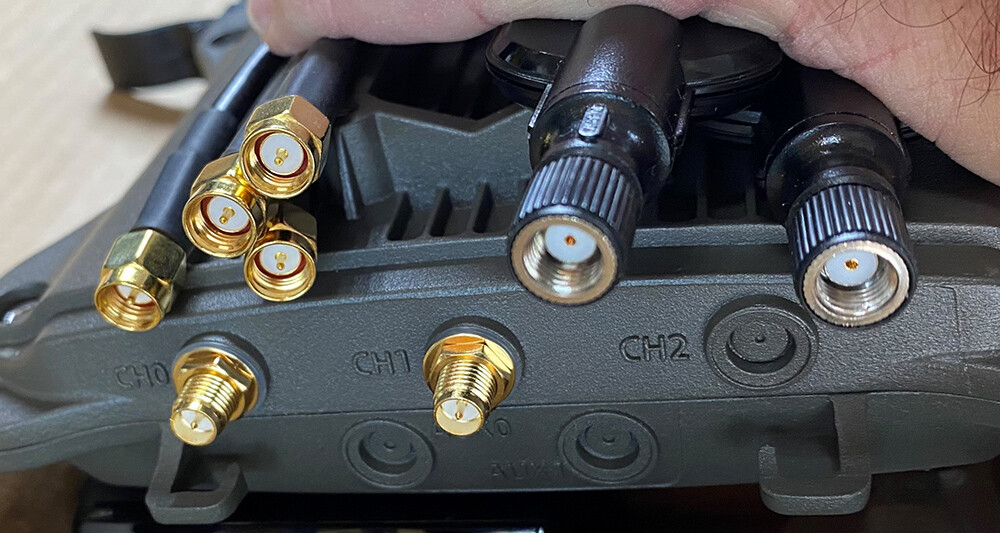
A basic accessory whenever doing connections Is to have a set of suitable adapters/converters:
https://store.rokland.com/en-de/blogs/news/connectors-101-rp-sma-vs-sma
and rest assured that this kind of mess Is created by electrical engineers (and their committees) exactly to make consumers go crazy.
There is no other possible explanation, if not this xkcd:
https://xkcd.com/927/
Basically, yes. Mostly. The most I can help you out with, is that the connector you describe is called RP-SMA (reverse-pin SMA) This, understandably leads to all sort of confusion.
Just to disappoint @jaclaz: this particular hell was not unleased by EEs, actually it was the FCC. They came out with a fairly misguided mandate that “if the antenna is detachable, the manufacturer should ensure that no antenna that would violate the EIRP limits can be attached by the end user”. And that’s the story of how RP-SMA became widespread.
EDIT: Just looked at your photos. The connector on the NetMetal is RP-SMA, the connector on your pigtail is SMA.
To be honest, I would have expected the NetMetal to have straight SMA, for professional equipment it’s much more common.
…and I think there is a Family Guy song about the FCC…
https://youtu.be/MfHnX94JDrA?si=xSWCmfQ151RzgnET