Very nice indeed. But suppliers in Europe still can’t deliver them. “Mid June” is best answer I get…
And I hope they don’t make the same mistake then as Ignitenet. Most of us will use 60Ghz to escape from the 5Ghz overloaded spectrum. But if the backup solution now is that it still needs to run this advantage is actually lost.
Maybe the advantage is there for the link itself, but in many cases in freeing 5Ghz on a link gives more ‘spectral’ space for our AP’s and maybe other long distant links. If this new 60Ghz link now still has to run to maintain its capacity we haven’t gained a lot in that respect.
So a 5Ghz backup should be a ‘cold’ backup. When 60Ghz goes down the 5Ghz radio’s fire up and take over… Maybe at such specific moment we create poor conditions for other 5Ghz networks or links but this is only an emergency solution. Usually during a heavy rainstorm people are really more interested in what happens outside then what happens on the internet…
As soon as the downpour stops the 60Ghz can take back duties and 5Ghz is shut down waiting for next event again…
OK, and how is this with LHG 60? On bigger distances ‘non’ beamforming 60Ghz devices are very hard to align. How is this on the 60Ghz LHG? Just eyesight aligning and ‘bang’ it goes?
thank you for your answer… it was some kind of error… Now even at 500m with wap and custom antenna it works 1,6Gb/s so I am very happy with it. I am using old and unused jirous antennas which can be bought almost for free now. LHG60 is not on stock and never was. I am not sure if it will be legal in Czechia. I am worried about LHG in snowy weather and with jirous with radom it should be better…
You could be right here. Somewhere on the forum a guy says the 5Ghz LHG’s don’t work in snow. The snow sticks to the disk and completely destroys the elips needed to reflect the radio waves. And due the design snow sticks easy and packs in the honey-grate structure and takes a long time to melt. So you might be right in that respect…
But then again, in Hawaii it never snows! But what about the heat resistance? With lava flowing in the streets this might become an issue with these plastic devices! 
Should I move to Hawai? 
No! Didn’t you hear about vulcanos?
Sent from my iPhone using Tapatalk
LEDs show you where to move the device
WHAT? “LEDS show you”?? Meaning they tell me to; “go left”, or “go right”? “Go up”, or “go down”?? THAT would be nice… but I doubt it. The leds probably only tell you the signal level. But that is nothing more then a rough adjustment. Fine adjustments would still be needed?
But then again, surprise me… In some future when these LHG-60’s become available I can give it a try…
This is a great installation to test the limit of the technology if we can have some prinstcreen and/or report about signals in rainy days to help to plan future link without selfyesting it
Exactly, depending on used beam-forming pattern LHG can tell you where to turn it. LED sticker comes with small arrows and device “blinks you to the right direction”
Ok, that would be nice.
But then I have one question; Is there a difference in which ‘beam-forming’ pattern is used? I was given the impression that with the beam forming patterns it didn’t make a lot of difference anymore if the two back haul devices were precisely aligned or not…
In fact, we just fit two w60g units in a backhaul constellation where we just aligned by eye sight.
In the C.L. I see now:
/interface w60g> monitor 0
       connected: yes
       frequency: 62640
  remote-address: 30:07:4D:89:F1:BE
             mcs: 8
        phy-rate: 2.3Gbps
          signal: 65
            rssi: -66
       tx-sector: 34
  tx-sector-info: right 11.4 degrees, up 3.8 degrees
       rx-sector: 96
Does this mean we should align this unit a bit better and move it right some 11 degrees and move it up some 4 degrees?
And what are these tx and rx sector’s telling us? “rx-sector: 96”. What is that?
Could this ‘mis’ alignment also be the reason we can only get some 600Mbps tcp aggregated over this link that only has to cross some 116 meters..
When I’d try udp traffic we’d reach the full 1Gb cable limit easy.
I was surprised by this since we’ve setup some P2MP networks with these devices and here we get similar or even better speeds at bigger distances.
I also made a test with a ‘wirespeed out of the box’ set two months ago and had no problems getting more then 1Gb of aggregated tcp traffic over 150 meters distance…
So is this unit not aligned well?
can someone explain what “signal” means? RSSI is -69 to -70 and signal is load dependent.. up to 100Mb/s = 80, 700Mb (maximum and full duplex) 35 to 50.
It is longest WAP with custom antenna i have… 520m
can anyone ship these? Ill buy 5-10 right now.
[quote=andreysZek post_id=665169 time=1527629160 user_id=120895]
All those photos of you in Hawaii and not one of them showing you in a swimsuit at the beach. For shame
[/quote]
+1

Results on a rainy day: P Light rainfall …
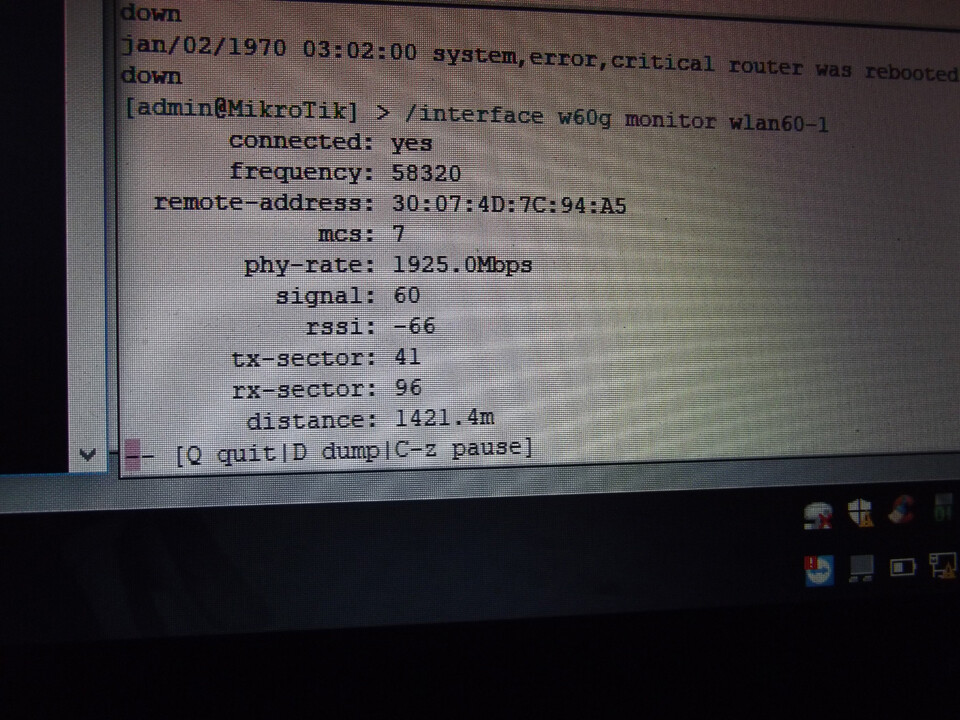
Rock stable at 1200m on the rain. The new antenna model has a box with a connector Keysotne or Krone at the back of the antenna, the front is completely enclosed with a draft radom shield 
?? Photo’s of the antenna and the type of shield? Would the shield make any difference in respect of the rain?
[quote=ccpaulin post_id=666259 time=1528179013 user_id=91464]
The rain affects the attenuation and polarization of millimeter waves, shielding will not lessen the impact of rain.
"At the millimeter wave frequency of 60GHz, the atmospheric absorption …
[/quote]
We write about the test links that actually are running. I know the limitations of the physics, but we are speaking from experience of actual effects on traffic running on a LHG60 link.
[quote=normis post_id=666274 time=1528183315 user_id=5]
[quote=ccpaulin post_id=666259 time=1528179013 user_id=91464]
The rain affects the attenuation and polarization of millimeter waves, shielding will not lessen the impact of rain.
"At the millimeter wave frequency of 60GHz, the atmospheric absorption …
[/quote]
We write about the test links that actually are running. I know the limitations of the physics, but we are speaking from experience of actual effects on traffic running on a LHG60 link.
[/quote]
Yes. This is great.
As 60GHz is very special it would be a great if someone does a showcase with a fast 5GHz Failover solution. Esp where 60GHz is used near to it's physical limits and voip is used ...