Good day, dear users.
At the moment I use a combination of:
MikroTik hEX S - RB760iGS
MikroTik cAP ac (RBcAPGi-5acD2nD)
SFP port is equipped with a module - Alcatel 3HE00062CB 01
I get internet from my provider from it.
And ports 'ether1-5' are used for consumers (three TVs, a computer, a Wi-Fi access point).
Not long ago, the updated 'Hex S 2025' was released.
I'm wondering whether I should switch to it or not.
I saw several posts on the forum about the new device having some problems with the 'ether1' port. I also understood that the new device has 2 cores CPU, the previous revision also had 2 cores, but 4 threads.
Is it worth switching to the updated model or not, what do you think?
I would like to know your opinion and/or experience of use.
The issue with ether1/SFP has been fixed in one of the latest 7.20 betas, so I would - in case - wait until a 7.20 "stable" is released.
BUT, it is pretty much binary:
Does everything work as you expect now?
0 - No there are some issues. <- Which ones? Would they be solved by a faster device? If yes, then replace the old Hex S with the new one.
1 - Yes. <- Then leave it alone.
In routing test results (512 bytes packet, 25 firewall filter rules) are 265.2 vs. 498.1 Mbits (old vs. new), the bridging results are roughly the same with the two devices, so it only depends on the speed of your ISP, if the old model is fast enough, it is fast enough.
Hex S to Hex S 2025 is a cpu power increase but not that much more. Ok, it's arm so zerotier can be used...
Now if you would move to RB5009, that's something else...
And I fully agree with jacklaz on the decision flow.
If it works and there are no short term problems, why change ?
Just for the sake of changing ?
At least, I think that here, by analogy with a PC processor, the performance per core (for example, per consumer) has increased.
And the overall, with several devices working simultaneously, may have decreased (there were 4 threads, the new one seems to have only 2). Logically, it should be loaded more. The change in architecture will not affect this so much, will it?
But, perhaps, I am wrong, of course.
I think so, at least for 3 years everything works stably. I don't even go near it, only to wipe off dust when cleaning))
Unless something changes - like your ISP doubling your internet speed connection - there is then no reasons to change the device at the moment.
And maybe - just maybe - before that happens Mikrotik will come out with some new, "better", devices.
What Is actually missing (IMHO) in their offer is a device faster than the hex's (old and new models) but slower (and cheaper) than the RB5009 while still with one SFP and 8 ethernet ports, a sort of L009 (2025).
The problem is not the cost of the device.
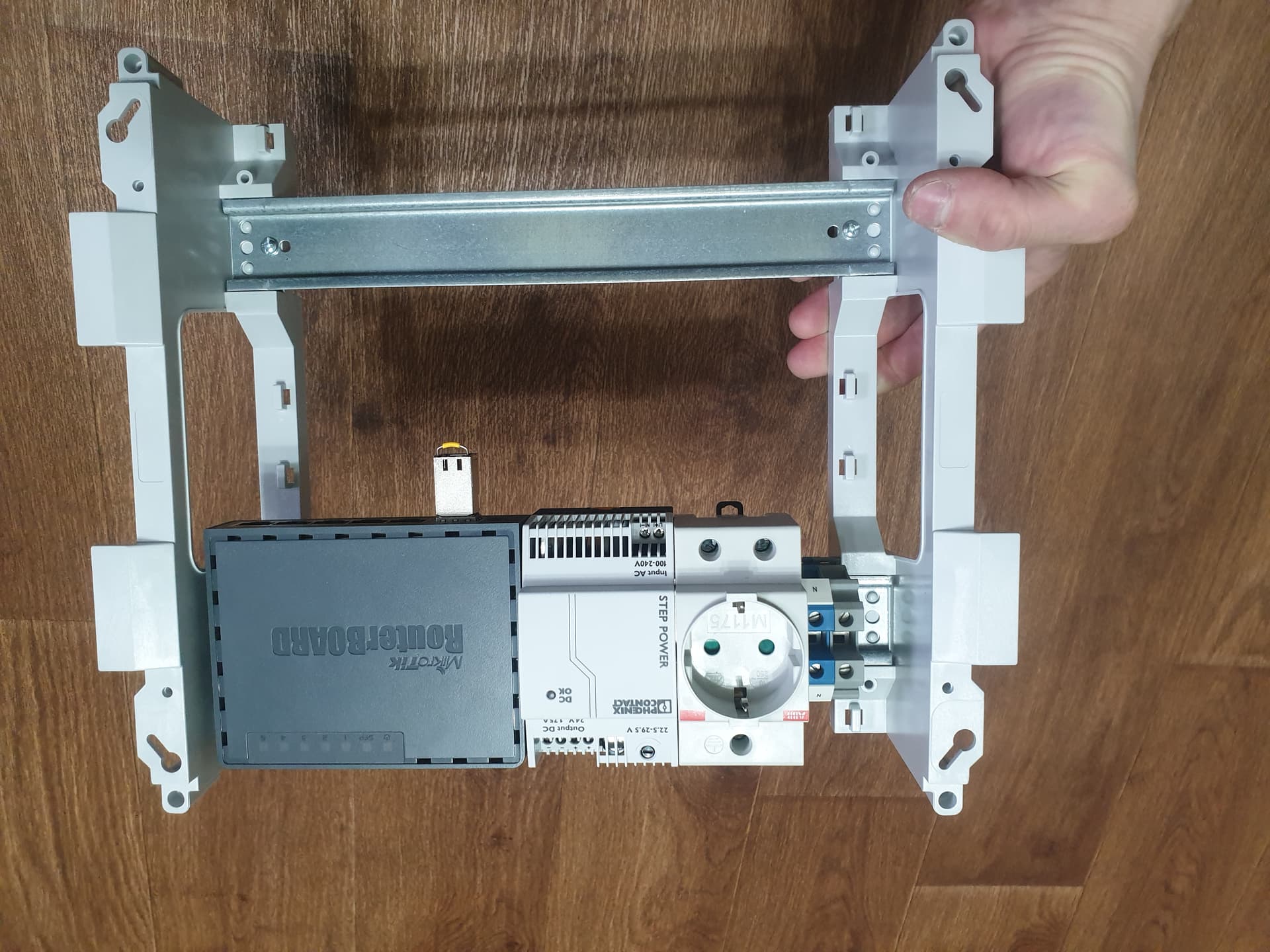
Size plays a big role here. My current Hex is installed in the multimedia panel (next to the main electrical panel). Unfortunately, there is not much space there.
RB5009 is clearly too much for my needs. Too many ports will remain unused. It will probably be useful in a small office, but definitely not in a regular home where one TV, a computer and a couple of phones from a router can work at the same time))
The lower part of the DIN rail is occupied by the power supply and the alarm control module (in the photo above it is empty).
Am I correct in understanding that when multiple devices are running at the same time, it will perform worse than my current Hex S. If that's the case then I really need to keep the current Hex revision.
P.S.: Total number of devices 5. Three TVs are connected via wire, one desktop PC is connected via wire and the access point (MikroTik cAP ac) is connected to the last port. Speed (declared) from the provider - 300 Mbit/s
For myself, I probably decided that for now I can stay on the old, time-tested version.
But there is also another question. A friend wants to build his home network in a similar way.
But with slight differences. He will have an optical cable connected to the SFP port through a corresponding additional module.
The local network will consist of PS5 (connected by cable), two access points (to cover a large area of the house) and most likely a computer. Also a small number of consumers. Now the question is which device to buy 'Hex S' or 'Hex S 2025'. Unlike me, the router will be bought for the first time and the price difference is about $7 (the new model is a little more expensive).
As far as I know, the Hex S does not have a DLNA server, but maybe the updated version (Hex 2025) does?
If I'm not mistaken, you have the updated Hex (E50UG). Is there a way to add a DLNA server to it?
If I were your friend, I would get the new Hex S (2025), for more or less the same money he gets a more modern device, and 802.3af/at compatibility (maybe it will never be needed, still ..), see:
Fair enough. If space is a concern... the RB5009 isn't going to be a seller.
If DLNA is need, I'd try that on current hEX first. But that does use CPU, and have to imagine DLNA on ARM is better tested and performant than older hEX - so if that didn't work well... now you have an easier upgrade decision.
Like I said only downside on new hEX is for all practical purposes, you cannot readily use the container feature. Now you already can't, so no loss. But if that was in the cards in future, the new hEX may not be device for running containers. While most other ARM-based routers can run most common containers.
I got home, connected to my Hex. RouterOS version 7.11.1 was installed on it. If you look at the list of changes, the DLNA media server was added in version 7.15.
Updated to the latest stable version, connected an external HDD, configured the media server, and it worked (I checked by connecting to it from my phone).
I only found out about them after this message of yours))
I read a bit in the wiki. As far as I understand, containers for arm64 are common. And the 'E50UG' and 'E60iUGS' devices support only 'arm32v5'.
And judging by the topic from the previous message, the comrades from Mikrotik lied to users by indicating that the new devices are built on the 'ARM 64bit' architecture and quickly erased all mentions of this.