Yep, now what is happening is clear, how to change this behaviour is another thing.
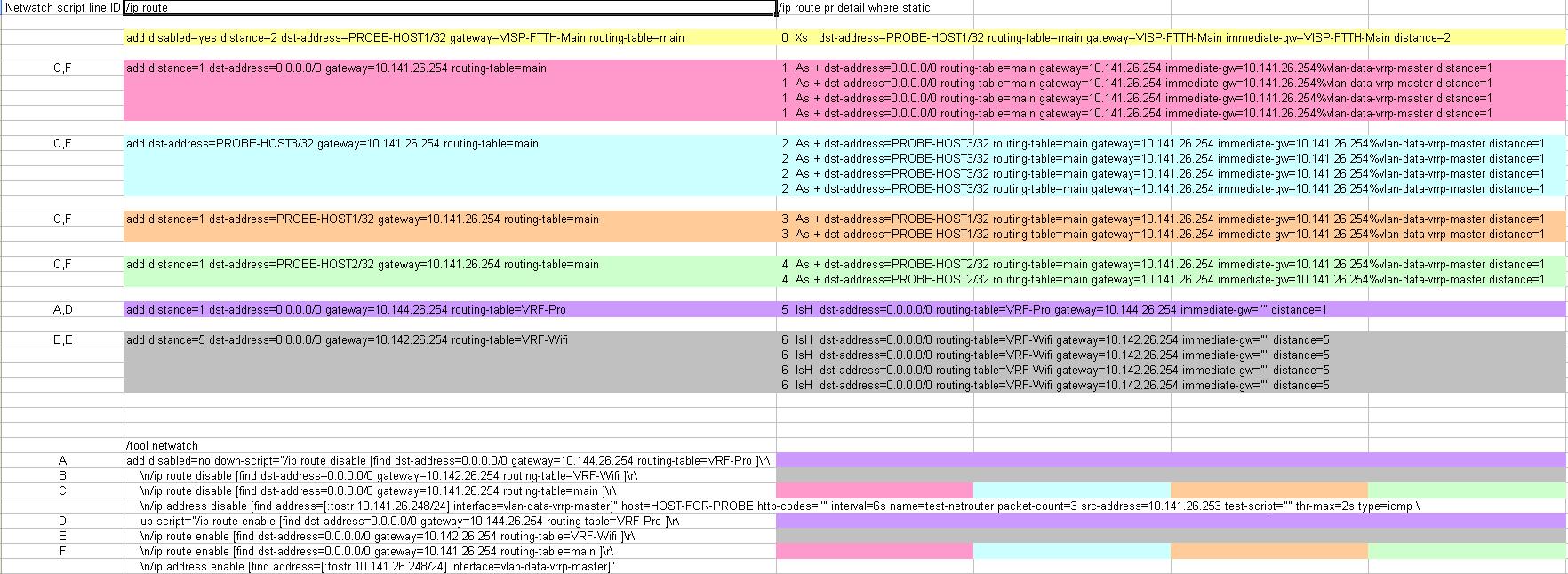
Pairing the routes in /ip route export with those in /ip route print (simplified) and matching them with the netwatch script lines (see the attached image) it seems to me clear that each time the down-script is run the interfaces are not always disabled, and when the up-script is run somehow the routes are re-added (creating the duplicates).
BUT the results of the SAME netwatch line that changes (should change) the enabled status of 4 different routes is not always the same for all the 4, possibly because when the script is run some interfaces are duplicated more than the others.
The two lines that “catch” only one route also seemingly behave differently, the VRF-Pro one seemingly works as intended, while the VRF-WiFI one creates the duplicates.
At first sight I though that the issue was with the command catching multiple routes, but since also one the “single” ones behaves the same, it is something else.
I would suspect that the disable action doesn’t take effect immediately because of whatever (established connections?) and when the down-script/up-script are run in a too short time interval the duplications are created, but this is only a guess, not that I know or understand what is actually happening.
Are you using src-nat or masquerade in /ip firewall nat?
The first usually needs to have the connection tables cleared, whilst the latter should do everything automatically, see the (seemingly unrelated) discussion starting here:
http://forum.mikrotik.com/t/simpler-failover-for-two-gateways-i-found-working/169108/1