peraso has at least 15 clients, but with their newer firmwares 32 is easy and I believe the newest software can do 45 or so but I haven’t seen that implemented
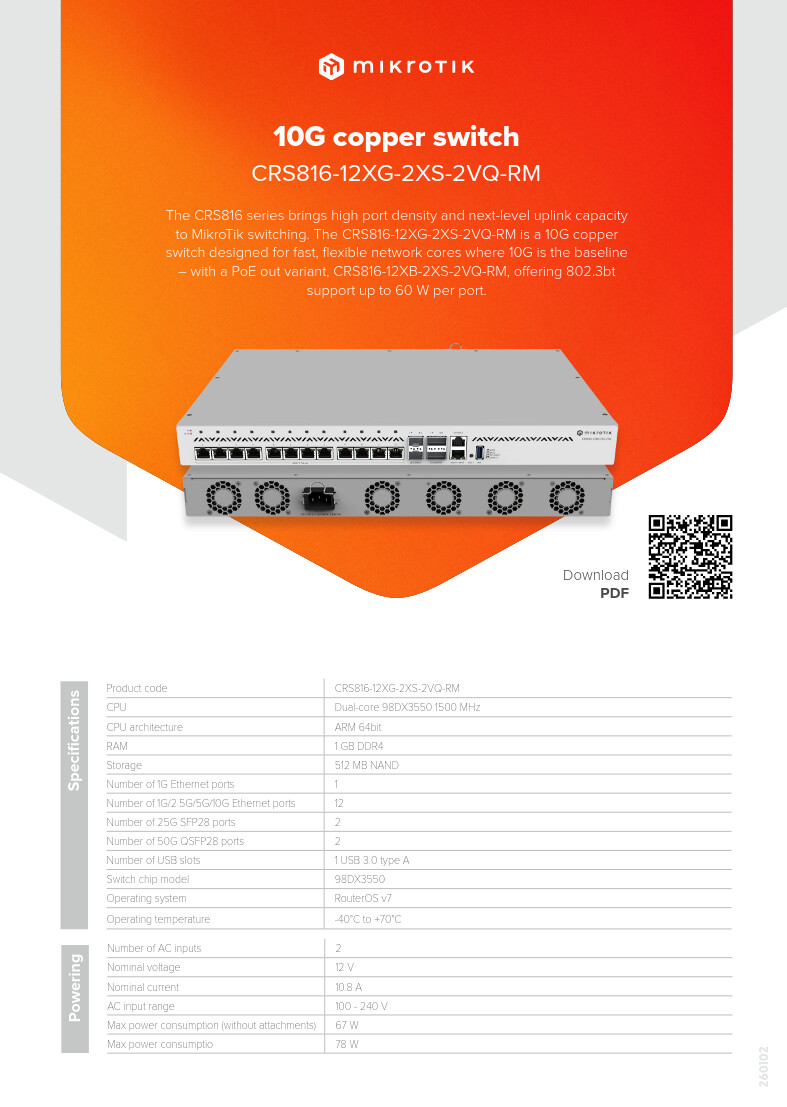
Yes they’re a bit odd, they use the QSFP form factor but they behave more like a single/combined port to connect switches together at 50G. Functionally speaking, they’re more or less the same thing as SFP56. I doubt 40G/100G modules will work.
Regarding GPON: The hAP ax GPON was presented a year ago and never released, so I’m sceptical about the A42GO-HbeP. I believe it when it actually becomes available.
And only 3 Ethernet ports and apparently no USB? Might be a dealbreaker.
Why isn’t MikroTik more invested in GPON? There is so little competition for decent all-in-one devices. Other than Fritz (AVM) and some locked-down Chinese OEM devices, there’s almost nothing available.
Bulk price is not that relevant for retail. GPON devices with RouterOS would easily be the most capable ones on the market while still being very affordable. They could become the go-to choice for many users who don’t want to use a CPE provided by their ISP.
While you can combine any router with a third-party ONT, this increases complexity, cost and power consumption way more than integrated GPON does.
That depends on perspective there were only a few people will buy ONT in 100USD price range only a few hobbyist is willing to go for it, and MT will not going to mass produce some device that will going to be sitting in the shelves for period of time, just my 0.002$ cheers
Probably depends on the market. A GPON-capable Fritzbox sells for €170 to €300+ retail here (depending on features), and it’s a very popular consumer product.
If you want to “borrow” a GPON-capable router from your ISP, they charge you an extra €6 to €10 a month for it.
A €100 to €150 all-in-one device from MikroTik would be without competition.
Glad to see more work being done in the mAP series! Is it possible to have some work done so virtual-AP are allowed to keep running while the master station is off/disconnected? Would really help those use cases where you need to edit configs wirelessly while the mAP isn’t connected to anything.
Regardless, can’t wait to add this to my collection of Mikrotik products!
I am also curious if the USB-C on the mAP AX will work with standard USB-C chargers of if its like the hap AX lite and will require a specific USB-A to USB-C for it to power on.
OTOH configuration of ONT part of GPON router is often complicated (depending on how infrastructure owner wants to run their infrastructure) and most of times out of average user's competence. And where I live, all infrastructure providers provide ONT device free of charge as part of subscription. So apart from having separate power adapter and a short UTP cable between ONT and CPE, setup is not very complicated and doesn't cause additional cost.
Again, where I live, ISPs provide CPE device free of charge as part of subscription. One can argue about configurability of ISP-provided CPEs, but the fact is that ISP-provided CPE has to perform up to subscribed service levels ... and it's up to ISP to make it work. With 3rd party CPEs that's up to each user, ISPs most often won't hear the performance complaints in such case. As to power consumption: it somehow relates with performance, MT devices capable of realistically dealing with 2.5Gbps (or more) also consume "a bit more" power (compared to older devices capable of handling 100Mbps traffic).
So unless MT gets into commercial cooperation with few (large) ISPs and GPON operators (but there bulk retail prices matter ... a lot), their market for integrated GPON/ONT device is small, limited to (a few) enthusiasts.
The ONT part is configured remotely by the ISP using OMCI / OAM / PLOAM. The user is not involved in low-level GPON stuff.
Really depends on the market. For most ISPs here, the hardware business is a profitable source of extra revenue. Some might give you a free ONT (not a router!), but typically a basic subscription only includes a passive optical outlet. Everything else (ONT + router or more commonly router with integrated ONT) you have to rent or buy. ISPs are very happy to charge you €10 extra a month for a “premium fiber router”.
Here it’s not only enthusiasts, it's also average users who don't want to pay the premium prices for ISP-provided fiber routers and choose to buy one on the free market instead. And they often want a “clean” setup - a single box with a single power supply, without cable mess, adapters and stuff. Not sure how big this market is exactly, but it seems significant.
Not if user tries to use device which is not supported by GPON provider. And in case where GPON provider provides their own ONT (which is the case where I live) they won't support anything but the limited set of devices they provide. So if user wants to replace ONT, then user is on hus own regarding configuration of ONT part of his device. And GPON provider won't even provide information about proper configuration (why would they, ONT is integral part of their network and they don't want to let users integrate some random devices into their network).
Again, depends on the market / jurisdiction. Here, the demarcation point is the passive optical outlet (by law). The ONT belongs to the customer’s network, not the ISP’s infrastructure. As a consequence, ISPs must accept and configure any standards-compliant ONT. Just like it was with DSL or even dial-up in the old days.
I’m not saying MikroTik would be able to successfully sell GPON products in all markets, but I’m convinced demand in the markets where they could is significant.