What worked for me: set “protocol=none” on the “station pseudobridge” device.
Not sure if any command currently exits script without producing error.
You can rework scripts and break certain logic into functions and call it under some conditions to avoid deep nesting. Loops can be braked using while command by checking condition of some variable which is set inside loop block.
I didn’t bother to modify some of my scripts like that, just muted script error log hoping that some day it will be possible to exit script without error like before.
Well, you can just wrap your code into a block, den catch the error and do nothing…
:do {
  # your code
  # exit early with :error
  :error false;
  # other code
} on-error={ }
BUT! Be aware that this mutes ALL errors, even the legitimate ones that should be regarded!
.
Worked also for me:
It’s stable and has been working perfectly for months.
You should try to make script so that it does not give error. And if there are no way around to avoid error du to different hw or software config, use on-error on a small block as possible.
It worked for me with “protocol=rstp” (default value) until 7.13.5. Problems started with 7.14.
Changelog of 7.14
*) bridge - improved protocol-mode STP and RSTP functionality;
“improved” is a Mikrotik codeword for introducing a fundamental change thus breaking some existing behaviour.
I did not find a way to debug RSTP until today. Neither log topics “bridge” nor “stp” log anything related to RSTP. Already asked support but all they told me was: try bridge or stp topic. I would like to log the RSTP election process of root brige, when ports stop forwarding and so on. But it seems to be impossible.
If root bridge election “wants” to go wrong then changing the RSTP priority can help. Set it to lower than default (8000) on bridge that should be a root bridge.
I’m debugging a mysterious problem… I have a RB4011 with a VLAN-filtering bridge on all ports (except ether1) and the wireless interfaces. It has 3 VLANs plus the default untagged. Some ports are untagged on one VLAN, others are “hybrid” (untagged one VLAN and tagged some others).
On one of the hybrid ports a hAP ac2 is connected which operates as a switch and WiFi access. IPv6 is not configured on the hAP ac2.
Until 7.15 was installed, the devices connected to the switchports or the WiFi on the hAP ac2 received IPv6 addresses being sent (RA) from the RB4011, but this now no longer works.
I have already disabled STP but there is no change. When I Torch on the switchport to the hAP ac2 I don’t see IPv6 traffic.
But when I monitor using wireshark on a PC connected to another port on the same router, I do see the IPv6 RA’s on the different VLANs. The PC and also devices connected to the RB4011 WiFi get IPv6 just fine.
This has me completely baffled… how can this happen? The bridge should just relay the RA multicasts to all ports, right?
And in the past (previous installed version was 7.12.1) it worked just fine!
Yes, I already noticed that. bridge of “station pseudobridge” device was elected as root-bridge. I already believed that this was my problem and lowered the bridge-priority on my main-AP to 0x7000. Then root-bridge was elected as I wanted - but it did not change anything on the issue. wifi port where the “station pseudobridge” connected was still “forwarding: no”. Set protocol=none on this “station pseudobridge” device and all working. For me it seems like “improved” RSTP of 7.14+ does not play well with that pseudobridge thingy. Or it is some kind of incompatibility as this “station pseudobridge” device is the only ROS v6 device on my network.
This is similar approach as when you mute script error logs in Logging settings since you need to put most of script code into do={} on-error={} to work (part where :error command is executed and everything after that). Nothing should not be added after on-error={} because it will be executed. It’s just hacky approach, personally I did’t want to change scripts like that.
Running 7.15.2 on CRS354-48G-4S+2Q+ devices. Using 2 x Q+DA0001 cables to create a 2 x 40G DAC bond as the MLAG peer bond.
Continue to see the switches reporting peer bond drops but the bond itself and ports that make up the bond are not flapping:
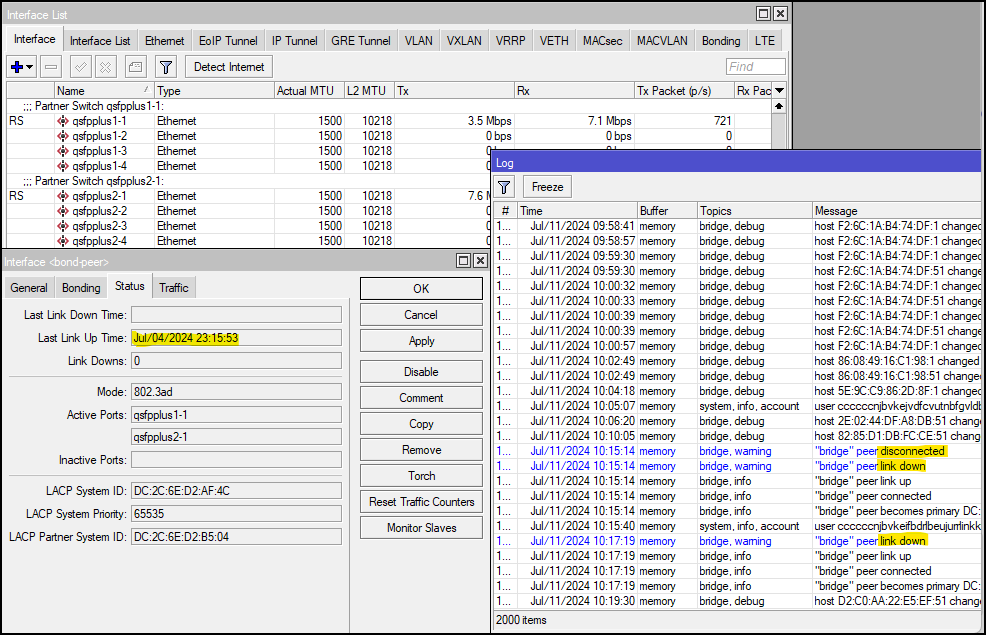
It seems like the 7.15 release broke radsec support for me and a few others. I’m linking it here in hope it gets some attention (http://forum.mikrotik.com/t/radsec-issues-after-7-15-upgrade/176401/9)
Only way to get proper attention is to create a support ticket.
you saved my life 
BUG:
Default smb “guest” user is deletable, on RouterOS v6 not.
But on v7 “guest” appear to be the default both on “export” and on winbox colours…
all Mikrotik devices. all RSTP by default. no other switches on the network.
I know what RSTP is. Ask Mikrotik why they ship all their devices with enabled RSTP by default.
But I have to admit that I only have a vague idea what “station pseudobridge” actually does on L2.
I have tried… only 1 out of 3 tickets got a reply for the past 3 weeks…
upon my observation this update works fine and stable on my hAP ax, thank you for keeping let us upgrade routerOS constantly.
[quote=wfburton post_id=1085188 time=1720719058 user_id=215408]
[quote=infabo post_id=1085187 time=1720718725 user_id=177714]
all Mikrotik devices. all RSTP by default. no other switches on the network.
[/quote]
Logically it should be no STP.
[/quote]
Why do you think that? If there are no bugs, then having xSTP enabled should not be a problem (but can potentially protect your network from errors in topology). So clearly if problem gets solved by disabling RSTP, then there's a bug (in this case in station-pseudobridge implementation).