Arm cores are more power/heat friendly compared to intel CPUs. So something like Snapdragon 8cx would be beefy. But I guess MT does not sell that high numbers. So it is difficult to get a reasonable price …
Throughput >1G is no problem. CCRs does this with ease (Just look at the tables at mikrotik.com). Problem with ROS is Routing Calculation (not routing itself) is done with one core. So one core is at 100% all the time. So your BGP learning speed depends on the performance of one core. Take a XEON with a single core speed >100 times of a CCR you get this done without problems. But take care to get HW/Network adapters which work flawless with CHR. So if you can get a tested system from a vendor you might avoid problems.
x86 also have power-efficient cores:
https://en.wikipedia.org/wiki/Gracemont_(microarchitecture)
https://en.wikipedia.org/wiki/Tremont_(microarchitecture)
There have been a couple of US only WISP x86 routers in the past and got favorable reviews back in the day.
I would love if they went down this road but I can understand from a power,cooling and expense probably makes it probably not the route their WISP/SMB customers want.
Given that the whole pc industry is now starting to pivot to ARM, Mikrotik might have chosen the correct path as Tilera was a bit of a dud tbh.
CCR2116 supports L3 Hardware Offloading. In some cases, it can route packets at close to 10Gbps speed while keeping the CPU idle.
ARM also has modern fast cores https://www.arm.com/products/silicon-ip-cpu/neoverse/neoverse-n2
and DPU based on this cores https://www.marvell.com/content/dam/marvell/en/public-collateral/embedded-processors/marvell-octeon-10-dpu-platform-product-brief.pdf
but Mikrotik uses old slow cores…
x86 processors
At my ISP/WISP business , we use a dozen=plus Mikrotik CHR ROS routers ( running on fast XEON processors under VmWare ESXi.
Almost all of my CHRs can UDP btest to 127.0.0.1 ( local internal CHR IP address ) and hit nearly 999-Gig throughput.
I’ve never seen a physical Mikrotik even come within 10-percent of that speed.
IMO , in my NOC , I don’t care about lower-power energy saving routers. I only want fast at any energy cost.
North Idaho Tom Jones
Another reason I prefer CHR on XEON processors is the following:
We do a lot of CGN-NAT. We normally average 70-thousand+ CGN-NAT translations going through the CHR and we easily exceed 3.8 Gig CGN-NATted throughput on our primary CGN-NAT CHR router while the Xeon CPUs all show under 20-percent utilization. I don’t think Mikrotik has a physical router that can handle this type of NAT throughput.
North Idaho Tom Jones.
raimondsp ; Re “… route packets at close to 10Gbps …”
Routing ( without any firewalls ) at close to 10Gbps can be a very low CPU intensive process.
However , running at close to 10Gbps and passing all the traffic through firewall filters and NATting at that speed and customer bandwidth shaping is very CPU intensive and difficult or impossible to hardware offload.
North Idaho Tom Jones
re: “Passing all traffic through firewall filters” - you do realize that it only offloads fasttracked traffic? If you have a fasttrack rule for all traffic, only the initial packet of each connection needs to be handled by the firewall and everything fasttracked is hardware offloaded (until you hit the connection limit). Obviously bandwidth shaping is a different matter.
I would guess price-point.
An multiple-SFP+ x86 board with some quality and required power supplies will cost at least as a Supermicro. Then just buy a Supermicro.
Then there exists a million ways to run a router/firewall on x86. VyOS is a great alternative for example.
But for many ports, power consumption and form factor - ARM and network SoCs beats x86.
I just wish a CCR1072 replacement comes soon.
only if they are modern ARM…
latest smartphones use new Cortex-X2 @3GHz
latest MT routers use old Cortex-A72 @1.4-2GHz
apparently, the MT’s engineers believe that the speed of the tunnel is less important than viewing Instagram
But can it act as a wirespeed MPLS LSR (P) using the Marvell ASIC ? and what about wirespeed LER (PE) ?
Single-core IPsec tunnels performance on Intel Xeon D-2798NX
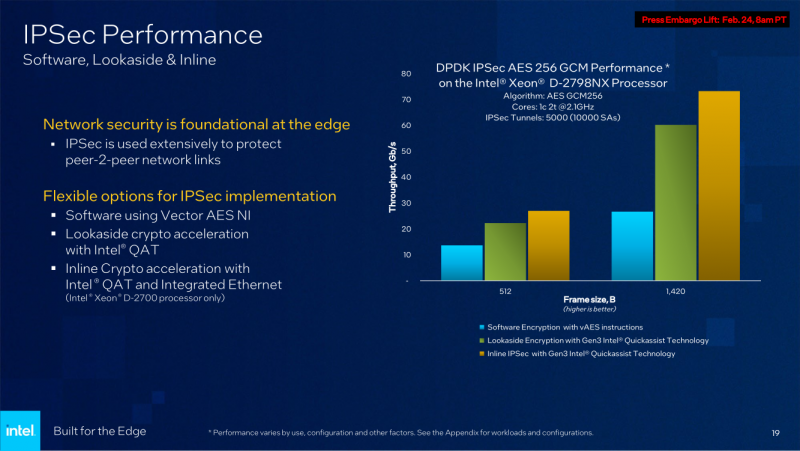
the improvements in IPSEC performance are from ASIC Hardware Acceleration Built in the SOC
there is no General Purpose CORE, not ARM, not x86, not MIPS, no POWER PC, capable of this kind of IPSEC performance by their own
only feasible using ASIC
because this Modern CPUs, ARM x86, MIPS, are integrating ASIC hardware Accelerators for some tasks
even when using CPU (AES-NI), speed reaches almost 30Gbps.
AES-NI is a form of hardware acceleration, is not ASIC in the stric term but is embedded into the core in the form os specific instructions inside the general purpose core to efficiently do AES in this case
and this kind of acceleration is not exclusive of x86, there is ARM solutions like this