I am working on getting some batteries setup on a few sites. I have some question about how to actually make this work.
2 12v batteries to get 24v. I dont think I want to do 12v because of cable distances and the possibility to go down to 10.5v might cause minipci radio problems.
These deep cell batteries typically need 14.8v to charge, sometimes they need 15v to condition them. That means I need 28-30v to charge them with… but the routerboards will croak at that voltage I hear. What are my options, put a DC to DC converter in the middle? Is there a charge controller than can charge the batteries with the proper 28-30v and have another output to run equipment (dc to dc converter)?
if u live in area with no frozen … you can try to place the batery much close to antenas …
for freezing area .. i recomand you to store batery at 2 meters underground …
What is the cable distance? 200 feet of 16ga wire with a RB433 at the other end will produce the voltage drop you require also.
ADD: From personal experience, 10.5v is enough for the radios. Last I checked, they use 3.3v regulated power provided by the RB. I use 12v solar, and have no problems.
I design electronics also. I learned ‘old school’, with linear power supplies. In that environment, the best power conversion was keeping the unregulated supply only a few volts above the regulated supply, just enough to keep the regulator in spec. Otherwise, a lot of your power is used by the regulator. That has just carried over to the newer PWM type regulators.
After over two years of solar experience now, I would have to say 12 volt is the way to go. I would definitely overbuy on the panels/charger tho. Here is the experience in a nutshell:
I have a RB433AH on a single 135w panel with a 10 amp charger and a size 27 battery. It does adequate even in January (short winter days) with a light overcast.
I have a RB333 and a RB433 on another setup. It ended up requiring two 135w panels and a 15 amp charger to keep up in the winter.
The lesson I learned is that almost any setup can power your router on a bright sunny day. But after 3 days of overcast in January, how will it do?
Hi adrianatkins! Let me know how your testing goes this winter. I like the features you are considering. Wish my chargers had a couple of those options also.
BTW: I could have probably gotten by on both systems with 85w panels, but at the time, I could purchase the 135w panels for almost the same price. Good thing I did tho. Last year was a ‘bad weather’ year. Lots of overcast and rain.
And a lot of this is based on the radios, not the router. If you are using one R52 on a remote, low traffic location, that will be a low current draw. If you have two XR5s on a busy network, that is a whole different story.
Don’t let the battery drop below 12v. If it stays there for any length of time, it will damage the battery.
below 12v. If it stays there for any length of time, it will damage the battery
Personally i couldn’t give a toss about damaging the battery, so long as i get enough advance warning that it will be broken.
I would prefer to let the battery die than let the AP go off.
This all assumes that there is enough solar to run the AP, and charge the battery of course.
If there isn’t enough Solar, then i need bigger panels (or more sunshine).
If there is a long period of insufficient Sunshine to run the AP and charge the battery properly, then it’s a straight choice - save the Battery or keep the AP running ?
I would choose to keep the AP running, and go replace the battery.
I guess the ultimate goal will to make a device that allows the User to choose these things.
That was my approach exactly! Since I can’t control the weather, or the season, I was forced to choose bigger panels. After two years, see the panel sizes above. I don’t want to choose between shutting down my access point or damaging my battery.
That no right … i have that battery from 3 years and work hard now …
the minimun required for rb433ah with 2 radio cards is 60w in summer and 120w in winter for static solar panels.
i recommand you 120-150Amp car battery … that battery keep your ap running until density is 1 ( watter ) or 6V … take care to voltage regulator … the classic one will not charge if your battery is almost empty … there r new charging tehnology, MPPT or maximum power point tracking … that controller calculate how much voltage to output in that way the battery will take maximum A/h … a 20A controller cost up to 200 euros … but will allmost double your power production
A 12 volt lead-acid deep cycle battery is 100% discharged at 10 volts. Discharging to less than 20% charge on a regular basis has been shown to cut its service life in half. I consider that damage. http://www.windsun.com/Batteries/Battery_FAQ.htm
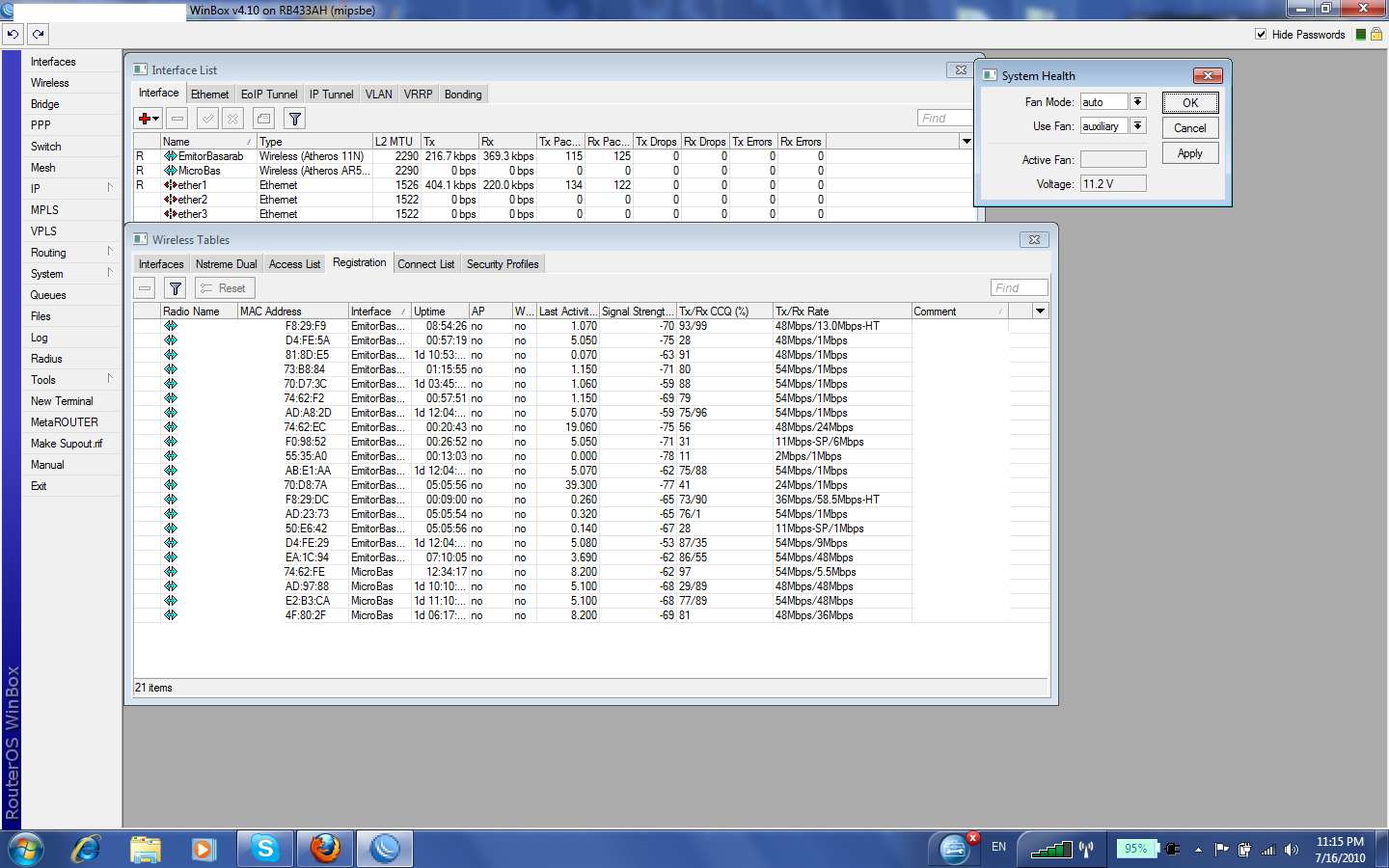
BTW, 11.2v (what your screen capture shows) is less than 10% charge. That is damaging your battery. In the charge state chart on the link above, that is in the red. It won’t fail immediately, but it will shorten its life.
ADD: And the voltage shown on the router is not always the voltage on the battery. I had one router that was 200 feet away from the battery (I moved it closer for this reason eventually), and the voltage drop on the wire was 1.5v. In my case, 11.2v was good. That would be 12.7v at the battery.
you r right … the real voltage is + 0.4V in my case 11.2v in winbox = 11.6V on battery … this battery work for more that 2 years … but this in a production so no mater his live … if i get it for 3 years i’ll say thanks
With 11.6v on the battery, you are above 20% charge state. Should be no damage from that. My systems do go below 12 volts, but not on a regular basis, maybe twice a year.
I was using 12 volts as a rough guide. In the weather conditions I have here, that is the rule that fits my situation. We get a lot of cloudy conditions and rain here in Florida. If you live somewhere that has more average sunshine, like Arizona or New Mexico, then you could use smaller panels and go lower on an average, like 11.8 volts.
A battery life of three years would be good with me also. Four would be better. If you look at the mathematics of battery life on that battery FAQ page, you will see it is determined by cycles x DoD (Depth of Discharge). The more it is cycled, and/or the more it is discharged each cycle, the shorter the battery life.
ADD: My personal experience shows the battery life formula is missing one factor. That is ToD (Time of Discharge). This is the amount of time the battery spends between being recharged fully. Even though I can’t give you an accurate percentage or amount, the effect on battery life is significant.
Batteries don’t ‘just die’, they lose electrolyte by gasing/evaporation, or the active chemicals from the plates, or in the worst case, the plates themselves (buckling).
Has anyone heard of a charger that zap-pulses the battery to reduce sulphate build-up, or somehow detects the level of the electrolyte ?
here come the science of marketing … if someone need a service , he will you buy it in hope of resolving his needs … eg. witches, priests, casino … etc.
i never see a sulfated battery reise from dead … ohhh .. but i see somethink like a little rejuvenation from 10% from original capacity to 15 % … but that the top … i don’t have time to song incantation to my old battery i just buy a new one and the old one i recycle it.
new charging tehnology, MPPT or maximum power point tracking … that controller calculate how much voltage to output in that way the battery will take maximum A/h
Oh. A Buck converter then.
MPPT isn’t really a new idea insofar as Solar Panel power usage is concerned, but it is currently being used as an Exellent Marketing Term by Solar Charger sellers.
but will allmost double your power production
Er …
“energy can neither be created or destroyed” - a basic principle really. (dunt explain entropy, but there you go).
Any of the stuff you buy has to obey physical laws, despite the Adverts.
Take a 200w 18v (loaded) panel at full power output. That’s 11Amps.
You will not get 22Amps out of it unless you drop the voltage to 9v, which=the same Power.
At 13.8v that’s almost 15 Amps. If you stuff that into a small battery, it will boil the electrolye out of it quite quickly, and probably melt the plates
PWM, MPPT and $3k VooDoo chargers can only do their best with what they got, and what batteries can take.
The physics don’t allow for magic to happen, but you can believe what you like and spend as much as you got.
The math is good but the physics is incorrect. Photovoltaic panels are constant current devices. In the example above, the 200w panel only produces 11 amps at 9 volts. That is half power.
This is the property of the panel that allows MPPT to work. It keeps the panel output voltage high to keep the power high. With the panel output at 18 volts, and the battery input at 9 volts, then you would get the 200 watts charge with an MPPT charger. Otherwise on a standard charger, with a panel and battery voltage of 9v, about 100 watts is all you get.
panel output at 18 volts, and the battery input at 9 volts, then you would get the 200 watts charge with an MPPT charge
Red rag to bull …
9v to the battery ? Are you sure that’s a good idea ? (lol)
In the end it comes down to getting the best current from the panel at the voltage you want, not the voltage or current you got.
This can be done in a few ways.
PWM works. The ones i bought to investigate do Crude PWM (IMHO) in that they simply bash the battery with Max volts from the Panel, but in a controlled kind of way (might not be a bad thing actually).
MPPT is generally used as a Sales Term, because no matter how much power you get from the panel, your battery and/or appliance (load) may not need that power, or be able to use/store it.
My own experience says that the Panel Voltage is generally High (i.e. >= 18v), but drops sharply when loaded under low-insolation conditions.
A Buck converter would seem to be the solution: convert the extra volts to Amps at a lower voltage, however that Voltage needs to be about 14v.
Oh, and hence track the Maximum Power Point of the Panel’s output …
I really really wish i knew what i was talking about, and could design a Solar Charger from scratch, publish it for free, and give away the code so others could make one.
 i just buy a new one and the old one i recycle it.