Funny thing that it never made to release notes of v7.24
It was in release notes for v7.23.3
How is it acceptable that I discover this BS while working on a completely different issue? What's next, you disable some of my DHCP options "just because"?
Funny thing that it never made to release notes of v7.24
It was in release notes for v7.23.3
How is it acceptable that I discover this BS while working on a completely different issue? What's next, you disable some of my DHCP options "just because"?
If you find this unacceptable, then you really should read all the changelogs between running ROS and version you're about to install.
Or do what majority of owners in SoHo segment do: never touch your router after initial setup. It will not break (but chances of being hacked will increase with time).
Funny thing is that I did read the changelogs. But nothing prompted that I should look for changes in that specific submenu.
Come on, Mikrotik was absolutely aware of the breaking changes. At the very least give me a list of migrated options prominently in the changelog. And remind me in the UI and CLI banner.
So spend the 5 minutes and roll it back . . . . Heck, it takes far less time to do than even griping.
You have already quoted @CGGXANNX post about this. Why do you keep on ranting? It is not like this warning message break anything.
You sure about this? I'm reading this message again and again and I don't understand its severity.
Was it supposed to start but wasn't or wasn't started regardless of whether it was supposed to? What dns config am I supposed to re-apply? Set dns=? Set advertise-dns=?
Because in IPv6 advertisements have lifetimes I won't find out until it expires somewhere. And that can be significant amount of time. And it may not be consistent everywhere.
IDK, could have been communicated better than "ipv6,ra - show warning about paused automatic RA on upgraded routers".
Perhaps it's my (non-native) English, but this to me indicates change in UI rather than in router's functionality. While in reality it was exactly the opposite - router's functionality changed but good MT people did add a warning about it in UI (which wasn't always the case previously).
If you had a version older than 7.23, then upgraded to 7.23.3 or 7.24, then nothing will change in the IPv6 ND behavior, except for the red warning. So it will not break things. It actually unbreaks some stuffs caused by 7.23-7.23.2.
But if you now go to that entry with the warning, make a change, and save the change (and revert back the setting change if you want), then now that ND entry behaves like 7.23-7.23.2, and might break things!!! (potentially spam Router Advertisements on interfaces where Router Advertisements should not be sent). And the red warning disappears.
So, if you want the router to behave like in <= 7.22, do not touch the entries. Normally, the entries with interface not set to all are safe too, you can do the modify-save-unmodify routine on those to remove the red warning.
But if the red warning is currently on the interface=all entry, then beware! Best is not to touch it! If the warning bother you, either edit that and turn off/remove the DNS & MTU settings, or explicitly add other /ipv6 nd entries for all the interfaces where you don't want to send RA (for example WAN interfaces, or bridges in case of pure switches / access points), and on those entries, turn off the DNS, MTU etc... settings, set ra-lifetime=none, so that those entries take priority over the interface=all entry.
If you have the interface=all entry without the red text, but it has DNS set to self or yes, then RA will be sent on all interfaces that don't explicitly have an entry under /ipv6 nd!
This is dumb that's why I wrote in the other post that the entry with interface=all should not cause RA to be sent if no matching /ipv6 nd prefix entry is present for an interface.
I'm upgrading from 7.21.5. I red your and @pe1chl posts in the other thread and I think I have a grasp of the issue: RAs were mistakenly sent on interfaces without advertised address and without RA-options.
Default interface=allwas and is disabled in my setup. The warning appeared over LAN interface with advertised address. What I did is reset dns and advertise-dns to the exact same value. That removed the warning.
This is how it currently looks:
interface=vlan-main ra-interval=3m20s-10m ra-delay=3s mtu=unspecified reachable-time=5m retransmit-interval=unspecified ra-lifetime=30m ra-preference=high hop-limit=unspecified advertise-mac-address=yes advertise-dns=yes managed-address-configuration=no other-configuration=yes dns=fd...::1
Better than nothing for sure. But do you really find this solution proper, something you'd use as an example of how to address such issues?
Any, and I mean any, change might break somebody's carefully crafted configuration. So yes, I find acceptable that if there's a change which might break configuration in a way which is destructive to other parts of network (specially of WAN side) the change is (temporarily) disabled and marked with a warning.
I'm not saying that such behaviour should be a norm, I don't have a general solution to that.
And I'm not talking about a f**kup (IMO it wasn't a bug, it was poor design decision) such as sending excessive IPv6 RAs on interfaces where this clearly should not be.
This case should actually be handled the way it is now (with new default feature temporarily disabled until device administrator reviews it and manually enables it). And if the interim state (where router was not really functioning properly) somehow did suit somebody and the latest fix breaks the functionality for that particular use case ... then my condolences, admin who was (ab)using faulty behaviour should return to his thought process and implement wanted functionality in a more proper way.
Then it's fine. Those are interfaces where you want to send RA. Even if the red warning is on them, RA are still sent if there is a matching /ipv6 nd prefix entry for that interface. Which was the behavior <= 7.22.
The new 7.23 behavior (and 7.24.x if you see no red warning) is that RA is sent even if there is no /ipv6 nd prefix entry for the interface at all. MikroTik did the change so that "RA can be sent if you only want to advertise only DNS, MTU, option flags, etc.., but not prefix".
Upgrade from an older version, which produces the red text pauses sending RA if only DNS/MTU etc... is set but no prefix exists,
Edit the entry to remove red text, and RA is sent even without prefix entry (but with DNS / MTU / Flags set).
So, if DNS is enabled on interface=all, and there is no red text => You send RA on WAN interfaces, switch / access points only interfaces => ISPs block you (in case of WAN) or your LANs suddenly have tons of routers because all switches and APs say that they are gateways.
IMHO, as I wrote above, the good behavior for the interface=all entry is the behavior like when it has the red warning. The problem is that once you've removed the warning from that entry, there is no other way to bring it back other than downgrade and upgrade again.
@CGGXANNX Allow me to rephrase to confirm my understanding: new behavior is that RA is sent as long as the configuration can produce ICMPv6 Option in the RA packet (prefix, flags, dns, mtu etc)?
Indeed, it's not clearly communicated that changing anything on the interface=all makes RouterOS to send RAs in every direction. Maybe there should be a distinct read-only default interface=all that takes into account /ipv6/nd/prefix as only condition whether a given interface needs RA.
How was an admin to derive anything useful from ipv6,ra - show warning about paused automatic RA on upgraded routers;? It doesn't even mention the menu where affected items exist. If not for @CGGXANNX I wouldn't get to the bottom of it.
Was there additional memo somewhere that I'm missing? If so then sincere apologies to Mikrotik.
Right (and ra-lifetime must be positive, of course). The 7.23 change was this item:
And it soon caused a lot of problems, even in the beta and RC thread. But as I wrote in those thread, in 7.21 it was already possible to do that, you just have to manually add an /ipv6 nd prefix entry with prefix=none, and RA will be sent if only the options are needed. It was controllable by the admin (you had to add the /ipv6 nd prefix entry explicitly).
7.23 removed the requirement that an /ipv6 nd prefix entry must exist.
The reason why MikroTik did not see the problem was because since 7.21, if you reset the configuration, then the interface=all entry has advertise-dns=no by default. So if they always reset and test, they won't see any problem.
But if you upgrade from < 7.21, then the upgrade automatically puts advertise-dns=yes on that entry. So if we bravely upgrade from < 7.21 to 7.23, we are hit by the RA spamming.
What I would write as "because they don't have good or wide enough test procedures" 
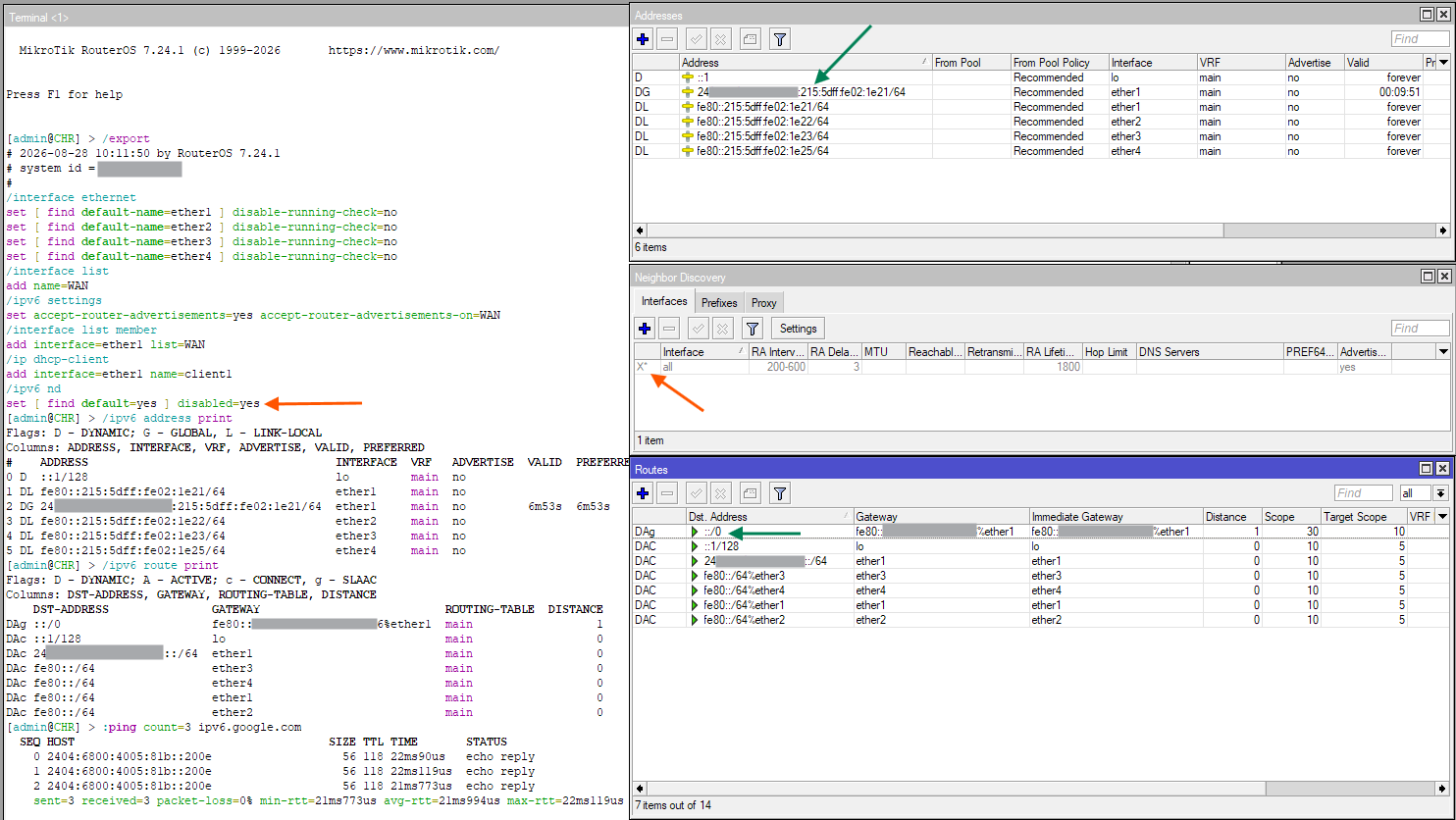
Somewhat tangential, but previously you needed /ipv6/nd enabled on WAN interface in order to participate in ND as a host (e.g. to learn default gateway). So since a long time I had ra-lifetime=none. Do I understand correctly that's no longer needed?
Most probably not. Entries in ROS changelogs are pretty vague and that's the way it always was. And we can all agree that there should be a system (portal or something) with more detailed information about what a particular changelog entry actually means. OTOH I agree that the published changelog (the "entry level") should not be too detailed because that would make it impossible to "quickly skim".
BTW, the actual issue was reported in (IIRC) relevant ROS release threads and then extensively discussed. So (more or less tight) following of relevant threads on this forum means that somebody installing a new ROS version will not be caught by surprise if some functionality changes ... not if one stands by for a week or three after a particular ROS version gets released and lets other find the surprises.
@mkx
If only there was a way to make a site page with text formatted in such a way that when you click on it it opens a new page, possibly with more details ....
... no, wait ...

It's not needed, as stated by the manual, it's only for the router role, not the client side:
IPv6 Neighbor Discovery | RouterOS Manual
RFC 4861 defines five ND message types: Router Solicitation (RS), Router Advertisement (RA), Neighbor Solicitation (NS), Neighbor Advertisement (NA), and Redirect. Adding an interface to
/ipv6/ndactivates only the router-side messages.
It's not needed if the router only needs to obtain address via SLAAC and the default route from the received RAs. For this, only the accept-router-advertisements / accept-router-advertisements-on are important. Here is a minimal configuration where both work without any /ipv6 nd entry enabled:
But if you have the interface=all entry enabled, then it's preferable to add entries for the WAN interfaces with ra-lifetime=none. That one fewer accidental problem like the one introduced by 7.23 (or if you for some reason add an /ipv6 nd prefix entry for the WAN interface).