CMR is a loooong way from being used in production. Easymesh is a nice addition. But what's with the VLANs ? I don't see any mention of VLANs being supported. What if I want to use separate VLAN for the backhaul ? Only bridge setting is mentioned.
Send us support output file, currently we are not able to guess what is the reason for the issue.
Long way?
It was launched in 7.26... Still in beta.
I’ve been thinking of it as “Central Management for RouterOS” but it would be nice to have an official definition.
Coupled with easymesh it can be awesome but need to be redundant for real production use.
If node is dead, no cmr, no easymesh manager.... What's the solution provided by mikrotik for ha?
In the next 7.26 beta, VLAN rules use the client's existing enabled bridge instead of cmr-bridge. Your own configuration on it stays in place: VLAN interfaces, IP addresses and other ports. Disabling, enabling or removing a rule, or restarting the CMR server, only adds or removes the ports and VLAN entries that CMR manages. The bridge is not recreated, so your management VLAN stays valid and the netwatch script is no longer needed.
Please keep only one enabled bridge on the client, and don't also define the VLANs assigned by CMR rules manually in /interface bridge vlan.
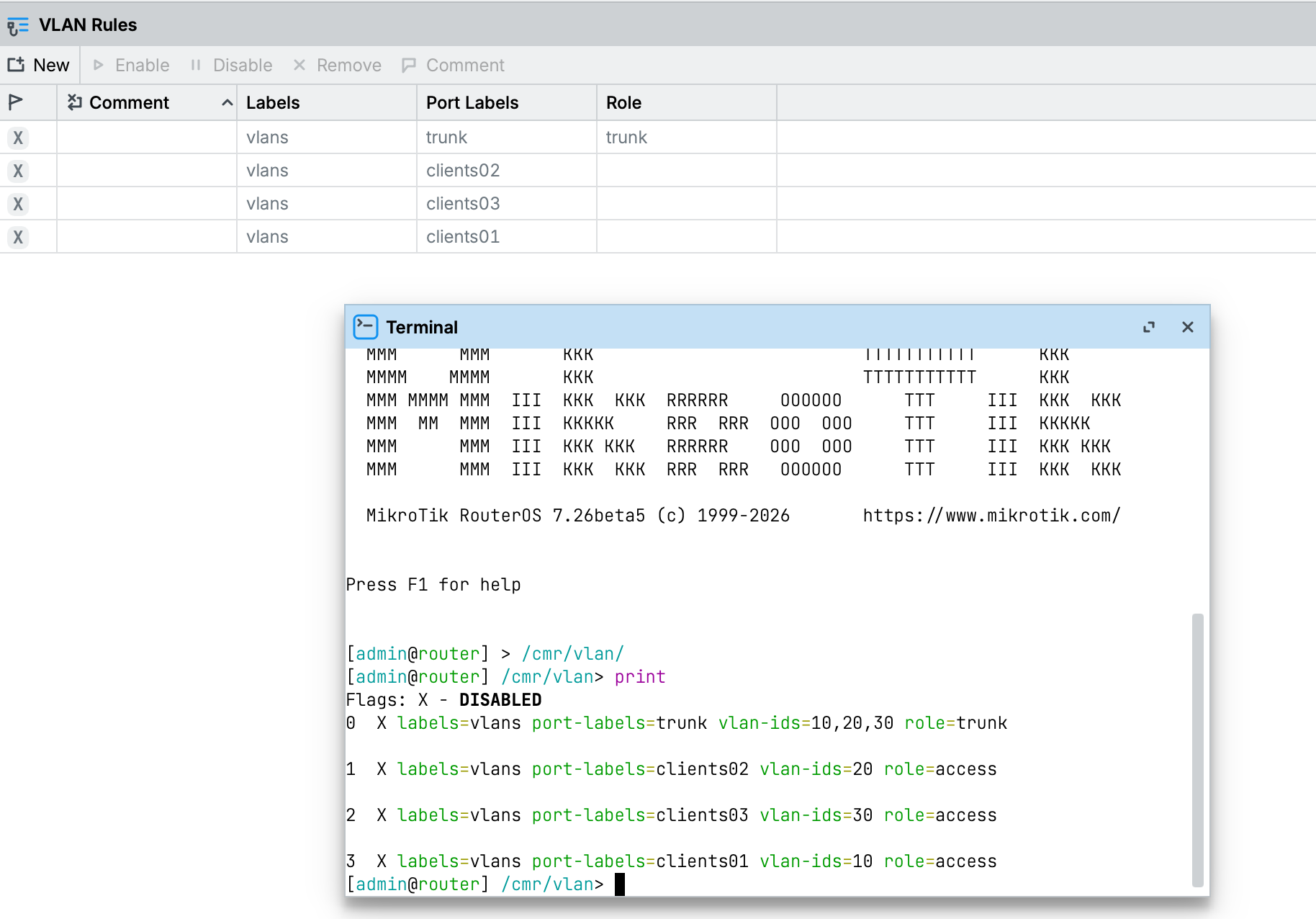
Currently there are 2 vlan roles:
- trunk
- access
Is there a reason why there is no hybrid role?
Hi , why can't CMR behave the same as when "bridge->ports->PVID" is set?
if the vlan is statically declared in "bridge->vlans->ports", nothing happens
if the vlan is "new", then it is added as a dynamic-enabled entry
As far as i know, there is no guidance to "not create the vlans in bridge->vlans" before applying via "bridge -> ports -> PVID"
Yes, thank you for the report. Will fix it.
seems that will be implemented in next beta as per @sergejs post
it was about WinBox not showing ports correctly.
We do not have final opinions how CMR VLANs will look like in final version. So we are open to the different suggestions.
@sergejs Can you share in what directions your internal discussions are going?
edit:
some feedback on /cmr/vlan, since you mentioned it isn't final yet.
Hybrid ports
This is the main thing I'm missing. Right now a port is either access or trunk, and a trunk drops untagged frames even if VLAN 1 is in vlan-ids. Two rules on the same port don't help either, because the first one wins and the second is silently ignored. Typical case: an AP uplink with untagged plus a few tagged VLANs for e.g. guest-wifi.
Simplest fix I can think of: split vlan-ids into untagged-vlan-id and tagged-vlan-ids and derive access/trunk/hybrid from that. role could stay as a shortcut.
Smaller points
- Overlapping rules on the same port should at least give a warning.
show-devicesor a dry run for VLAN rules, like for upgrade rules, would help before pushing changes.- Auto-rollback if the client doesn't reconnect after a VLAN change (like safe mode).
- With bridge reuse: an option to add the bridge itself as a tagged member, so a management VLAN interface keeps working when
vlan-filteringgets enabled. - CMR already knows both ends of each link, so flagging VLAN mismatches in the topology would be useful.
- The CLI reference marks
port-labelsas mandatory, but the description says all ports are used if it's omitted.
Thanks
It depends on how loosely “trunk” is defined here. Some vendors are super-rigid about trunks having a fixed and untagged VLAN 1 as PVID and use “hybrid” for any other interface configuration that involves tagging. Others use “trunk” for any tagged interface.
RouterOS has historically left this open with no real reference to “access”, “trunk”, or “hybrid” in the configuration itself. If there’s no reference to “hybrid” here, that suggests they’re using the looser definition of “trunk.”
(Let’s not even get into the vendors that like to use “trunk” to describe interface bonding.)
QinQ, Selective QinQ, VLAN translation.
I feel that the choice to "only do what is simplest" will lead to the same problems we already face today.
Currently, it is not possible to implement QinQ, Selective QinQ, or VLAN translation in RouterOS without resorting to "jury-rigged" workarounds.
It is also worth noting that these workarounds directly negatively impact hardware offload, L2 and L3.
I see an opportunity in version 7.26 to finally address this.
However, doing so requires finding a way to handle these inherently complex processes while providing an intuitive abstraction that simplifies how the user interacts with them.
I believe it is impossible to implement the aforementioned features—which are not actually that complex, yet are essential for a service provider operating at a carrier-grade level—without having VLAN filtering and ingress filtering enabled at all times.
same for per-vlan igmp snooping, per-interface rpf, per-port max-mac-count
Maybe useful, maybe not, coincidentally I am working on a simple cheatsheet related to VLAN's (not that I know much about them) but since I was struggling to understand some concepts and I noticed that everyone calls port differently, I had to make (with the help of Gemini) a little comparison table:
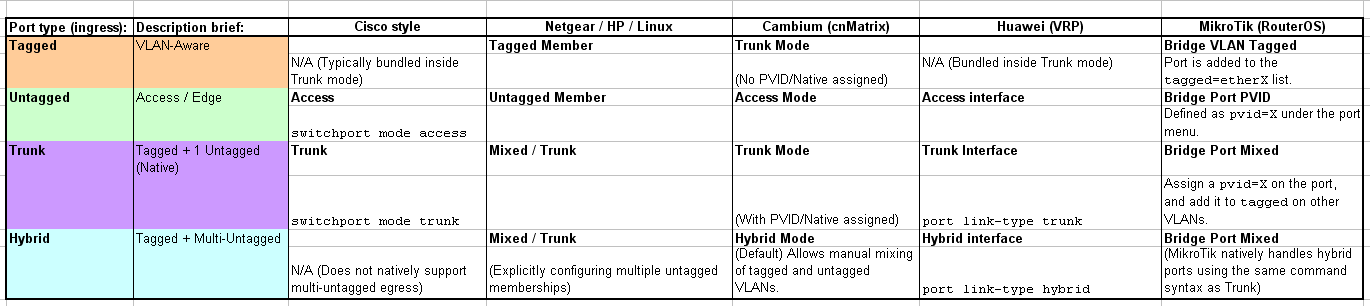
why I called it "hybrid": that's the term the Bridge VLAN Table guide uses for a port that carries one VLAN untagged and others tagged. In CMR, trunk already means tagged-only, so calling it trunk here would be confusing. On Cisco it would be a trunk with a native VLAN (as in your sheet).
This is not 100% correct. This may apply to Cisco IOS, but other Cisco products definitely support that definition of "hybrid".
Novel idea. Just use MVRP to control the VLAN assignment..., so CMR controls MVRP policy a port PVIDs/frame-types... and MVRP handles the VLAN sync. This allow a CMR to control the bridge with mvrp=yes, so that extra bridge without that are ignored. So CMR client could have multiple bridges, just only with mvrp=yes. And use standards where they exist.
And this is why RouterOS has long avoided "trunk"/"hybrid"/"access" — since it's not like there is a common definition. So I'd agree with @infabo, it generally mean one untagged; on a "trunk", as that, to me, mean no untagged... You mix any untagged and tagged == "hybrid".
But I'd don't think CMR should even use "trunk" nor "access". MikroTik correctly, IMO, eschews these debates, and use the pvid=/frame-type=. This isn't that hard with the newer dynamic VLAN interface tagged on bridge... So you really are just controlling these two settings with CMR... so no need to hide the real value names. In CMR those are the two important ones in /interface/bridge so CMR looses the "weird" ones, so the existing scheme becomes clear and in one place instead of multiple tabs/checkboxes needed for setup which CMR can already do.
Basically I'm in favor of the existing vocabulary than adding a MikroTik column to @jaclaz's table.