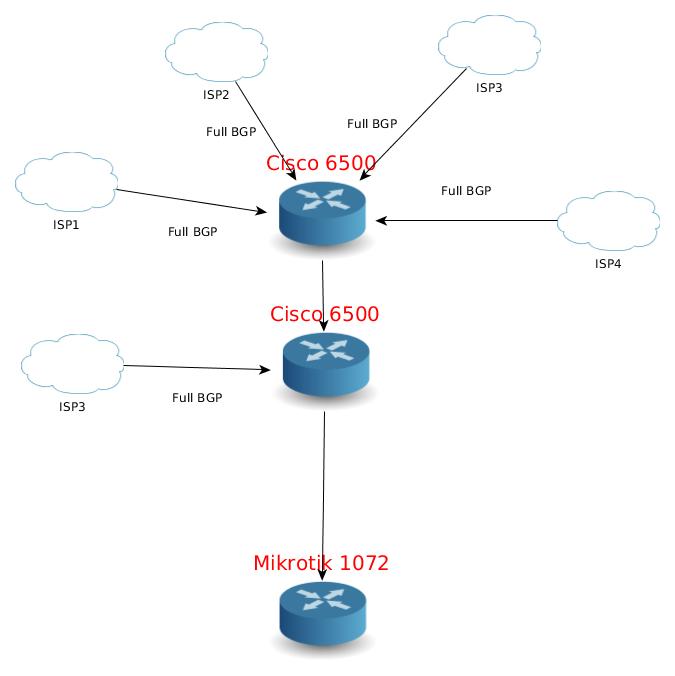
Hello, i have this network diagram:
Router 1 (Cisco 6500) has 4 Providers with full BGP 10G
Router 2 (Cisco 6500) has 1 Provider with full BGP 10G (this provider is also included in Router 1) and all BGP tables included on Router 1 with another 10G dedicated fiber.
Router 3 (Mikrotik 1072) has 1 10G fiber against Router2 With Full BGP.
The problem is that all routers have same AS and Mikrotik only get 480K routes from Router2, this routes are from the ISP provider of Router2 but BGP routes from Router1 are not accepted.
In accepted routes does not show his AS number in bpg-as-path message.
When the remote-as of the BGP peer is the same, the BGP peering become an iBGP peering.
Unlike eBGP, an iBGP router will not advertise routes learned from one iBGP peer to other iBGP peers by default. This is the reason iBGP requires full-mesh i.e. all routers peer to each other, or a route-reflector setup. A route-reflector is a special iBGP router which is allowed to re-advertise routes learned from other iBGP peers.
For a good iBGP setup, it is necessary to peer using loopback IP addresses and specify update-source loopback (and next-hop-self, if the eBGP connection links are not distributed within your IGP). Thus, an IGP (e.g. OSPF) is mandatory to be configured within your AS, so that all router loopbacks are in the routing table and reachable to all routers in your AS.
I tested changing AS number and I received all routes.
I continue with test to receive all routes with correct AS number.
I tested setting route-reflector to yes and no, but result no change.
For three routers, you should just do a full mesh of iBGP.
It appears that the Mikrotik is only peering BGP with the middle 6500. It’s that 6500 which needs to be configured as a route reflector, not the Mikrotik.