Hi, I am trying to work through the best way to deploy a Mikrotik CCR2116-12G-4s+ as a BNG for pppoe sessions from a wholesale carrier. The carrier provides an ENNI handover, over which the pppoe traffic is qinq tagged where each customer has a unique s-vlan/c-vlan combination.
cust1 - s-vlan 3000, c-vlan 10
cust2 - s-vlan 3000, c-vlan 11
custx - s-vlan 3001, c-vlan 10
etc
So far with my lab config I am finding for each customer you have to create the qinq interface. Also, a pppoe server for each qinq interface.
I wondered if there was a more efficient way of handling this type of service with less repetitive config.
This forum post seems to suggest another way to deploy this type of service using a bridge with a single pppoe server.
http://forum.mikrotik.com/t/stability-multiple-pppoe-servers-10-at-the-same-router-is-there-any-alternatives/139447/1
But I cannot find an example of this and all combinations I have tried don’t seem to work.
Can anyone help with an example config of a qinq interface and a bridge with a single pppoe server as suggested in the above article.
Or another approach to reduce the amount of config per new customer.
Any help is much appreciated.
current lab config
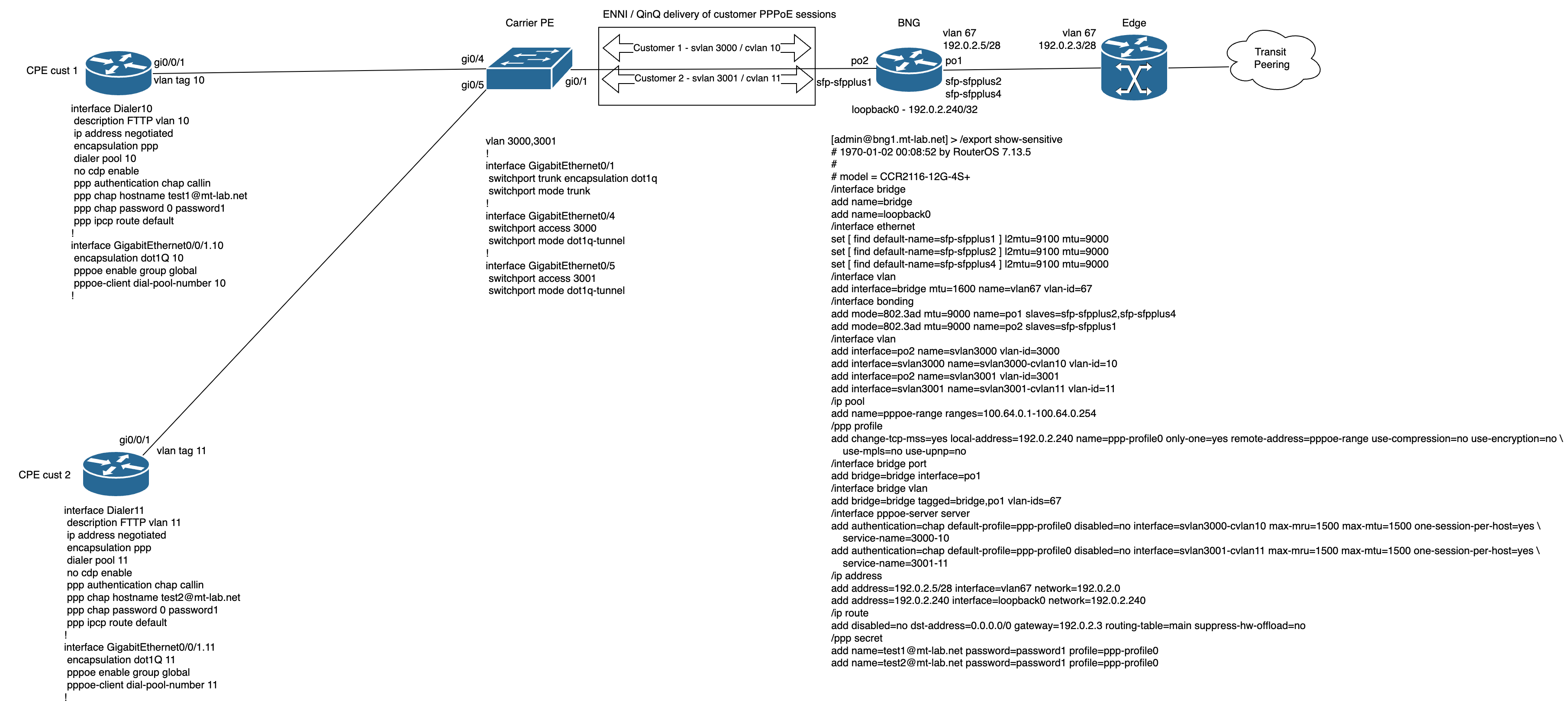
[admin@bng1.mt-lab.net] > /export show-sensitive
# 1970-01-02 00:08:52 by RouterOS 7.13.5
#
# model = CCR2116-12G-4S+
/interface bridge
add name=bridge
add name=loopback0
/interface ethernet
set [ find default-name=sfp-sfpplus1 ] l2mtu=9100 mtu=9000
set [ find default-name=sfp-sfpplus2 ] l2mtu=9100 mtu=9000
set [ find default-name=sfp-sfpplus4 ] l2mtu=9100 mtu=9000
/interface vlan
add interface=bridge mtu=1600 name=vlan67 vlan-id=67
/interface bonding
add mode=802.3ad mtu=9000 name=po1 slaves=sfp-sfpplus2,sfp-sfpplus4
add mode=802.3ad mtu=9000 name=po2 slaves=sfp-sfpplus1
/interface vlan
add interface=po2 name=svlan3000 vlan-id=3000
add interface=svlan3000 name=svlan3000-cvlan10 vlan-id=10
add interface=po2 name=svlan3001 vlan-id=3001
add interface=svlan3001 name=svlan3001-cvlan11 vlan-id=11
/ip pool
add name=pppoe-range ranges=100.64.0.1-100.64.0.254
/ppp profile
add change-tcp-mss=yes local-address=192.0.2.240 name=ppp-profile0 only-one=yes remote-address=pppoe-range use-compression=no use-encryption=no \
    use-mpls=no use-upnp=no
/interface bridge port
add bridge=bridge interface=po1
/interface bridge vlan
add bridge=bridge tagged=bridge,po1 vlan-ids=67
/interface pppoe-server server
add authentication=chap default-profile=ppp-profile0 disabled=no interface=svlan3000-cvlan10 max-mru=1500 max-mtu=1500 one-session-per-host=yes \
    service-name=3000-10
add authentication=chap default-profile=ppp-profile0 disabled=no interface=svlan3001-cvlan11 max-mru=1500 max-mtu=1500 one-session-per-host=yes \
    service-name=3001-11
/ip address
add address=192.0.2.5/28 interface=vlan67 network=192.0.2.0
add address=192.0.2.240 interface=loopback0 network=192.0.2.240
/ip route
add disabled=no dst-address=0.0.0.0/0 gateway=192.0.2.3 routing-table=main suppress-hw-offload=no
/ppp secret
add name=test1@mt-lab.net password=password1 profile=ppp-profile0
add name=test2@mt-lab.net password=password1 profile=ppp-profile0