please anyone have a deep understanding about this boot option in Router os ..?
so what is the different between this option ..?
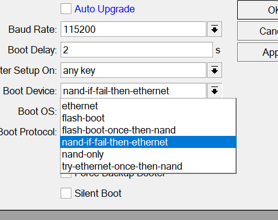
Here’s my uderstanding … which is not complete as I don’t have any device where the flash options make any sense:
- ethernet … device tries to boot via network. In most cases this means netinstall, I’ve never seen example where this was used for booting device into normal operating state. Beware that usually devices only boot via ether1 (which is by default configured as WAN port on most device types) … I don’t know whuch port is used for netboot on devices with only SFP ports (and single RJ45 port).
- nand-only … this is usual boot selection, device boots from built-in non-volatile storage (flash disk, a.k.a. NAND storage)
- nand-if-fail-then-ethernet … tries to boot from NAND and if boot fails it tries network. Booting from NAND can fail for various reasons, such as nand device failing or upgrade going wrong or …
- try-ethernet-once-then-nand … the opposite of previous item: try network boot and if network boot doesn’t work (e.g. because no TFTP/BOOTP servers are available) boot from nand. This option comes handy when one would like to perform netinstall but it isn’t possible to press the button on device (during power-on, pressing button affects the boot sequence, one of possible modes is ethernet boot).
I guess that flash items refer to some add-on semi-permanently attached flash storage (SD card or M.2 card) which is supported by some device models. I don’t expect that USB flash disks are supported as boot media.
I’ve used try-ethernet-once-then-nand option and after booting from nand, selection automatically returned to nand-only … I guess it’s a security feature. I don’t know if other options change to default automatically as well, but if it does happen, this certainly has some sense.
Flash is for the “old” flashfig, and the name refer to the speed, not to the name of the memory.
Is like netinstall, but reinstall only the config, not all the OS
Is used on batch process, and flash-boot-once-then-nand is the default when you buy a new device (not branded or manipulated like CPE/911 from reseller)
Thanks for clearing things up.