I saw some mention in the notes from the US MUM of using OSPF for full duplex and redundancy. Lets compare.
Bonding: Full bandwidth either way. Redundancy?
NStream2: Full Duplex. 1/x redundancy.
OSPF: Full Duplex. Can push full bandwith with some packet marking. (I do not know how, do not ask) Redundancy squared.
That is impossible with any normal bridge and any such solution would require custom coding which would be prone to a lot of issues.
A L2 network can normally only have one operational link between two places. Any additional links must be muted (disabled/blocked/prevented from forwarding). However, if the L2 network was to be tunneled (EoIP) over a routed L3 network then that would reduce the efficiency somewhat but would accomplish what you want.
Hi all,
I have the same application here . Two sides to be bridged together (layer2), they are on a FLAT network and a DHCP server is on one side, giving new IP addresses both on local and remote site. An old wireless link between the two sites should be joined with a new one or more (usually of the same speed, but can be faster or slower).
In order to have redundancy, you can simply use STP protocol (spanning tree) and simple layer2 switches, but this will use only one (the “main”) of the links until the main link fails. What we need here is both links running together PLUS redundancy. Using one link for uploading only and the other for downloading only cannot be the way, unless you change the configuration “on the fly” as soon as the main link fails. So it seems that OSPF (a layer3 protocol) is the way, but basically we need bridging. Maybe the example here is the best ? http://wiki.mikrotik.com/wiki/Bonding_Examples (monitoring must be activated). Is there any additional script to write to let the whole system work ?
To be brief (OT): Sten is right. As I said, STP lets ONE only link work at a time, while the other will be blocked so packets won’t be forwarded on both links but on one of them. As a result you spent money for a wireless link which is down most of the time. STP and Fast STP are layer2 protocols and cannot aggregate two or more channels in a single big one: they give you only redundancy. Although Layer 2 switches also allow you to do what they call “trunking” which is a real aggregation of N channels, it needs all channels to be the same (same speed and protocol) and usually you can do it only with cables/fibres. I’m even not sure about fault tolerance of trunks like those.
To return in the topic…
DHCP forwarding, EoIP tunnels, and L3 bonding is the key
Did anyone test it ? Does it work ?
Routing may prevent broadcasts to pass from LAN-A to LAN-B. Usually you need broadcasts in a flat network (for example a DHCP server is usually on one side, VoIP softwares need broadcasts, …)
I have the OSPF Full duplex working!! The issue i am having is my CPU load gets to 100% when trying to do a bandwith test. i think i would get better speed if i can get the load down.(remove things that are running that dont need to be.)
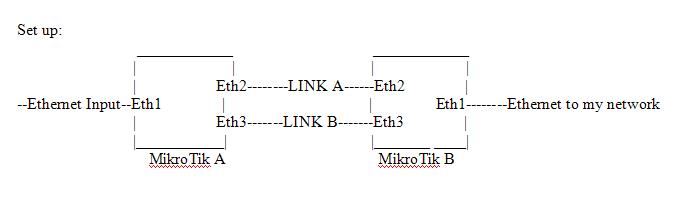

 . Two sides to be bridged together (layer2), they are on a FLAT network and a DHCP server is on one side, giving new IP addresses both on local and remote site. An old wireless link between the two sites should be joined with a new one or more (usually of the same speed, but can be faster or slower).