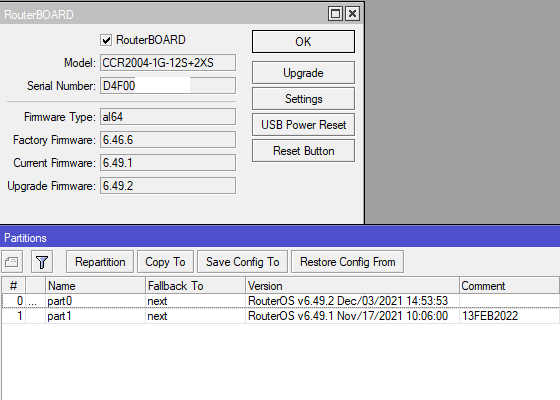
are you sure this devices currently support partitions?
I sure hope they DO
If not, then I pity the adventurous admin that decides to ever update firmware on one of these boxes, and be faced with a “fix by netinstall only, run-to-site” situation.
it is one thing to face such a prospect with a HAP-Lite;
it is suicide to face such a situation in a core-router / ISP scenario with 100Gb/s worth of customers, running to your house, with torches and pitchforks on hand.
OMG… thats not funny.. mikrotik don´t know how to play anymore.. 2 100G…seriousssssssssss OMG… hehehehhehe 16 core ARM kkkkkk pricelist? só i can sell my house and save up some cash.
Since I have yet to bother partitioning my MT devices, I’m not supporting the contention that MT ARM devices can’t do it, just saying why it might be the case that some can’t do it.
Can you check how much traffic passes per route? In relation to your total traffic?
Pretty sure the vast majority of your traffic will flow over less than 1k routes in total. Thus, 79-119k routes left for the rest of the traffic to be routed in hardware, with only a tiny amount actually being routed by software (CPU).
Hi all.
I see that Router supports transceiver XS+2733LC15D. One for TX, one for RX (or TX/RX+TX/RX. Dunno*).
Now this scenario is new to me. How could Router handle this?
Have you got any example of conf or a manual?
Thanks in advance.
“Normal” SFP-Modules have one connector for RX and one for TX and on both sides of the connection are the same modules. This connection needs two fibers. One for data flow in the one direction and one for the other. The modules you are mentioning are transmitting both directions in the same fiber (only one fiber needed). To achive this, the two directions have different wavelengths or “colors”. Therefore you need two different SFP modules on both ends. The one transmitting in color A and receiving color B. The other end has to be the other way around. That’s why you buy these modules as pairs. They are NOT inserted in the same router but at both ends.
Those modules are using the wavelenghts 1270 and 1330. “Normal” single mode modules are 1310 only. And you use them normally for long distance connections that are leaving your building only. That’s where they become handy. Long distance fiber lines can get expensive and with those BiDi-Modules (bidrectional) you only need one fiber not two.
For short distance you normally use multimode modules with two fiber.
Hi all.
A question about transceiver compatibility with CCR2216-1G-12XS-2XQ
I’m ok with 25Gbps and Fiber to Copper transceiver, thanks to Mikrotik support.
I do not find -atm - transceivers for multimodal fiber 10Gbps (Mikrotik CCR to my Aruba and HP switches).
Thinking about Mellanox MFM1T02A-SR Compatibile 10GBASE-SR SFP+ 850nm 300m DOM LC MMF
I wish to buy a MikroTik CCR2216 for testing first, any 100 Gigabit QSFP28 transceiver module recommended for this router? it seems Mikrotik doesn’t have any 100G transceiver module for this router
off course with ccr2216 2.800 USD full price you dont even pay the annual support of this hyperscale things, is completely out of context of this topic
There are four hot-swappable fans, as well as dual-redundant hot-swap power supplies. And these PSUs might look familiar if you have used our CCR1072 before: you can keep using your previous hot-swap power supplies and SFP modules.
You’re saving time and money on accessories, while also getting better performance with lower power consumption
This is very strange product.
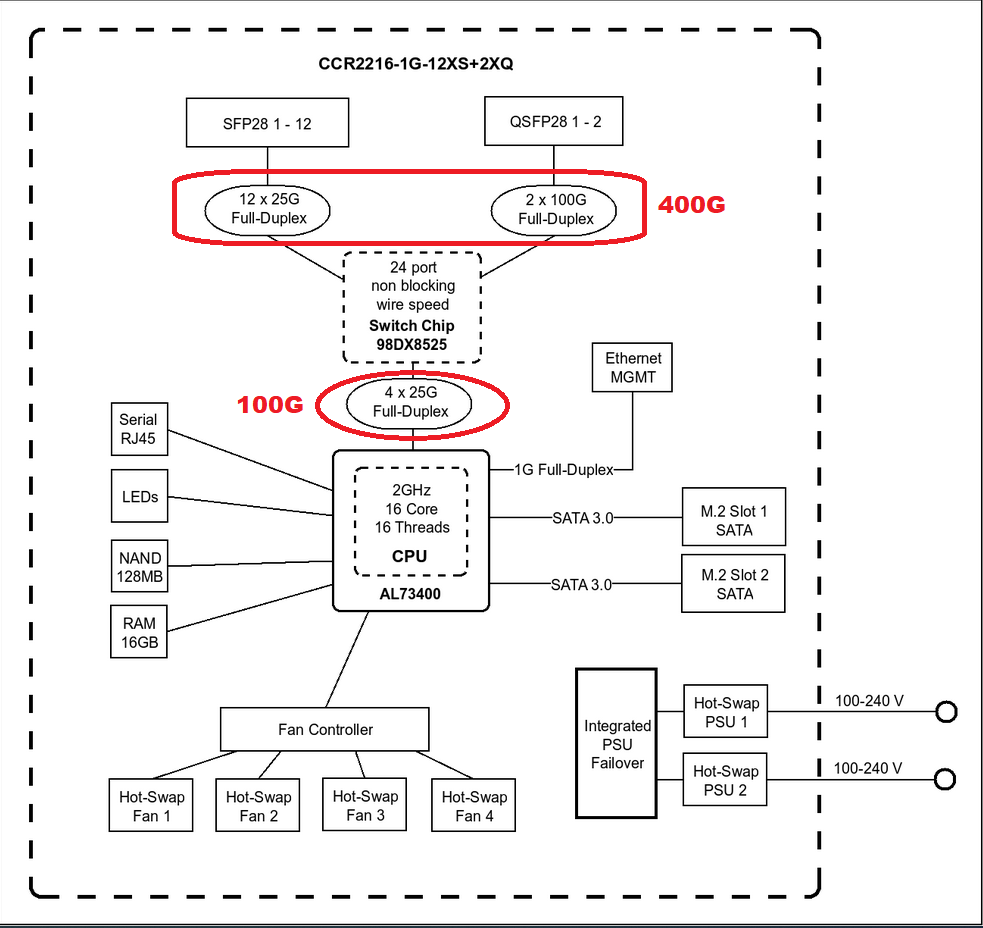
Mikrotik team, why did you add 25G and 100G interfaces for that architecture? Obviously that we can use effectively only 10 interfaces with 10G mode. Because internal bus can pass through to CPU only 100G. You can say “we have HW offloading”.
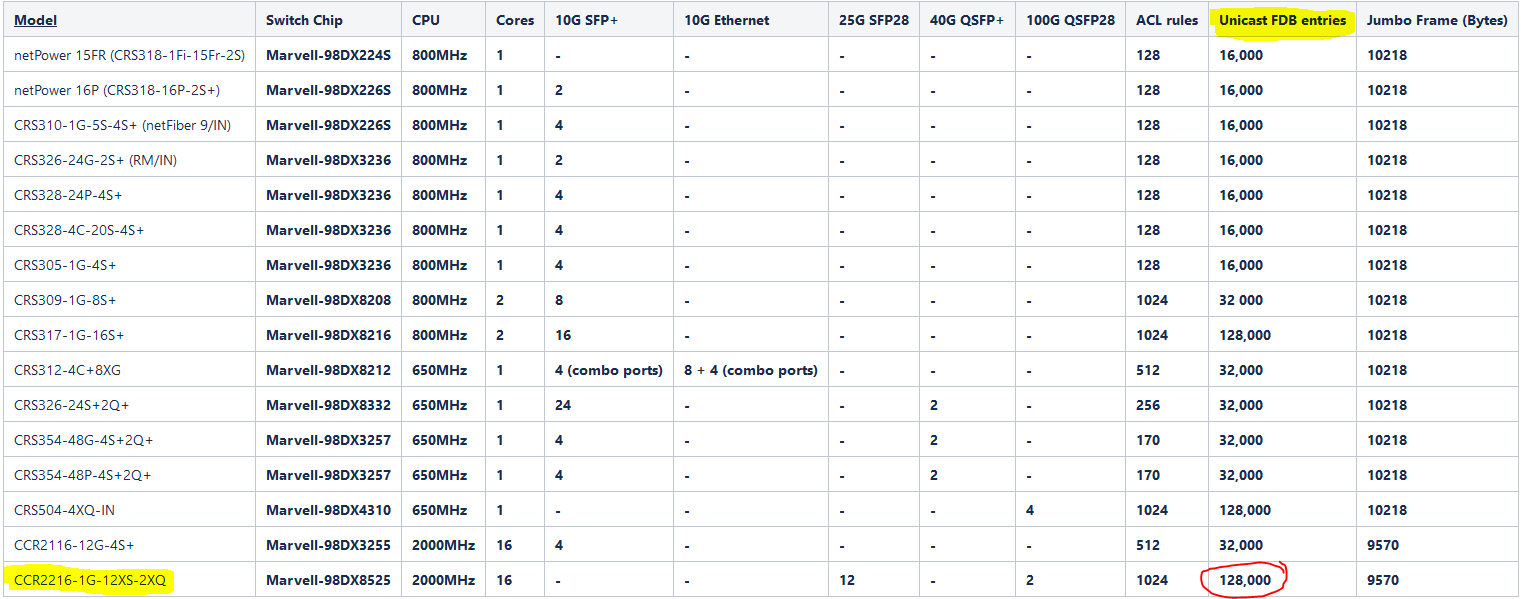
Yes but it is totally useless because it can handle traffic only for 128k routes. But what scenario do you offer to use this device? Where did you see the router with 25G and even more so 100G which use less than 128K routes? Of course I can think up this scenario but it will be limited cases.
And if we pay attention to test results for CCR2216 and CCR1072 with 25 ip filter rules or 25 simple queues we find that CCR2216 has much less performance than CCR1072. Which totally confirms that the router does not need 25G and 100G interfaces. Because there is no (ok, no so much) real scenario where we can use this interfaces.
I think it is absolutely marketing product and it is step back for mikrotik.
Any IPv4 routing done within the routing tables of the switch chip will be done in wirespeed. That 100G link to the CPU is only relevant for the rest.
Have you actually checked on how many routes >90% of your traffic flows? You should.
Keep in mind that IPv6-L3HW has already been announced as being worked on.