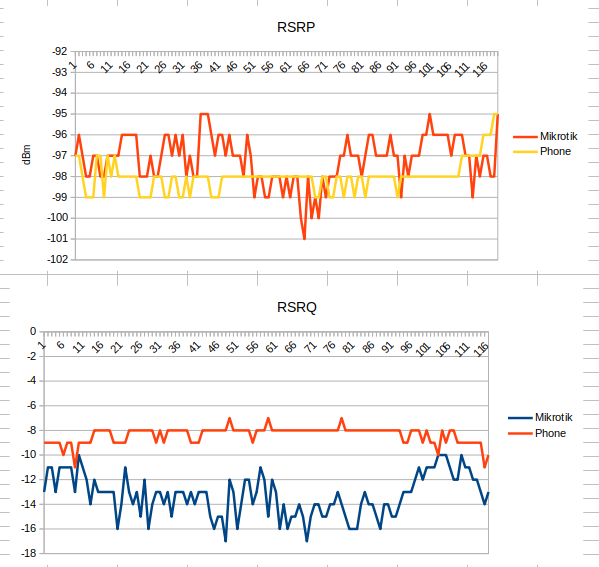
Hello everyone, I’m a electrical engineer and I’m totally new to Mikrotik products. Currently, I’m working with Router Mikrotik R11e-4G and I want to compare the signal strength, signal quality between Mikrotik and my mobile phone Samsung S7 GM-S930F on LTE cellular network . And surprisingly, it’s not better (much) than my phone. I did a test, recording log on both devices over 24h within 30min interval. I placed them on a weak signal zone inside my house. I expected that Mikrotik would have got the signal much better than phone (look at its shape ) at least 5-7dB. but no, it didn’t. You can take a look at the attached graph. just so you know, both devices connected to the same eNB, same cell, same band, same frequency, and because I only have 1 SIM card so I didn’t record log on the same day on both devices but literally, it’s still reliable.
Anyone knows what is the cellular gain value of Mikrotik R11e-4G’s Rx antenna or whichever model familiar because I couldn’t find it anywhere. I only found the gain value in term of Wifi antenna. And has anyone faced that problem or it’s normal?
Any comment would be appreciated because I couldn’t explain this myself. Thank you very much for coming by and reading all this.
yeah true though, but my purpose is comparing the performance of Mikrotik to my phone and the point is it’s not better much than the phone. Could you please perform a quick comparison of your Mikrotik and your phone to see whether you also got problem or not. Thank you very much.
does that mean LHG will have better signal when user points it toward the base station, otherwise received signal would just as good as on mobile phone?
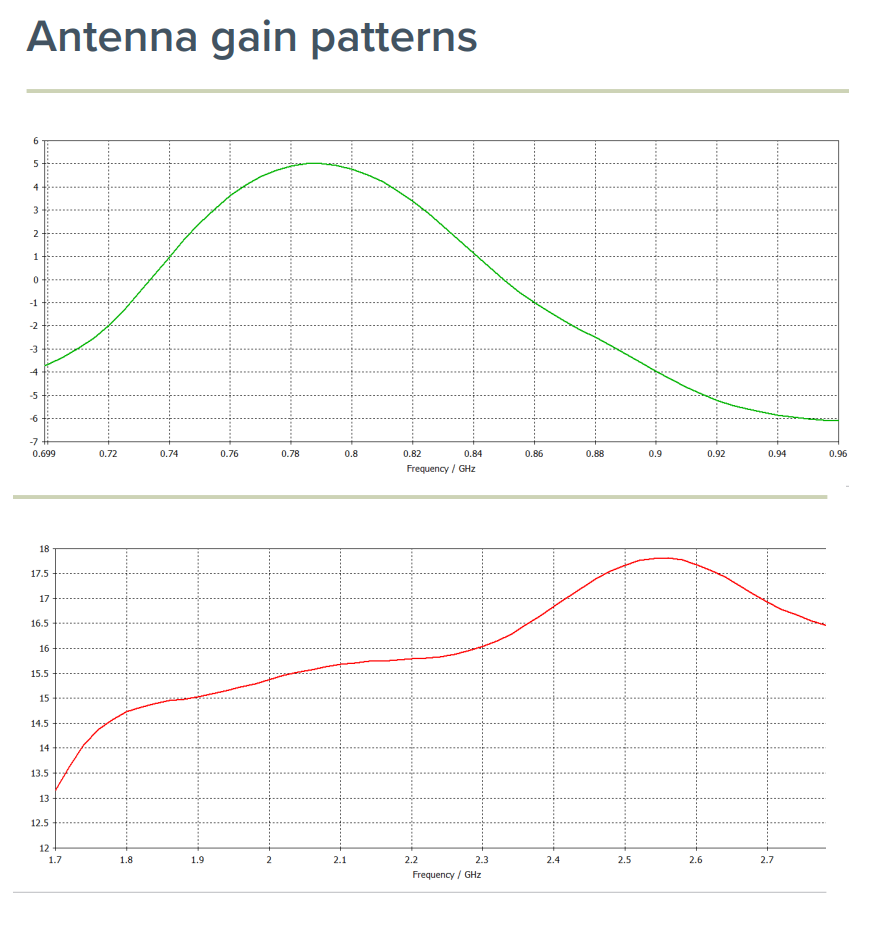
The two charts show antenna gain (y-axis in dBi) for different frequency used (x-axis in GHz). Graphs show that LHG’s antenna has a very good gain for higher frequencies (lower graph, peaks at almost 18dBi) while it has mediocre to shitty gain in lower frequencies (upper graph, peaks at 5dBi but goes below -5dBi as well).
And all of that is true when LHG dish is pointed directly at base station in case of line-of-sight or almost line-of-sight. When used in environment with high steep obstacles and non-line-of-sight (skyscrapers, deep and narrow mountain valleys) it is sometimes better to turn antenna towards one of obstacles which might act as a reflector, so one has to experiment. Antenna gain for signals arriving from other directions is lower than 0 - this actually enables the high gain in “main direction” and also helps to supress interference coming from other directions (improves SINR).
You’re saying that signal serving is band 20 … that’s 800 MHz which translates to antenna gain of roughly 3.5dBi. Which is not much (only slightly better than a decent omni directional antenna would provide) and it’s really important to point LHG in direction with maximum signal to get any advantage of directional antenna.
[edit]
Closer look at it … EARFCN of 6200 means downlink center frequency is 0.796GHz and uplink center frequency is 0.837GHz. According to gain graph, this means that in downlink antenna provides gain of around 4.5dBi but in uplink a mere 1dBi. So your LHG will struggle in uplink.
I was looking SXT LTE/4G products datasheet and show the same mediocre and even negative gain on lower bands, very important, especially nowadays with the 700mhz band widely used in many countries for LTE
Summarizing
These products are best suited for a proper outdoor installation aimed toward provider tower to use high-frequency bands that provide better bandwidth/speed
The key factors of success using high frequencies:
Antenna gain (devices like LHG and SXT provide it)
Outdoor Installation Free from obstacles aimed toward provider tower (depends on scenario)
These factors can allow better signal and performance than a mobile terminal and can make possible the use of high frequency bands where a mobile terminal only can pick low frequency band
For lower bands, you can expect almost no benefit like in this case
I was not aware of these details too until this discussion emerge
thank you @mkx very much for such an informative and detail answer. The important thing to know is LHG is a directional antenna and if it doesn’t point to the right direction, the gain is small. I think my question is literally cleared now. I will try to do another experiment with different positions of LHG and will update here.
Just a minor correction: my EARFCN is 6400 though but not that important. I got your explanation anyway.
Thank you for your reply. It’s true though, when we dig deeper into a problem, we get more interesting knowledge even with a simple device like a 4G router. It’s just a pug and play device but how to use it efficiently and which model suits the best to the scenario also requires us to truly understand products.
Right, when I was checking the exact frequencies used for given EARFCN, I took wrong figure. So in your actual case, center frequency of bot uplink and downlink is 0.02GHz higher … where antenna gain is even slightly worse than I wrote.
Just for information: there are antennae on the market that provide much better performance in low frequency bands but they don’t look as sleek as LHK dish does. Mostly they are either log-periodic or yagi ugly beasts (the horizontal pole with orthogonal pikes of different lengths) and for proper 4G/5G you need a pair of those (mounted at 90° for best performance). Such as this one. Indeed they have low WAF, but if the choice is between ugly looking antennae on the building and poor/no internet, then I guess most of Ws will choose the former.
 ) at least 5-7dB. but no, it didn’t. You can take a look at the attached graph. just so you know, both devices connected to the same eNB, same cell, same band, same frequency, and because I only have 1 SIM card so I didn’t record log on the same day on both devices but literally, it’s still reliable.