hello,
is a set of cube 60 pro devices a good choice for installation near sea? it will be on a 8m high pole about 20m away from sea side where we tend to have strong winds. salt water wind hitting the devices will be a normal occurence.
omnitik ac and sxtsq are surviving these conditions, but older models (old omnitik and old sxt) die after a few years because they're too open from the underside and salt water goes in and corrodes everything.
this is the only mikrotik device that has 60G with 5G backup, link lenght will be 1.2km.
is the problem with bad sealing on the devices been solved? i remember seeing many photos of dead devices because rainwater went inside because of bad sealing around the device.
thanks
Exactly... If you remember it yourself, there's no point for repeat it again...
I don't know who the genius was who thought of giving it that shape,
but it's ridiculous, among other construction issues,
that the cable exits horizontally, instead of vertically, at the bottom, which would be the most logical place...
since nobody else is replying, i'll take it you're right.
i still have till next week to decide, but looks like i'll take another 60G offer which also has 5ax backup and a more protected casing.
As the source of leaking is known so what is the problem to buy a tube of
silicone sealant and apply additional sealing on each device. You can easily remove that protection if needed.
As I posted on the mentioned thread, I would rather use an o-ring, as there are the "right" grooves on the plastic side.
And since I don't trust even myself, I would add an external caulking with geotextile and a liquid sealer.
The issue remains about the connector receptacle, but mounting the thingy correctly and using self-sealing tape should be not a problem.
Also, personally, I would anyway look to find a place where to drill a small drain hole, and put a breather valve allowing the water/humidity to exit the case (small M5 or M6 nylon valves do exist).
Yes, I agree but .... 
IMHO finding proper o-ring or o-band is much, much time consuming than buying a tube of a good bath/kitchen silicone seal.
For the new installation the cover is opened so applying silicone on the chassis and closing the cover over it makes the connection water proof. The silicone could be also easily applied to the cable hole to prevent leaking that way.
If you have device already installed then you just apply the silicone just "from outside" with no screw intervention on the front and back.
According the holes I have no idea which place is better. If the device is set with front higher than back then it should be drilled at the back. If front is lower than back side, then the hoie should be in front.
Any decision clashes with sealing procedure as it opens the way of moisture to get in same way as it lets it get out.
Cube60 Pro is absolutely not suitable for installation near the sea.
The leakage issue can be worked around but the metal bracket will rust in no time.
It doesn't appear to be galvanised, just spray painted. The design makes it hard to get paint into all the gaps and tightening the hose clamp damages the paint anyway.
I have many of these 1km or more from the sea and within a few months they look terrible due to corrosion.
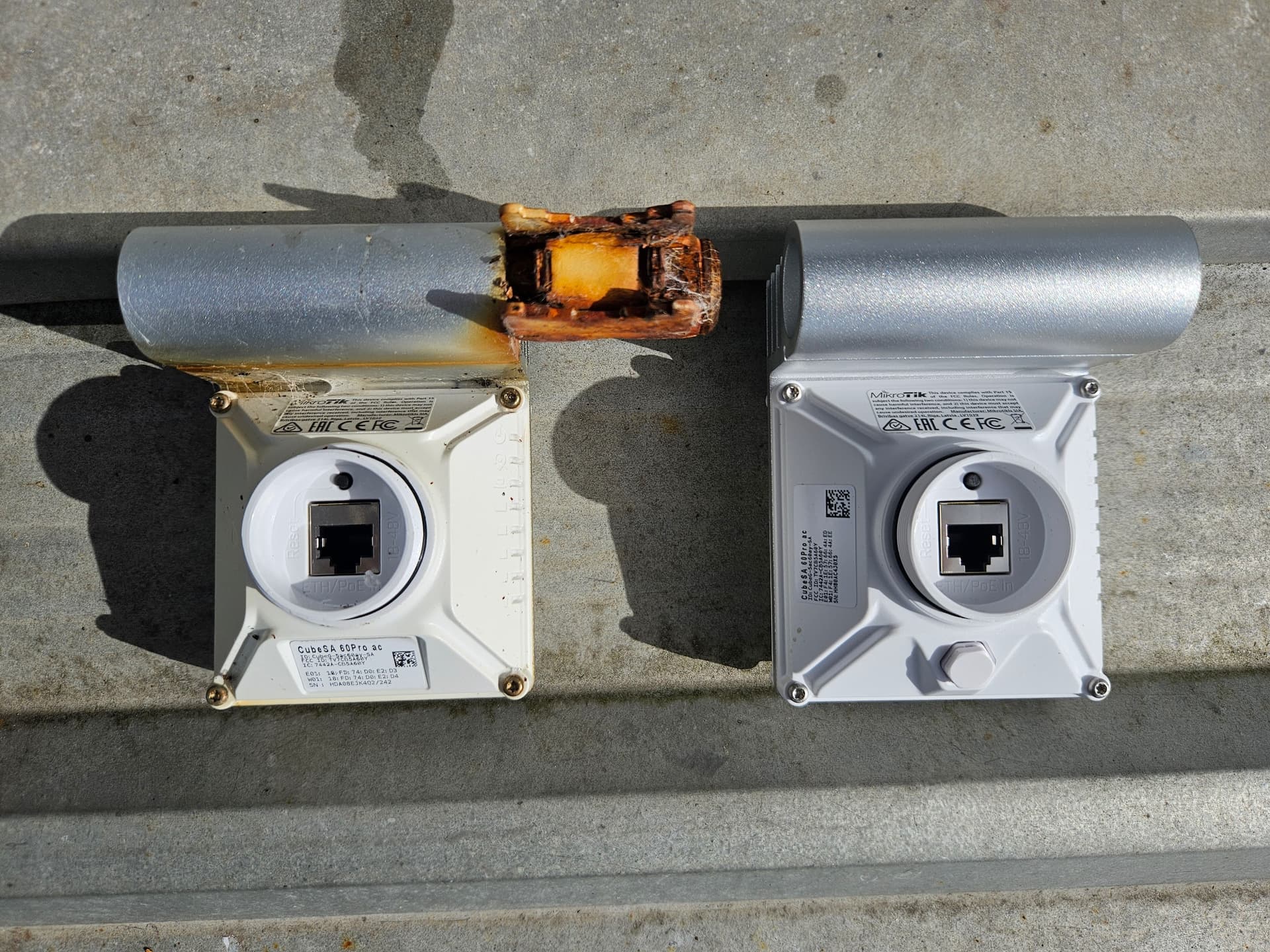
Photo below shows an approx 1yr old CubeSA alongside the quietly revised version with a breather gland.
Well, JFYI, there are ( actually quite expensive) kits to make your own o-rings, so-called splicing kits, they are used in automotive repair workshops, but finding a given length/diameter o-ring Is not that difficult.
However nowadays they can be 3d printed with TPU or TPE or similar elastic filaments, at an affordable cost, and in this specific case It would be better because of the peculiar shapes of the corners.
Venting valves are designed to be installed on IP55 or 65 boxes without lowering their protection grade, sure they make sense on the lowest side, but installing two of them won't worsen the situation, a Cube Pro Is not intended as a watertight/submersible device.
Anecdotally, I have some experience with lights placed outdoors and the old models (with rubber gaskets/o-rings and venting holes/valves) never gave me problems with moisture (but of course lamps had to be changed yearly or so and needed a lot of power) when leds projectors came out, with an expected 10000 to 20000 hours, i.e. 3 to 5 years at least, certified IP 65, sealed with grey silicone like caulking, primary manufacturers (Philips or Osram) I switched to them.
But they all lasted 2 years or less, due to moisture accumulating in them, until I started adding to them a little (M8 in my case) venting valve, last batch is now almost five years old, maybe It Is only a coincidence, still ...
So, at least the SA version has now the breather from factory?
Also the plastic pyramid seems to have been modified, removing the depressed area for the label and adding a sort of elevated reinforcement where the valve is placed.
Good to know, thanks for the picture. 
thanks for replies and photos.
all of the above suggestions MIGHT be OK for a home installation, a non-critical one. but mounting something for enterprize usage and having to rely on DIY for a device that is being sold as outdoor is a big no-no.
so overall thank you all for showing this is a wrong device for the intended setup. i'll order a set of wave-lr. for a home user it might be expensive but for enterprize usage it's not important. reliability is.