Google has announced (https://android-developers.googleblog.com/2025/09/simplifying-advanced-networking-with.html) that it is finally preparing a DHCPv6-PD client for Android.
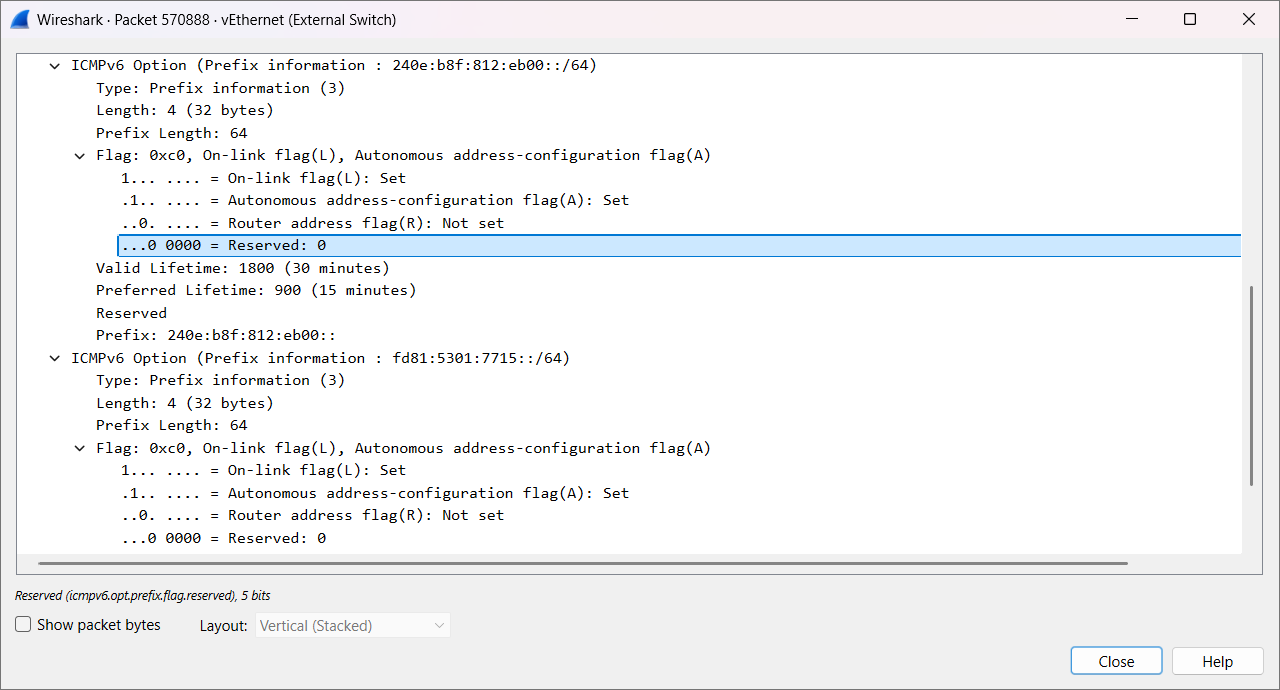
According to the developer documentation, the DHCPv6-PD client will be activated if it does not find SLAAC on the network (which will be few implementations) or it will activate the DHCPv6-PD client if the router reports a "P flag".
My question is whether Mikrotik implements the "P flag" configuration according to RFC 9762, which notifies the client that DHCPv6-PD is preferred over SLAAC on the network.
Android will then be able to work in networks with SLAAC + DHCPv6-PD server configuration. And if Mikrotik includes this implementation, how is it set up?
Personally, my ISP allocates me an dynamic /56 block through DHCPv6 PD over PPPoE, so not implementing RFC 9762 is not a concern, and I already enabled DHCPv6 PD on my LAN. Currently, the Thread Border Router embedded in Apple HomePod mini requires a delegated prefix for the use of Thread network. No other devices require a delegated prefix for now.
As currently required in RFC 9762, delegating prefixes with prefix length longer than 64 is not allowed. Which means this is really not suitable for home usage, if each of your Android devices take a whole /64 block out of the available pool. That's too wasteful. My home ISP only allocates a /60 for instance. It's really only usable for enterprises where user tracking/logging is required, and who own prefixes with smaller prefix length (like /48).
Another disadvantage with DHCPv6-PD, is that the addresses in the allocated prefix are not on-link addresses. When the Android device that got a prefix via DHCPv6-PD tries to talk to other devices in the same VLAN, everything would need to be routed through the gateway instead of the devices talking directly to each other (as in case of SLAAC). The gateway will need to support sending ICMPv6 redirect messages to work-around that (if the client devices also support it). Otherwise, you using your phone to watch something from your NAS or cast something to the TV will generate load on the router.
That's where RFC 9762 kicks in, it requires the gateway, by default, not setting the P flag for any prefix, until the administrator manually designate which prefixes prefer the devices to require delegated prefixes.
In practice, the gateway could broadcast RA with P flag set to zero, but send unicast RA with P flag set to one to devices which the admin would like to delegate prefixes to.