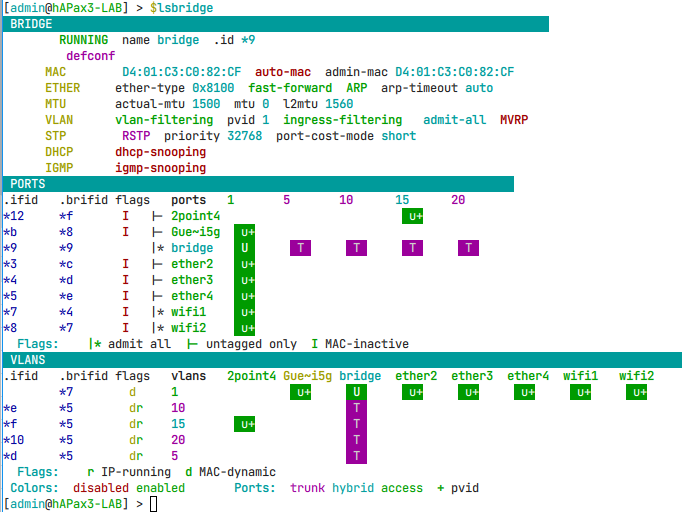
So the scripts here are part of multi-year background project to build some interactive TUI (terminal user interface) over RouterOS, many covered by my other Scripting topics. But it takes a lot of parts - the “scripting VLAN bridging” part is covered here. We’ll be on Mars before I’m “done” however. But unwinding /interface/bridge scripting was a key part and not so simple (see post above). But one main thing I’ve want to do is visually view (and ideally, one day, edit) a vlan-filtering=yes /interface/bridge.
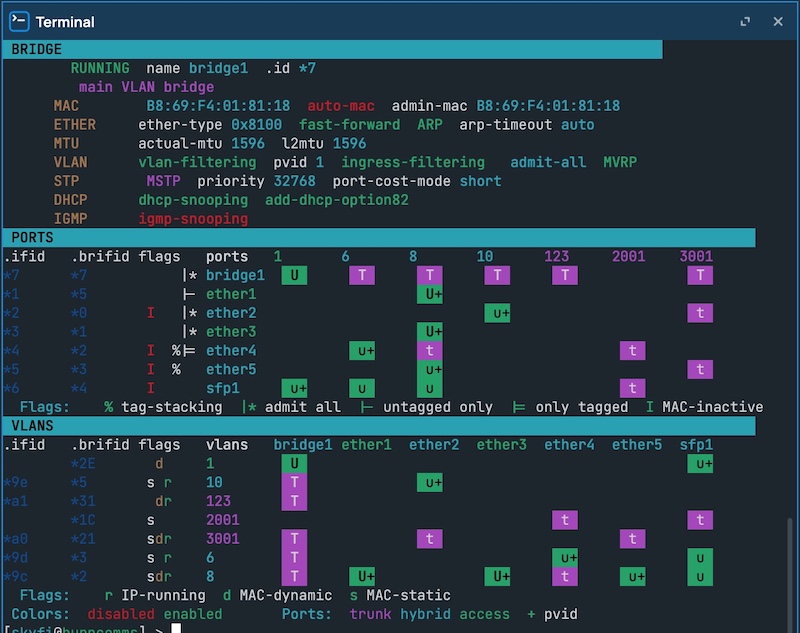
Below is a screenshot of $lsbridge in this series. Nothing interactive yet… it just presents the /interface/bridge config as a PivotTable™.
I’m kinda looking for feedback on the look-and-feel right now. I have included the script if anyone wanted to try, but it’s really more a prototype at this point & requires 7.18beta on top of that.
# 2025-02-01 06:02:17 by RouterOS 7.18beta4
# model = RB760iGS
/interface bridge
add add-dhcp-option82=yes admin-mac=B8:69:F4:01:81:18 auto-mac=no comment="main VLAN bridge" dhcp-snooping=yes mvrp=yes name=bridge1 port-cost-mode=short protocol-mode=mstp vlan-filtering=yes
/interface bridge port
add bridge=bridge1 interface=ether2 internal-path-cost=10 path-cost=10 pvid=10 trusted=yes
add bridge=bridge1 interface=ether3 internal-path-cost=10 path-cost=10 pvid=8 trusted=yes
add bridge=bridge1 frame-types=admit-only-vlan-tagged interface=ether4 internal-path-cost=10 path-cost=10 pvid=6 tag-stacking=yes trusted=yes
add bridge=bridge1 ingress-filtering=no interface=ether5 internal-path-cost=10 path-cost=10 pvid=8 tag-stacking=yes trusted=yes
add bridge=bridge1 ingress-filtering=no interface=sfp1 internal-path-cost=10 path-cost=10
add bridge=bridge1 frame-types=admit-only-untagged-and-priority-tagged interface=ether1 internal-path-cost=10 path-cost=10 pvid=8 trusted=yes
/interface bridge vlan
add bridge=bridge1 tagged=bridge1,ether4 untagged=sfp1 vlan-ids=8
add bridge=bridge1 tagged=bridge1 untagged=sfp1 vlan-ids=6
add bridge=bridge1 tagged=bridge1,ether2 vlan-ids=10
add bridge=bridge1 comment="added by \$mktrunk" tagged=ether4,sfp1 vlan-ids=2001
add bridge=bridge1 comment="added by \$mktrunk" tagged=ether2,ether5 vlan-ids=3001
The full code uses, which include the above helpers here. I was more trying to “play” with various visual appearance – the code can always be cleaned up later. This is from a hEX-S with a semi-random bridge setup to show the various flags/colors/letters. The code uses :serialize and :convert options that do not exist prior to 7.18beta – why I’m call it a "prototype – and also it’s pretty inefficient taking a 5-10 seconds.
# for array output - \$prettyprint
:global prettyprint do={
:if ([:typeof $1]="nothing") do={
:put "usage: $0 <data> - print provided <data>, including arrays, in a pretty format"
:put "example: $0 {\"num\"=1;\"str\"=\"text\";\"float\"=\"0.123\"}"
:error ""
}
:local jsonstr [:serialize to=json options=json.pretty $1]
:if ($2 = "as-value") do={ :return $jsonstr } else={ :put $jsonstr }
}
# logging helpers - \$l0g
:global debug
:global "l0g-no-put"
:global "l0g-no-log"
:global l0g do={
:global prettyprint
:local lvl $level
:if ($lvl~"(debug|info|warning|error)") do={} else={:set lvl "info"}
:local msg "$[:tostr $1]"
:if ([:typeof $2]!="nothing") do={:set msg "$msg\r\n$[$prettyprint $2 as-value]"}
:if ($"l0g-no-log") do={} else={
:if ($lvl="debug") do={/log debug $msg}
:if ($lvl="info") do={/log info $msg}
:if ($lvl="warning") do={/log warning $msg}
:if ($lvl="error") do={/log error $msg}
}
:if ($"l0g-no-put") do={} else={:put $msg}
}
# extra help just for dending debug
:global l0gd do={
:global debug
:global l0g
:if ($debug) do={
$l0g $1 $2 level=debug
}
}
# coloring helper
:global c0lor do={
:global c0lor
:local helptext "\
\r\n \$c0lor
\r\n generates ANSI codes that can be used in a string to add colorized text\
\r\n \$c0lor <text-color> [inverse=yes] [[bold=yes]|[dim=yes]]"
# handle 8-bit color names
:local lookupcolor8 do={
:local color8 {
black={30;40};
red={31;41};
green={32;42};
yellow={33;43};
blue={34;44};
magenta={35;45};
cyan={36;46};
white={37;47};
"no-style"={39;49};
reset={0;0};
"bright-black"={90;0};
}
:if ($1 = "as-array") do={:return $color8}
:if ([:typeof ($color8->$1)]="array") do={
:return ($color8->$1)
} else={
:return [:nothing]
}
}
:if ($1 = "color") do={
:if ([:typeof $2] = "str") do={
:local ccode [$lookupcolor8 $2]
:if ([:len $ccode] > 0) do={
:put $ccode
:return [:nothing]
} else={$c0lor colors}
} else={$c0lor colors}
}
:if ($1 = "colors") do={
:put "\t <color>\t\t $[$c0lor no-style inverse=yes]inverse=yes$[$c0lor reset]\t\t $[$c0lor no-style bold=yes]bold=yes$[$c0lor reset]\t\t $[$c0lor no-style dim=yes]dim=yes$[$c0lor reset]"
:foreach k,v in=[$lookupcolor8 as-array] do={
:local ntabs "\t"
:if ([:len $k] < 8 ) do={
:set ntabs "\t\t"
}
:put "\t$[$c0lor $k]$k$[$c0lor reset]$ntabs$[$c0lor $k inverse=yes]\t$k$[$c0lor reset]\t$[$c0lor $k bold=yes]$ntabs$k$[$c0lor reset]\t$[$c0lor $k dim=yes]$ntabs$k$[$c0lor reset]"
}
:return [:nothing]
}
:if ($1 = "help") do={
:put $helptext
:return [:nothing]
}
# set default colors
# sets default to no-style - :local c8str {mod="";fg="$([$lookupcolor8 no-style]->0)";bg="$([$lookupcolor8 no-style]->1)"}
:local c8str {mod="";fg="";bg=""}
# if the color name is the 1st arg, make the the foreground color
:if ([:typeof [$lookupcolor8 $1]] = "array") do={
:set ($c8str->"fg") ([$lookupcolor8 $1]->0)
:set ($c8str->"bg") ([$lookupcolor8 "no-style"]->1)
}
# set the modifier...
# hidden=
:if ($hidden="yes") do={
:set ($c8str->"mod") "8"
} else={
# bold=
:if ($bold="yes") do={
:set ($c8str->"mod") "1"
# set both bold=yes and light=yes? bold wins...
} else={
# dim=
:if ($dim="yes") do={
:set ($c8str->"mod") "2"
}
}
# inverse=
:if ($inverse="yes") do={
:if ([:len ($c8str->"mod")]>0) do={ :set ($c8str->"mod") "$($c8str->"mod");"}
:set ($c8str->"mod") "$($c8str->"mod")7"
}
}
# if bg= set, apply color
:if ([:typeof $bg]="str") do={
:if ([:typeof [$lookupcolor8 $bg]] = "array") do={
:set ($c8str->"bg") ([$lookupcolor8 $bg]->1)
} else={:error "bg=$bg is not a valid color"}
}
# build the output
:local rv "\1B["
:if ([:len ($c8str->"fg")]>0) do={
:if ([:len ($c8str->"mod")]>0) do={
:set rv "$rv$($c8str->"mod");$($c8str->"fg")"
} else={
:set rv "$rv$($c8str->"fg")"
}
} else={
:set rv "$rv$($c8str->"mod")"
}
:if ([:len ($c8str->"bg")]>0) do={
:if ([:len $rv]>2) do={
:set rv "$rv;$($c8str->"bg")"
}
}
:set rv "$($rv)m"
# if debug=yes, show the ANSI codes instead
:if ($debug = "yes") do={
:return [:put "\\1B[$[:pick $rv 2 80]"]
}
# if the 2nd arg is text, or text= set,
:local ltext $2
:if ([:typeof $text]="str") do={
:set ltext $text
}
:if ([:typeof $ltext] = "str") do={
:return [:put "$rv$2$[$c0lor reset]"]
}
:return $rv
}
:global pvid2array do={
# autovlanstyle - overrides the default IP addressing scheme,
# valid values: "bytes", "bytes10", or "split10"
:global autovlanstyle
# i.e. by adding a valid style to end of above, like this:
# :global autovlanstyle "split10"
# determine "addressing style" from \$autovlanstyle - default bytes
:local schema "bytes"
:if ([:typeof $style] = "str") do={
:if ($style~"(bytes|bytes10|split10)") do={} else={
:error "$0 style= must be either bytes | bytes10 | split10 "
}
:set schema $style
}
:if ([:typeof $autovlanstyle] = "str") do={
:if ($autovlanstyle~"(bytes|bytes10|split10)") do={
:set schema $autovlanstyle
}
}
# process args
:local vlanid [:tonum $1]
# check it PVID is valid
:if ([:typeof $vlanid] != "num" || $vlanid < 2 || $vlanid > 4094) do={
:error "PVID must be valid as first argument to command function"
}
# find the bridge interface
:local bridgeid [/interface bridge find vlan-filtering=yes]
:if ([:len $bridgeid] != 1) do={
:error "A bridge with vlan-filtering=yes is required, and there can be only one for this script."
}
# uses :convert to break pvid into array with 2 elements between 0-256
:local vlanbytes [:convert from=num to=byte-array $vlanid]
:local lowbits ($vlanbytes->0)
:local highbits ($vlanbytes->1)
# NOTE: UGLY workaround for MIPSBE/other, detected when we don't get two parts from the vlan-id
:if ([:len $vlanbytes]>2) do={
:if ($vlanid > 255) do={
# even worse workaround, normalize to 8 bytes - ros wrongly trims leading 0
:if ([:len $vlanbytes]=7) do={
# make it len=8 by pre-pending a 0 - so the swap below is correct
:set vlanbytes (0,$vlanbytes)
}
# now swap the high and low bytes
:set lowbits ($vlanbytes->1)
:set highbits ($vlanbytes->0)
}
# lowbits is right if under 256
}
# determine the leading 3 octets, based on the "schema"
:local ipprefix "0.0.0"
:if ($schema = "bytes") do={
# for pvid below 257, use 192.168.<pvid>.0/24 as base IP prefix
# for others map pvid into unique /24 with 172.<lowbits+15>.<highbits>.0/24
:if ($vlanid < 256) do={
:set ipprefix "192.168.$vlanid"
} else={
:set ipprefix "172.$($lowbits + 15).$highbits"
}
}
:if ($schema = "bytes10") do={
# map pvid into /24 with 10.<lowbits>.<highbits>.0/24
:if ($vlanid < 256) do={
:set ipprefix "10.0.$vlanid"
} else={
:set ipprefix "10.$($lowbits+1).$highbits"
}
}
:if ($schema = "split10") do={
# map pvid into 10.pvid[3]pvid[2].pvid[1].pvid[0] using ASCII chars in pvid
:if ($vlanid < 100) do={
:set ipprefix "10.0.$vlanid"
} else={
:set ipprefix "10.$[:tonum [:pick $vlanid 0 ([:len $vlanid]-2)]].$[:tonum [:pick $vlanid ([:len $vlanid]-2) [:len $vlanid]]]"
}
}
# now calculate the various "formats" of a prefix for use in other scripts
:return {
"vlanid"="$vlanid";
"basename"="vlan$vlanid";
"commenttag"="mkvlan $vlanid";
"vlanbridge"="$[/interface/bridge get $bridgeid name]";
"ipprefix"="$ipprefix";
"cidrnet"="$ipprefix.0/24";
"cidraddr"="$ipprefix.1/24";
"routerip"="$ipprefix.1";
"dhcppool"="$ipprefix.10-$ipprefix.249";
"dhcpgw"="$ipprefix.1";
"dhcpdns"="$ipprefix.1"
}
}
:global mkvlan do={
:global pvid2array
:global mkvlan
:if ([:typeof [:tonum $1]]="num") do={
:global mkvlan
:return ($mkvlan <%% [$pvid2array [:tonum $1]])
}
:put "starting VLAN network creation for $cidrnet using id $vlanid ..."
:put " - adding $basename interface on $vlanbridge using vlan-id=$vlanid"
/interface vlan add vlan-id=$vlanid interface=$vlanbridge name=$basename comment=$commenttag
:put " - assigning IP address of $cidraddr for $basename"
/ip address add interface=$basename address=$cidraddr comment=$commenttag
:put " - adding IP address pool $dhcppool for DHCP"
/ip pool add name=$basename ranges=$dhcppool comment=$commenttag
:put " - adding dhcp-server $basename "
/ip dhcp-server add address-pool=$basename disabled=no interface=$basename name=$basename comment=$commenttag
:put " - adding DHCP /24 network using gateway=$dhcpgw and dns-server=$dhcpdns"
/ip dhcp-server network add address=$cidrnet gateway=$dhcpgw dns-server=$dhcpdns comment=$commenttag
:put " - add VLAN network to interface LAN list"
:if ([:len [/interface list find name=LAN]] = 1) do={
/interface list member add list=LAN interface=$basename comment=$commenttag
}
:put " - create FW address-list for VLAN network for $cidrnet"
/ip firewall address-list add list=$basename address=$cidrnet comment=$commenttag
:put " * NOTE: in 7.16+, the VLAN $vlanid is dynamically added to /interface/bridge/vlans with tagged=$vlanbridge "
:put " thus making an access port ONLY involves setting pvid=$vlanid on a /interface/bridge/port"
:put " * EX: So to make 'ether3' an access point, only the following additional command is:"
:put " /interface/bridge/port set [find interface=ether3] pvid=$vlanid frame-types=allow-only-untagged"
/log info [:put "VLAN network created for $cidrnet for vlan-id=$vlanid"]
}
:global rmvlan do={
:global pvid2array
:global rmvlan
:local tag "INVALID"
:if ([:typeof [:tonum $1]]="num") do={
:global rmvlan
:return ($rmvlan <%% [$pvid2array [:tonum $1]])
}
:if ([:typeof $comment]="str") do={
:set tag $comment
} else={
:if ([:typeof $commenttag]="str") do={
:set tag $commenttag
} else={
:error "$0 requires with an tag provided by '$0 comment=mytag' or via '($0 <%% [$pvid2array 1001]"
}
}
:put "starting VLAN network removal for comment=$tag"
:put " - remove $basename interface on $vlanbridge using vlan-id=$vlanid"
/interface vlan remove [find comment=$tag]
:put " - remove IP address of $cidraddr for $basename"
/ip address remove [find comment=$tag]
:put " - remove IP address pool $dhcppool for DHCP"
/ip pool remove [find comment=$tag]
:put " - removing dhcp-server $basename "
/ip dhcp-server remove [find comment=$tag]
:put " - remove DHCP /24 network using gateway=$dhcpgw and dns-server=$dhcpdns"
/ip dhcp-server network remove [find comment=$tag]
:put " - remove VLAN network to interface LAN list"
/interface list member remove [find comment=$tag]
:put " - create FW address-list for VLAN network for $cidrnet"
/ip firewall address-list remove [find comment=$tag]
/log info [:put "VLAN network removed for comment=$tag"]
}
:global catvlan do={
:global pvid2array
:global catvlan
:global prettyprint
:local tag "INVALID"
:local json [:toarray ""]
:if ([:typeof [:tonum $1]]="num") do={
:return [($catvlan <%% [$pvid2array [:tonum $1]])]
}
:if ([:typeof $comment]="str") do={
:set tag $comment
} else={
:if ([:typeof $commenttag]="str") do={
:set tag $commenttag
} else={
:error "$0 requires with an tag provided by '$0 comment=mytag' or via '($0 <%% [$pvid2array 1001]"
}
}
:set ($json->"/interface/vlan") [/interface vlan print detail as-value where comment=$tag]
:set ($json->"/ip/address") [/ip address print detail as-value where comment=$tag]
:set ($json->"/ip/pool") [/ip pool print detail as-value where comment=$tag]
:set ($json->"/ip/dhcp-server") [/ip dhcp-server print detail as-value where comment=$tag]
:set ($json->"/ip/dhcp-server/network") [/ip dhcp-server network print detail as-value where comment=$tag]
:set ($json->"/interface/list/member") [/interface list member print detail as-value where comment=$tag]
:set ($json->"/ip/firewall/address-list") [/ip firewall address-list print detail as-value where comment=$tag]
# Ideally it be able to do a "export where" to show the code, which kinda works
# But for dhcp-server here, but elsewhere too, it exports all children despite the "where"
# Mikrotik confirmed it a known bug to be fixed, no ETA.
# ":grep" used to strip comments from "export where" since it be duplicate when doing multiple exports
# [[:parse ":grep pattern=\"^/\" script={:grep pattern=\"lease-time\" script={/ip/dhcp-server/export terse where comment=\"$tag\"}} "]]
# [[:parse ":grep pattern=\"^/\" script={/ip/dhcp-server/network/export terse where comment=\"$tag\"} "]]
:return [$prettyprint $json]
}
:global lsbridge do={
:global l0g
:global l0gd
:global c0lor
:global prettyprint
$l0gd "hello?"
### PROCESS ARGS
# help
:if ("$1" = "help") do={
:error "$0 [ports|vlans] [show-ids] [as-value] [trim=yes*|no] [color=yes*|no]"
}
# display/table options
:local showtables [:toarray ""]
:if (" $1 $2 $3 $4 $5 $6 $7 $8 " ~ " vlan | vlans ") do={
:set showtables ($showtables,"vlans")
}
:if (" $1 $2 $3 $4 $5 $6 $7 $8 " ~ " port | ports ") do={
:set showtables ($showtables,"ports")
}
:local shouldtrim true
:if ("$trim" ~ "no") do={
:set shouldtrim false
}
:local usecolor true
:if ("$color" ~ "no") do={
:set usecolor false
}
# output options
:if ([:len $showtables] = 0) do={
:set showtables ("ports","vlans")
}
:local showids false
:if (" $1 $2 $3 $4 $5 $6 $7 $8 " ~ " show-id | show-ids ") do={
:set showids true
}
# "classic" to disable output to console
:local asvalue false
:if (" $1 $2 $3 $4 $5 $6 $7 $8 " ~ " as-value ") do={
:set asvalue true
}
### MACROS AND HELPER LOCAL FUNCTIONS
:local flagmap {
"vlans"={".opts"=[:toarray ""];".flags"=[:toarray ""]};
"ports"={".opts"=[:toarray ""];".flags"=[:toarray ""]}
}
# setcharposition <str> <char> pos=<pos>
:local setcharposition do={
:local bytes [:convert to=byte-array $1]
:local lmin [:tonum $min]
:local lpos [:tonum $pos]
#:put "$0 debug setcharposition START - str '$1' char '$2' pos '$lpos'/'$lpos' min '$min'/$lmin"
:if ($lpos < 1) do={:set $lpos 0} else={:set $lpos [:tonum $lpos]}
:if ($lpos > $lmin) do={:set lmin $lpos}
#:put "$0 debug setcharposition fixup - str '$1' char '$2' pos '$lpos' min '$min'"
:if ([:len [:tostr $2]] = 1) do={
:set ($bytes->$lpos) [:tonum [:convert to=byte-array [:tostr $2]]]
#:put "$0 debug setcharposition replace - min '$min' bytes $[:tostr $bytes]"
}
:if ($lmin > 0) do={
:for p from=0 to=([:tonum $lmin]-1) do={
#:put "$0 debug setcharposition pad enter - $p of $min - char '$[:tostr ($bytes->$p)]' bytes '$[:tostr $bytes]'"
:if (($bytes->$p)>127 or ($bytes->$p)<32) do={
:set ($bytes->$p) 32
}
}
}
:local rv [:convert from=byte-array $bytes]
#:put "$0 debug - setcharposition END - $rv $[:len $rv] $[:tostr $bytes]"
:return $rv
}
### HEALTH CHECK - require one vlan bridge or bridge=<interface>
:local vlanbridgeids [/interface/bridge find vlan-filtering=yes]
:local bridgeid $vlanbridgeids
# if NO VLAN bridges... see what's going on first, before error'ing
:if ([:len $vlanbridgeids] = 0) do={
# check if safe to enable vlan-filtering
:local allbridgeids [/interface/bridge find]
:if ([:len $allbridgeids] = 1) do={
# okay, one bridge only, do any ports NOT use pvid=1?
:local ispvid1 true
:local hasports false
:foreach port in=[/interface/bridge/port/print detail as-value] do={
:set hasports true
:if (($port->"pvid") != 1) do={
:set ispvid1 false
}
}
# if no ports, just fail
:if ($hasports = false) do={
:error "$0 error - no bridge ports found, manual bridge setup required"
}
# if any port has non-default PVID, also fail
:if ($ispvid1 = false) do={
:error "$0 error - some bridge ports do not use pvid=1, manual bridge setup required"
}
# recommend vlan-filtering=yes - only one bridge, >1 ports, all pvid=1
:put "\t\tTIP..."
:put "$0 requires a bridge with vlan-filtering=yes to continue, to enable it:"
:put "\t/interface/bridge/set $[:tostr $allbridgeids] vlan-filtering=yes"
:put "\t\t(use at your own risk, likely safe with from a default configuration)"
:put ""
:error "$0 error - no bridges with vlan-filtering=yes"
} else={
:error "$0 error - no bridges with vlan-filtering=yes, manual bridge setup required"
}
}
:if ([:typeof $bridge]="str") do={
:local tempbrid [/interface/bridge/find name=$bridge]
:if ([:len $tempbrid] = 1) do={
:set bridgeid $tempbrid
} else={
:error "$0 got bridge=$bridge, but bridge name was not found"
}
}
:if ([:len $bridgeid] != 1) do={
:error "$0 only works with one bridge at a time, use 'bridge=<name>' in args to set one"
}
:local bridgename [/interface/bridge get $bridgeid name]
### MAKE VLANS MAP
# dictionary-of-dictionaries indexed by bridge *vlan-id* & included in output
:local pvidmap [:toarray ""]
# start with /interface/bridge/vlan/print
:local brports [/interface/bridge/vlan/print detail as-value where bridge=$bridgename]
# loop array of vlan entires from print
:foreach brport in=$brports do={
# loop again... each bridge vlan may have MULTIPLE vlan-ids inside
:foreach vlanid in=($brport->"vlan-ids") do={
# initialize vlan-id in pvidmap, if not already
:local ifid [:tostr [/interface/vlan/find vlan-id=$vlanid interface=$bridgename]]
:if ([:typeof ($pvidmap->"$vlanid")] != "array") do={
:set ($pvidmap->"$vlanid") {
"tagged"=([:toarray ""]);
"untagged"=([:toarray ""]);
"current-tagged"=([:toarray ""]);
"current-untagged"=([:toarray ""]);
"dynamic-id"="";
"static-id"="";
".ifid"=($ifid);
".brifid"=($brport->".id");
".flags"="";
".opts"="";
"flags"=""
}
}
# NOTE: each vlan-id in /inteface/bridge/vlan may have TWO entries:
# - dynamiclly created by RouterOS based on some other option
# - "statically" (manually) by user config
# ...thus we may see same vlan-id TWICE in loop
# store .id based on if static or dynamic (since there could be BOTH)
:if ([/interface/bridge/vlan/get ($brport->".id") dynamic]) do={
:set ($pvidmap->"$vlanid"->"dynamic-id") (($pvidmap->"$vlanid"->"dynamic-id"),($brport->".id"))
} else={
:set ($pvidmap->"$vlanid"->"static-id") ($brport->".id")
}
# set .flags
# has dynamic bridge vlan entry (non-standard flag)
:if ([:len ($pvidmap->"$vlanid"->"dynamic-id")]>0) do={
if (($pvidmap->"$vlanid"->".flags")~"d") do={} else={
:local posflag [$setcharposition ($pvidmap->"$vlanid"->".flags") pos=2 min=3 "d"]
:set ($pvidmap->"$vlanid"->".flags") $posflag
:set ($flagmap->"vlans"->".flags"->"d") "MAC-dynamic"
}
}
# has "static" bridge vlan (non-standard flag)
:if ([:len ($pvidmap->"$vlanid"->"static-id")]>0) do={
if (($pvidmap->"$vlanid"->".flags")~"s") do={} else={
:local posflag [$setcharposition ($pvidmap->"$vlanid"->".flags") pos=1 min=3 "s"]
:set ($pvidmap->"$vlanid"->".flags") $posflag
:set ($flagmap->"vlans"->".flags"->"s") "MAC-static"
}
}
# disabled
:if ([/interface/bridge/vlan/get ($brport->".id") "disabled"]=true) do={
:local posflag [$setcharposition ($pvidmap->"$vlanid"->".flags") pos=0 min=3 "X"]
:set ($pvidmap->"$vlanid"->".flags") $posflag
:set ($flagmap->"vlans"->".flags"->"X") "MAC-disabled"
}
:set ($pvidmap->"$vlanid"->".flags") [$setcharposition min=3 ($pvidmap->"$vlanid"->".flags")]
# set .opts
:local vopts {
"disabled"={"x";1};
"mvrp"={"M";2};
"running"={"r";0};
"use-service-tag"={"%";2};
}
:foreach a,opt in=$vopts do={
:if ([:len "$ifid"] > 0) do={
:if ([/interface/vlan/get $ifid $a]=true) do={
:local posflag [$setcharposition ($pvidmap->"$vlanid"->".opts") pos=($opt->1) min=[:len $vopts] ($opt->0)]
:set ($pvidmap->"$vlanid"->".opts") $posflag
:set ($flagmap->"vlans"->".opts"->($opt->0)) "IP-$a"
}
}
}
:set ($pvidmap->"$vlanid"->".opts") [$setcharposition min=[:len $vopts] ($pvidmap->"$vlanid"->".opts")]
# merge .flages and .opts into flags in map
:set ($pvidmap->"$vlanid"->"flags") (($pvidmap->"$vlanid"->".flags").($pvidmap->"$vlanid"->".opts"))
# store interfaces in "pvidmap"
:set ($pvidmap->"$vlanid"->"tagged") (($pvidmap->"$vlanid"->"tagged"),($brport->"tagged"))
:set ($pvidmap->"$vlanid"->"untagged") (($pvidmap->"$vlanid"->"untagged"),($brport->"untagged"))
:set ($pvidmap->"$vlanid"->"current-tagged") (($pvidmap->"$vlanid"->"current-tagged"),($brport->"current-tagged"))
:set ($pvidmap->"$vlanid"->"current-untagged") (($pvidmap->"$vlanid"->"current-untagged"),($brport->"current-untagged"))
}
}
### MAKE PORTS MAP
# dictionary-of-dictionaries indexed by bridge *ports* & included in output
:local portmap [:toarray ""]
# start with VLANS MAP (pvidmap) first to build the "portmap"
:foreach vid,conf in=$pvidmap do={
# using tag/untag attributes "portmap"
:foreach attr in=("tagged","untagged","current-tagged","current-untagged") do={
:foreach iface in=($conf->"$attr") do={
# create if portmap entry for interface, if missing
:if ([:typeof ($portmap->"$iface")]!="array") do={ :set ($portmap->"$iface") [:toarray ""] }
# copy data from pvidmap into portmap
:set ($portmap->"$iface"->"$attr") (($portmap->"$iface"->"$attr"),$vid)
}
}
}
# NOTE: "portmap" is initially created using the "tagged"/etc in /interface/bridge/vlan
# but pvid= & others should be included from /interface/bridge/port
# so this modifies BOTH "pvidmap" and "portmap"
# start with /interface/bridge/port
:local arrports [/interface/bridge/port/find bridge=$bridgename]
# loop though all bridge ports
:foreach pid in=$arrports do={
:local pattr [/interface/bridge/port/get $pid]
:local lpvid [:tostr ($pattr->"pvid")]
# add ports not already found
:if ([:typeof ($portmap->"$($pattr->"interface")")] != "array") do={
:set ($portmap->"$($pattr->"interface")") [:toarray ""]
:foreach attr in=("tagged","untagged","current-tagged","current-untagged","pvids") do={
:set ($portmap->"$($pattr->"interface")"->"$attr") [:toarray ""]
}
}
:set ($portmap->"$($pattr->"interface")"->"untagged") (($portmap->"$($pattr->"interface")"->"untagged"),$lpvid)
:set ($portmap->"$($pattr->"interface")"->"pvids") (($portmap->"$($pattr->"interface")"->"pvids"),$lpvid)
# NOTE: below modifies "pvidmap" here, since pvid= only on bridge ports
# in order to correctly identify the PVID in the "pvidmap"
# also add pvid= to VLANS map ("pvidmap")
:if ([:typeof ($pvidmap->"$lpvid")] != "array") do={
:set ($pvidmap->"$lpvid") [:toarray ""]
:foreach attr in=("tagged","untagged","current-tagged","current-untagged","pvids") do={
:set ($pvidmap->"$lpvid"->"$attr") [:toarray ""]
}
}
:set ($pvidmap->"$lpvid"->"untagged") (($pvidmap->"$lpvid"->"untagged"),($pattr->"interface"))
:set ($pvidmap->"$lpvid"->"pvids") (($pvidmap->"$lpvid"->"pvids"),($pattr->"interface"))
}
# loop though the generated "portmap", instead of /interface/bridge/port, to fill in more data
:foreach k,v in=$portmap do={
# get the portid
:local portid [/interface/bridge/port/find interface=$k bridge=$bridgename]
# NOTE: could be the "mysterious" bridge "port", which is not a /interface/bridge/port
# but /interface/bridge itself will have VLAN attributes there, not in ports...
# storage for "port" attributes, which could be the bridge interface's attributes (not "port")
:local portattrs [:toarray ""]
# depending on if bridge port, get the port's vlan attributes
:local isbridge false
:if ([:len $portid] != 1) do={
# must be a bridge?
# TODO: check if is actually bridge & handle if like non-existant >1
:set portid $bridgeid
:set isbridge true
:set portattrs [/interface/bridge/get $portid]
} else={
# get all bridge port attributes
:set portattrs [/interface/bridge/port/get $portid]
}
# portid should be a string (TODO: check if needed)
:set portid [:tostr $portid]
# store interface ids in "portmap"
:set ($portmap->"$k"->".ifid") "$[:tostr [/interface/find name="$k"]]"
:set ($portmap->"$k"->".brifid") $portid
# status to .flags
:local attr2flags {
"disabled"={"X";0};
"dynamic"={"D";2};
"inactive"={"I";1};
"hw-offload"={"H";3}
}
:foreach a,opt in=$attr2flags do={
:if (($portattrs->"$a")=true) do={
:local posflag [$setcharposition ($portmap->"$k"->".flags") pos=($opt->1) min=4 ($opt->0)]
:set ($portmap->"$k"->".flags") $posflag
:local fname "MAC-$a"
:if ($a="hw-offload") do={ :set fname "$a"}
:set ($flagmap->"ports"->".flags"->($opt->0)) $fname
}
}
:set ($portmap->"$k"->".flags") [$setcharposition min=4 ($portmap->"$k"->".flags")]
# frame-types to .opts indicators
:local fts {
"admit-all"={"*";2;"admit all"};
"admit-only-untagged-and-priority-tagged"={"-";2;"untagged only"};
"admit-only-vlan-tagged"={"=";2;"only tagged"}
}
# NOTE: but only if ingress-filtering is enabled,
# as frame-types does not apply otherwise so don't show
:if (($portattrs->"ingress-filtering")=true) do={
:foreach ft,opt in=$fts do={
:if (($portattrs->"frame-types")=$ft) do={
:set ($portmap->"$k"->".opts") [$setcharposition ($portmap->"$k"->".opts") pos=($opt->1) min=3 ($opt->0)]
:set ($flagmap->"ports"->".opts"->"|$($opt->0)") ($opt->2)
}
}
}
# vlan filtering/status bools to .opts
:local vis {
"ingress-filtering"={"|";1};
"tag-stacking"={"%";0}
}
:foreach vi,opt in=$vis do={
:if (($portattrs->"$vi")=true) do={
:set ($portmap->"$k"->".opts") [$setcharposition ($portmap->"$k"->".opts") pos=($opt->1) min=3 ($opt->0)]
:if ($vi != "ingress-filtering") do={
# ingress-filtering flag is included with frame-type,
# since you cannot have one without the other - to save space in output
:set ($flagmap->"ports"->".opts"->($opt->0)) $vi
}
}
}
:set ($portmap->"$k"->".opts") [$setcharposition min=3 ($portmap->"$k"->".opts")]
:set ($portmap->"$k"->"flags") (($portmap->"$k"->".flags").($portmap->"$k"->".opts"))
}
$l0gd ("$0 debug - PORTS:$[:len $portmap] VLANIDS: $[:len $pvidmap]")
### MAKE COLUMN HEADERS FOR VLANS AND PORTS TABLES
# generate column "views" and create output array
# by ports
:local listports [:toarray ""]
:foreach k,v in=$portmap do={:set listports ($listports,$k)}
# by vlans
:local listvlanids [:toarray ""]
:foreach a,v in=$pvidmap do={:set listvlanids ($listvlanids,$a)}
# sort the "by vlan" so its numerical - not easy...
# add leading zeros
:foreach i,x in=$listvlanids do={
:while ([:len ($listvlanids->$i)]!=4) do={
:set ($listvlanids->$i) "0$($listvlanids->$i)"
}
}
# by making it map, it sorted by RouterOS
:local fakemap [:toarray ""]
:foreach m in=$listvlanids do={:set ($fakemap->"$m") [:tonum $m]}
# now unwind the "fake" map into the list
:set listvlanids [:toarray ""]
:foreach k,vid in=$fakemap do={:set $listvlanids ($listvlanids,$vid)}
# ...done sort vlan id's numbers numberically...
### "MAKEROW" FUNCTION - essentially makes a "PivotTable" using a maps
# makerow - returns simple list, in column order from above, for BOTH MAPS
:local makerow do={
:local rv [:toarray ""]
# loop over the map, to create plain list of untag/tag status from provided map
:foreach q,prt in=$zmap do={
:local rp [:toarray ""]
:foreach ivp,vid in=($zlist) do={
# determine U / u / T / t from provided entry in map
:foreach torc in=("tagged","untagged") do={
:if ([:typeof [:find ($prt->"$torc") $vid]]="num") do={
:if (([:typeof [:find ($prt->"current-$torc") $vid]]="num")) do={
:set ($rp->$ivp) [:tostr [:convert transform=uc [:tostr [:pick $torc 0 1]]]]
} else={
:set ($rp->$ivp) [:tostr [:pick $torc 0 1]]
}
} else={
# nothing mean port is NOT on the VLAN
:if ([:typeof ($rp->$ivp)] != "str") do={
:set ($rp->$ivp) [:nothing]
}
}
}
# handle PVID "+"
:if ([:typeof [:find ($prt->"pvids") $vid]]="num") do={
:set ($rp->$ivp) (($rp->$ivp)."+")
}
}
:set ($rv->"$q") $rp
}
:return $rv
}
### USING ROWS, DETERMINE HYBIRD, TRUNK, OR ACCESS PORTS
# use above to resolving the tag/untag flags & add it as a "row" list in both maps
:foreach p,portrow in=[$makerow zmap=$portmap zlist=$listvlanids rmap=$pvidmap] do={
:set ($portmap->"$p"->"row") $portrow
:set ($portmap->"$p"->".type") ""
:foreach r in=$portrow do={
:if ([:len $r] > 0) do={
:if ($r~"(U|u)") do={
:if (($portmap->"$p"->".type") ~ "(trunk|hybrid)") do={
:set ($portmap->"$p"->".type") "hybrid"
} else={
:set ($portmap->"$p"->".type") "access"
}
}
:if ($r~"(T|t)") do={
:if (($portmap->"$p"->".type") ~ "(access|hybrid)") do={
:set ($portmap->"$p"->".type") "hybrid"
} else={
:set ($portmap->"$p"->".type") "trunk"
}
}
}
}
}
# same as above, for "pvidrow" (TODO: should refactor)
:foreach v,pvidrow in=[$makerow zmap=$pvidmap zlist=$listports rmap=$portmap] do={
:set ($pvidmap->"$v"->"row") $pvidrow
:set ($pvidmap->"$v"->".type") ""
:foreach r in=$pvidrow do={
:if ([:len $r] > 0) do={
:if ($r~"U|u") do={
:if (($pvidmap->"$v"->".type") ~ "(trunk|hybrid)") do={
:set ($pvidmap->"$v"->".type") "hybrid"
} else={
:set ($pvidmap->"$v"->".type") "access"
}
}
:if ($r~"T|t") do={
:if (($pvidmap->"$v"->".type") ~ "(access|hybrid)") do={
:set ($pvidmap->"$v"->".type") "hybrid"
} else={
:set ($pvidmap->"$v"->".type") "trunk"
}
}
}
}
}
### FLATTEN ALL MAPS FOR DISPLAY
# determine output columns
:if ($showids = true) do={}
:local precols (".ifid",".brifid","flags")
# finally "flatten" maps for use in display/CSV into ->.table
:local tablegen {
"ports"={"fmap"=$portmap;"cols"=$listvlanids;"rmap"=$pvidmap;"rows"=[:toarray ""]};
"vlans"={"fmap"=$pvidmap;"cols"=$listports;"rmap"=$portmap;"rows"=[:toarray ""]}
}
:foreach tablename,opts in=$tablegen do={
:local frows [:toarray ""]
:local fmap ($opts->"fmap")
:local cols ($opts->"cols")
:local rmap ($opts->"rmap")
# helper to shorten ifnames to 8 chars to display as table in terminal
:local trimcell do={:return $1}
:if ($shouldtrim = true) do={
:set trimcell do={
:if ([:len $1] > 8) do={
:return "$[:pick $1 0 3]~$[:pick $1 ([:len $1]-3) [:len $1]]"
}
:return $1
}
}
# trim colum names
:local scols [:toarray ""]
:foreach c in=$cols do={
:set scols ($scols,[$trimcell $c])
}
# update column header colors
:foreach i,c in=$scols do={
:local v ($rmap->"$[:tostr $c]")
:local tcolor "no-style"
:if (($v->".type")="hybrid") do={:set tcolor "cyan"}
:if (($v->".type")="trunk") do={:set tcolor "magenta"}
:if (($v->".type")="access") do={:set tcolor "green"}
:if ([:len ($v->".brifid")] = 0) do={
:set tcolor "yellow"
}
:set ($scols->$i) "$[$c0lor $tcolor bold=yes]$c$[$c0lor reset]"
}
# build the flat table
:foreach k,v in=$fmap do={
:local frow [:toarray ""]
:local mrow ($v->"row")
:set frow [:toarray ""]
:foreach i,pcol in=$precols do={
:set ($frow->$i) ($v->"$pcol")
:local dim no
:local pcolor no-style
:if ($pcol~"id\$") do={:set dim yes; :set pcolor blue}
:if ($pcol="flags") do={
:local fansi ""
:foreach j,f in=[:convert to=byte-array ($v->"flags")] do={
:local c [:convert from=byte-array ({$f})]
:if ($c~"H|r") do={
:set fansi ($fansi.[$c0lor green dim=yes].$c.[$c0lor reset])
} else={
:if ($c~"d") do={
:set fansi ($fansi.[$c0lor yellow dim=yes].$c.[$c0lor reset])
} else={
:if ($c~"X|x|I") do={
:set fansi ($fansi.[$c0lor red bold=yes].$c.[$c0lor reset])
} else={
:set fansi ($fansi.$c)
}}}
}
:set ($frow->$i) $fansi
} else={
:set ($frow->$i) "$[$c0lor $pcolor dim=$dim]$($v->"$pcol")$[$c0lor reset]"
}
}
:if ($usecolor = true) do={}
:foreach i,m in=$mrow do={
:local color "no-style"
:local bold "no"
:local inv "no"
:local bg "no-style"
:if ($m~"(U|u)") do={:set color "green"}
:if ($m~"(T|t)") do={:set color "magenta"; :set bg "white"}
:if ($m~"(U|T)") do={:set bold "yes"}
:if ($m~"(U|u|T|t)") do={:set inv "yes"}
:set ($mrow->$i) " $[$c0lor $color bg=$bg inverse=$inv bold=$bold] $[$setcharposition $m min=2]$[$c0lor reset]"
}
:local tcolor "no-style"
:if (($v->".type")="hybrid") do={:set tcolor "cyan"}
:if (($v->".type")="trunk") do={:set tcolor "magenta";}
:if (($v->".type")="access") do={:set tcolor "green"}
:if ([:len ($v->".brifid")] = 0) do={
# must be the mysterious bridge port, since it is NOT a /interface/bridge/port
:set tcolor "yellow"
}
:set frow ($frow,"$[$c0lor $tcolor bold=yes]$[$trimcell $k]$[$c0lor reset]",$mrow)
:set frows ($frows,{$frow})
}
:if ($addtableheaders = true) do={}
# add footers
$l0gd [$prettyprint $flagmap as-value]
:local footer ([$c0lor inverse=no].[$c0lor cyan bold=yes]." Flags: ".[$c0lor no-style])
:foreach fall in=(".opts",".flags") do={
:foreach f,t in=($flagmap->"$tablename"->"$fall") do={
:set footer ($footer." ".[$c0lor green bold=yes].$f." ".[$c0lor no-style dim=yes].$t)
}
}
:local header ($precols,"$[$c0lor bold=yes]$tablename$[$c0lor reset]",$scols)
# set table header/footer for output
:set ($tablegen->"$tablename"->".header") $header
:set ($tablegen->"$tablename"->".footer") $footer
# combine table for output
:set frows ({$header},$frows)
# also update the rows in tablegen array
:set ($tablegen->"$tablename"->"rows") $frows
}
### CREATE OUTPUT ARRAY FROM LOCAL VARIABLES
# setup output, including flat vlan/port tables
:local out [:toarray ""]
:set ($out->"ports") $portmap
:set ($out->"vlans") $pvidmap
# add "columns", which store the vlanid/port name indexed same as rows
:set ($out->".cols") [:toarray ""]
:set ($out->".cols"->"ports") $listports
:set ($out->".cols"->"vlans") $listvlanids
:set ($out->".cols"->".pre") $precols
# store generated tables (TODO: should be arg to control)
:set ($out->".tables") [:toarray ""]
:set ($out->".tables"->"ports") ($tablegen->"ports"->"rows")
:set ($out->".tables"->"vlans") ($tablegen->"vlans"->"rows")
# store the headers/footer
:set ($out->".header"->"ports") ($tablegen->"ports"".header")
:set ($out->".header"->"vlans") ($tablegen->"vlans"->".header")
:set ($out->".footer"->"ports") ($tablegen->"ports"->".footer")
:set ($out->".footer"->"vlans") ($tablegen->"vlans"->".footer")
# handle as-value
:if ($asvalue) do={
# do nothing - since actually always return the out array
} else={
# ... output are "pretty" tables
:global catbridge
$catbridge bridge=$bridgename
:foreach tbl in=$showtables do={
# generate header line
:local header " $tbl "
# calculate heder length
# NOTE: port cols uses vlans, & vice-versa... so use "inverse" table to calc [:len]
:local revrow "vlans"
:if ($tbl="vlans") do={:set revrow "ports"}
# add spaces (8 chars are tab break; name is not in .pre nor .cols, so +1)
:local headerlen (([:len ($out->".cols"->".pre")]+[:len ($out->".cols"->"$revrow")]+1)*8)
:local nspaces ($headerlen-[:len $header])
:for c from=0 to=$nspaces do={ :set $header ($header." ") }
# build header with spaces and colorize if needed
:set header ([$c0lor cyan bold=yes inverse=yes].[:convert transform=uc $header].[$c0lor reset])
:put $header
# output rows for table
:local map ($out->".tables"->"$tbl")
:foreach row in=$map do={
:put [:serialize to=dsv delimiter="\t" $row]
}
:put ($out->".footer"->"$tbl")
}
:put ([$c0lor cyan bold=yes]." Colors: ".[$c0lor reset].[$c0lor red]."disabled ".[$c0lor green]."enabled ".[$c0lor cyan bold=yes]."\t Ports: ".[$c0lor reset].[$c0lor magenta]."trunk ".[$c0lor cyan]."hybrid ".[$c0lor green]."access ".[$c0lor bold=yes green]."+ ".[$c0lor reset].[$c0lor gray]."pvid".[$c0lor reset])
}
:return $out
}
:global catbridge do={
:global c0lor
:global l0gd
# check for c0lor, if none disable ANSI codes
#:if ([:typeof $c0lor]="nothing") do={
# :put " No \$c0lor found. See http://forum.mikrotik.com on how to add \$c0lor function"
# :set c0lor do={return ""}
#}
# find bridge to cat
:local bridgeid
:local bridgename $name
:if ([:typeof $bridgename]!="str") do={
:set bridgeid [/interface/bridge/find vlan-filtering=yes disabled=no]
} else={
:set bridgeid [/interface/bridge/find name=$bridgename]
}
# handles errors and help
:local helptext "$0 [bridge=<bridge-name>] - colorized display of bridge settings\r\n\t(default: bridge= first vlan-filtering=yes disabled=no bridge)"
:if ($1="help") do={
:error $helptext
}
:if ([:len $bridgeid]!=1) do={
:put $helptext
:error "error - could not find bridge, should be one but got '$[:tostr $bridgeid]'"
}
# get bridge settings
:local brget [/interface/bridge/get $bridgeid]
# store results in array first
:local rv [:toarray ""]
# mapping attributes to categories
:local bridgemap {
{ "";{"running";"disabled";"dynamic";"name";".id"}}
{ "";{"comment"}}
{ "mac";{"mac-address";"auto-mac";"admin-mac"}};
{ "ether";{"ether-type";"fast-forward";"arp";"arp-timeout"}};
{ "mtu";{"actual-mtu";"mtu";"l2mtu"}};
{ "vlan";{"vlan-filtering";"pvid";"ingress-filtering";"frame-types";"mvrp"}};
{ "stp";{"protocol-mode";"priority";"port-cost-mode";""}};
{ "dhcp";{"dhcp-snooping";"add-dhcp-option82"}};
{ "igmp";{"igmp-snooping";"igmp-version";"multicast-router";"multicast-querier";"mld-version"}};
}
:foreach bridgeitem in=$bridgemap do={
:local groupname ($bridgeitem->0)
:local attrs ($bridgeitem->1)
# build map based bridgemap array, and colorize if possible
:local oline ""
:foreach attr in=$attrs do={
:local val ($brget->$attr)
:local oval $val
:local oattr $attr
:local usegeneric true
:local colorval cyan
:local colorattr no-style
# handle fixups
:if ($oval="enabled") do={
# cause "enabled" to be same as another bool
:set oval true
}
:if ($oval="disabled") do={
# cause "enabled" to be same as another bool
:set oval false
}
:if ($attr=".id") do={
:set oval [:tostr $bridgeid]
}
:if ($attr~"(running|disabled|dynamic)") do={
:if ($oval=false) do={
:set usegeneric false
}
if ($attr~"disabled") do={
:set colorval red
}
:set oattr [:convert transform=uc $oattr]
}
:if ($attr~"(frame-types|mac-address)") do={
:set oattr ""
}
:if ($attr="protocol-mode") do={
:set oattr ""
:set colorval magenta
:set oval [:convert transform=uc $oval]
}
:if ($attr="comment") do={
:set oattr ""
:set colorval magenta
:if ([:len $oval]=0) do={
:set usegeneric false
}
}
:if ($attr~"mvrp|arp\$") do={
:set oattr [:convert transform=uc $oattr]
}
:if ($attr="multicast-router" and $val="temporary-query") do={
:set oattr ""
:set colorval green
}
:if ($attr="igmp-version") do={
:set oattr "ver"
}
# run styling code
:if ($usegeneric) do={
:local valtype [:typeof $oval]
:if ($valtype="str") do={
:set oline ($oline.[$c0lor no-style dim=yes].$oattr." ".[$c0lor $colorval bold=yes].$oval.[$c0lor reset]." ")
}
:if ($valtype="num") do={
:set oline ($oline.[$c0lor no-style dim=yes].$oattr." ".[$c0lor $colorval bold=yes].$oval.[$c0lor reset]." ")
}
:if ($valtype="bool") do={
:if ($oval = true) do={
:set oline ($oline.[$c0lor green bold=yes].$oattr.[$c0lor reset]." ")
} else={
:set oline ($oline.[$c0lor red bold=yes].$oattr.[$c0lor reset]." ")
}
}
# array or nothing not handled
:if ($valtype~"str|num|bool") do={} else={}
}
}
:local line " $[$c0lor yellow bold=yes]$[:convert transform=uc $groupname]$[$c0lor reset]\t$oline"
:set rv ($rv,$line)
}
:local headerline " BRIDGE "
:for s from=[:len $headerline] to=77 do={
:set headerline ($headerline." ")
}
:put ([$c0lor cyan inverse=yes bold=yes].$headerline.[$c0lor reset])
:foreach r in=$rv do={:put $r}
}
:global mktrunk do={
:local bvid [/interface/bridge/vlan find dynamic=no vlan-ids=[:if ([:len [:find $"vlan-ids" $1]]) do={:return $"vlan-ids"}]]
:if ([:len $bvid]=0) do={
:set bvid [/interface/bridge/vlan add vlan-ids=$1 comment="added by $0" bridge=[/interface/bridge/find vlan-filtering=yes disabled=no]]
}
/interface/bridge/vlan set $bvid tagged=([get $bvid tagged],$2)
}
:global rmtrunk do={
:local bvid [/interface/bridge/vlan find dynamic=no vlan-ids=[:if ([:len [:find $"vlan-ids" $1]]) do={:return $"vlan-ids"}]]
:local orig [/interface/bridge/vlan get $bvid tagged]
:local final [:toarray ""]
:foreach i in=$orig do={ :if ($i != "$2") do={:set final ($final, $i)} }
/interface/bridge/vlan set $bvid tagged=$final
# optional, if there are no more tagged or untagged ports, remove bridge vlan itself
:if (([:len [/interface/bridge/vlan get $bvid tagged]]=0) and ([:len [/interface/bridge/vlan get $bvid untagged]]=0)) do={
/interface/bridge/vlan remove $bvid
}
# while mktrunk could take an array of interface, rmtrunk must be a single interface in $2
}
:global mkpvid do={
:local bpvid $1
:local bpname $2
/interface/bridge/port set [find interface=$bpname] pvid=$bpvid
}
Part of the idea is someone could more easily “see” some configuration error with the colors. So here is the “light mode” version from same hEX-S used above, but with some birding/port/vlan settings subtly different from above config.
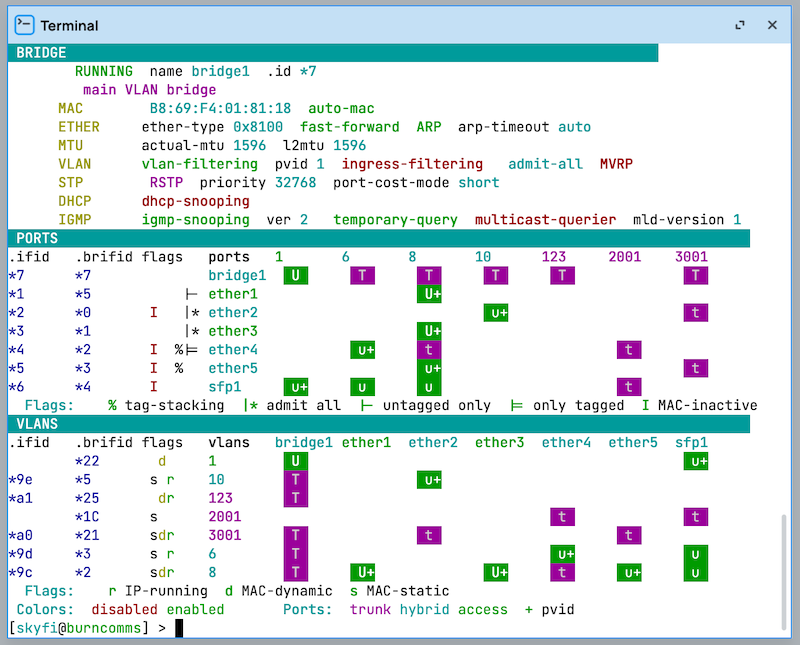
Like a color-blind test… can you spot the different settings in white vs dark mode?
Anyway, if anyone has thought at what should be included (or not included here), LMK. Or, have other ideas on how to visualize bridging “mysteries”.