/32 Point to Point links are useful to reduce the consumption of IP addresses (a lot) for direct links between routers. Specially when using the same IP address for all interfaces of the same router. (concept similar to unnumbered IP address). Another advantage is simplification of the configurations and routing tables.
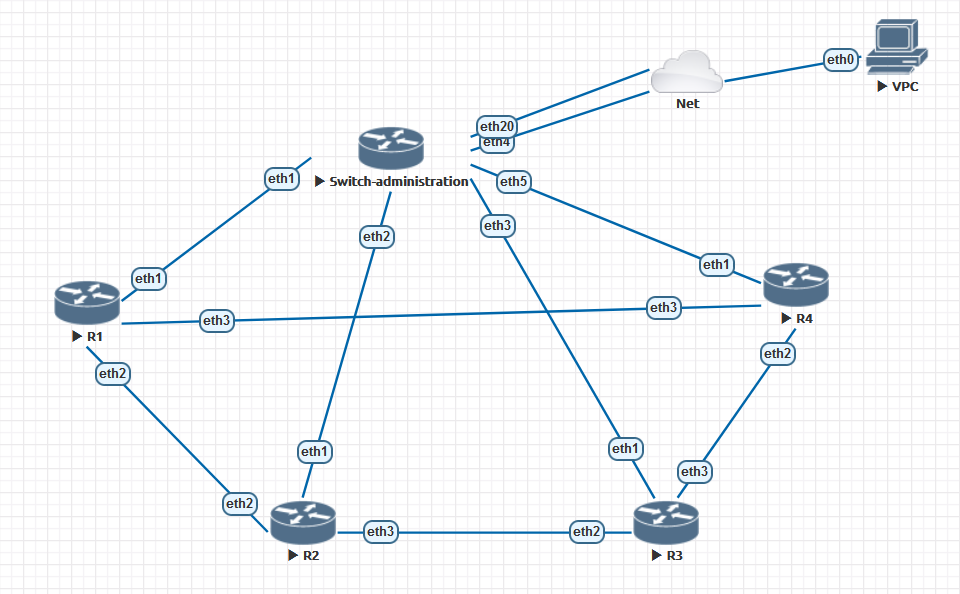
So i started to test this with Router OS 7.2 rc1 using a set of four routers, connected through /32 point to point direct links, All interfaces of the same router have been given the same /32 IP address, using the /32 address of the remote endpoint interface as network address for each link. This is a setup known to work on Mikrotik. It is even more efficient than /31 links.
Then i did find connection failures between routers when only one interface was disabled or one cable disconnected. Should not be the case because i did use redundant links. The routing protocol (OSPF) should have managed to restore full connectivity after a single link failure, after a few seconds.
I did watch the OSPF routes propagation after disabling an interface, or removing a cable, and did find that all worked flawlessly for all routers (using OSPF in ptp mode).
Then i did investigate a bit more and did find that the problem did not come from the router protocol (OSPF) but from /32 point to point interfaces that were not disabled when the remote side was disconnected or disabled.
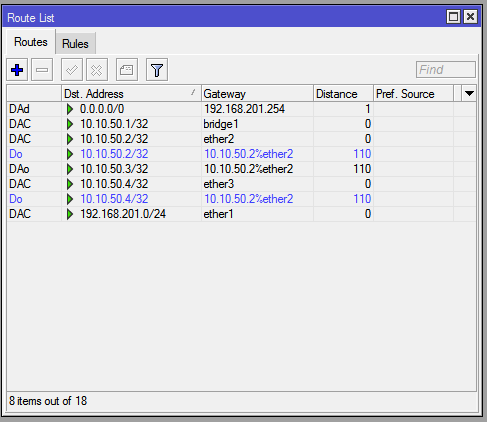
Not only the interface did stay up, but more importantly the dynamic connected route to the remote ptp side was still in active state.
The problem did come from here : the connected routes have priority over OSPF routes. If a connected route of a ptp link stay active when a cable is disconnected or when the remote interface is down, then the router does not try the OSPF proposed alternative route because this later one has less priority over the connected route. So the router still try to send traffic through the broken link. Result is connection lost to the router at the end of the broken ptp link.
As a side note, the solution to add a static /32 route with gateway check detection for the remote ptp address (by ARP or Ping) does not work, because the connected route has the same mask. The static route is not more specific and cannot be used for that.
A solution (tested working) is to use a bonding interface, put the Ethernet interface inside, put the /32 address on it, and use active backup mode with arp link monitoring detection, using the IP address of the remote ptp interface.for ARP link state detection. Like this the bonding interface comes down when the link is broken, the dynamic connected route disappear, and OSPF routes can take priority.
Perhaps another workaround (not tested) would be to use a routing filter to modify the metrics of the connected routes (i’m not sure that will work).
But using those workarounds is not a clean way. I feel that something should be done in Router OS 7 to remove the dynamic connected route of a Point to Point link when the link is down. Perhaps using BFD ?
This seems mandatory for a working setup using /32 point to point links between routers and unnumbered style addressing.