I'm afraid it's USB 2...
Do all these chips support WiFi 6e? That means 6GHz support. But I don't see any information about 6GHz support in the hAP ax S specs.
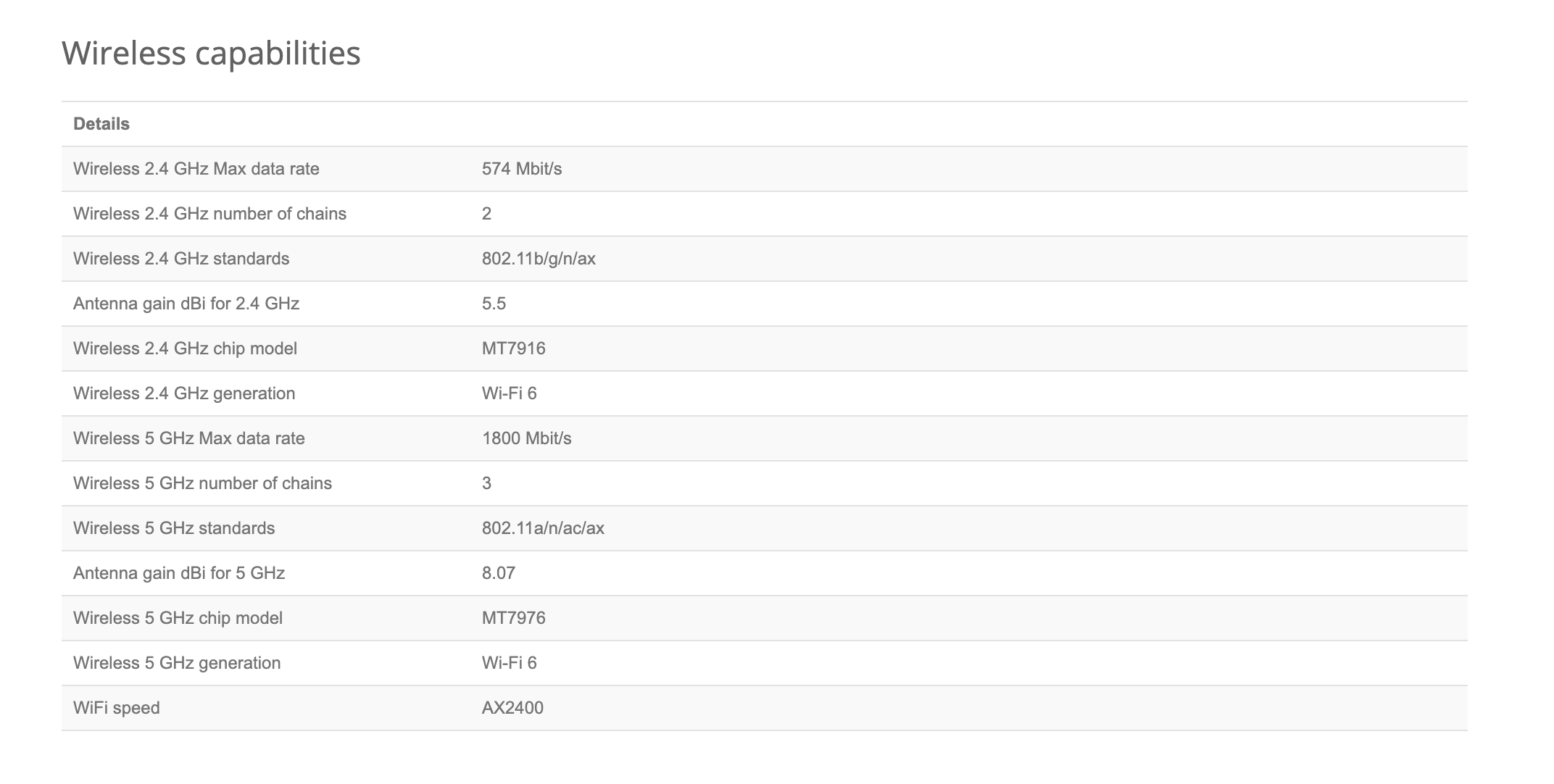
Well that WiFi chips data are from open source site, maybe there are other unmentioned versions or there are software limitations on that
I think it's more the underlying RouterOS does not support Wi-Fi 6E. And, unless it really was just an AP (no routing/NAT/VPNs), I think hAP ax S CPU might not keep up with 6E based on Test Results page.
That would be a great Christmas gift.
@victorbayas wAP ax supports 160MHz.
coming from a private house with a RB3011 backend router (VLAN, FW, Container,...) and a few hAP ac via LAN (Wifi 4/5 AC1750, 3x3 chains, gain 2.5/2)… my thoughts:
| Criteria | hAP be³ | hAP ax² | wAP ax | hAP ax S | Comment |
|---|---|---|---|---|---|
| ARM | 64Bit | 64Bit | ? | 32Bit | relevant for some ROS 7 - functionality |
| RAM | 2GB | 1GB | 256MB | 512MB | all good for an AP |
| Storage | 512MB | 128MB | 128MB | 128MB | all good for an AP |
| Ports | 5 | 5 | 2 | 5 | depends on use cases |
| 2,5G | 5 | - | - | SFP | 1GB may limiting WiFi 6/7 |
| Antenna Gain | 4/7,5/8 | 4/4.5 | 6.9/7 | 5.5/8.1 | see below for answer (thankx @Ca6ko) |
| Wifi 6 | AX1800 | AX1800 | AX3000 | AX2400 | Relevant for an AP! |
| 2.4GHz | 600 | 600 | 600 | 600 | Mbit/s: all good (max would be 1200 with HE160) |
| 5GHz | 1200 | 1200 | 2400 | 1800 | Mbit/s: more is better! (max would be 4800 with 4x4) |
| 6GHz | 6000 | - | - | - | Mbit/s: WiFi 7 only |
| Chains | 2/2/2 | 2/2/- | 2/2/- | 2/3/- | More is better? |
- Question: How to read the Antenna gain for a usual private home with 1 AP per floor? the current hAP ac has 2.5/2 only... but worked for us (acceptable, but not good). What means e.g. a gain of 4 compared to 2 now? doubled speed at the same distance? --> see below... thankx @Ca6ko )
- AX2 (AX1800) is just a bit faster than my current hAP ac (AC1750) = no Progress = no good choice?
- Is hAP ax S (AX2400) a Progress? is it something you feel with Laptop and Smartphone comapred to AC1750)?
- or is wAP ax the better choice with AX3000 - even for indoor use? But 2 ports only (I Need more) and AX3000 limited with 1GB LAN = AX3000 is more theortical, isn't it?
Conclusion (for an AP in NOV 2025):
- compared to current hAP ac
- no Progress (hAP ax2)
- or limited port count and port speed (wAP ax)
- or just a slight speed progress (hAP ax S).
- Does THIS worth the money ~80€? Looks like to wait for the next device? Is there anything known at the horizon beyond the new hAP ax S?
Conclusion (APR 2026): Yes, the hAP be³ could be better in 5GHz (AX2400 or AX3000) but anyway: Hell, I want some of these hAP be³ in my SOHO 
The antenna gain should be mostly irrelevant as what is limited (by regulation) is the output (radio) power (EIRP).
This depends on the channel, it can be (ETSI) 20dBm (100mw) up to 30dBm (1000mw), but devices with fixed (internal) antennas such as those you mention) won't allow you to change the antenna gain and the sum of the fixed antenna gain + transmit power = allowed max power will be fixed limiting automatically the transmit power to not exceed regulations.
In theory, it should be better to have relatively low antenna gain as it means a fatter toroid (for omnidirectional antennas), see this picture:
and the actual speed depends on both the AP and the device that connects to it, and a very high antenna gain might be counterproductive, as it will also get more interferences.
The Wap Ax antennas are more directional, so they are not directly comparable.
I have one in my hand, and it has 160MHz channel 
If only the published specs matched... Not the first time MikroTik has gotten specs wrong.
In my opinion, if you only have devices available on 5GHz, you shouldn't use 160MHz channels. Currently (in the EU), 5GHz only accommodates two non-overlapping 160MHz channels. For a multi-site Wi-Fi network, you need at least three non-overlapping channels to spread nodes out without collisions.
Block diagram for new hAP AX S dont promises.. SFP and Ether1 uses the same topology as AX s. It goes directly to CPU instead to switch.

It’s SoC, so nothing new - instead it has to be something like RB5009 with switch chip
antenna directivity coefficient
This characterizes how much more the antenna radiates in one direction compared to another. As a rule of thumb, for an antenna to radiate 8 dB in one direction, it must attenuate by 16 dB in the other direction, so for access points, the lower the antenna gain, the better, in my personal opinion.
In this device, the entire lower part is occupied by a solid radiator, which means that Wi-Fi does not radiate in that direction.
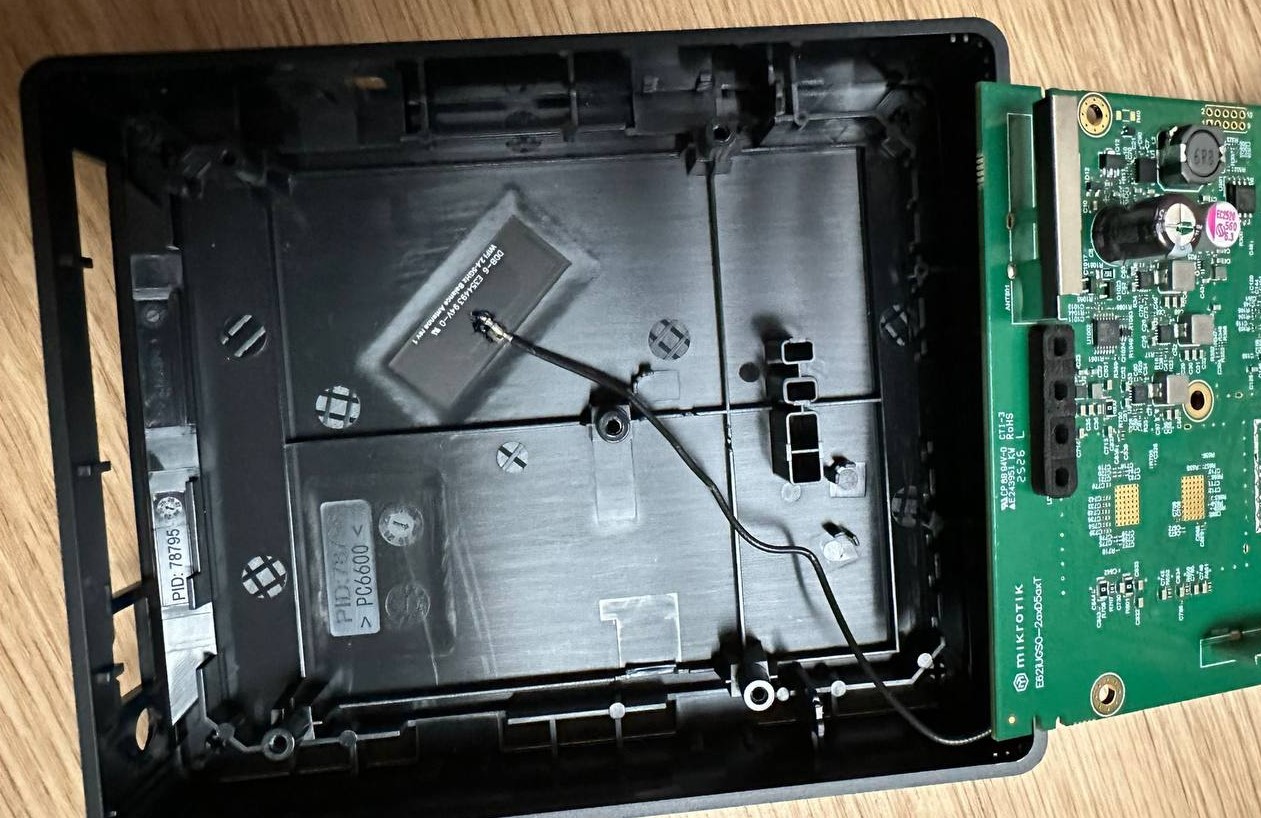

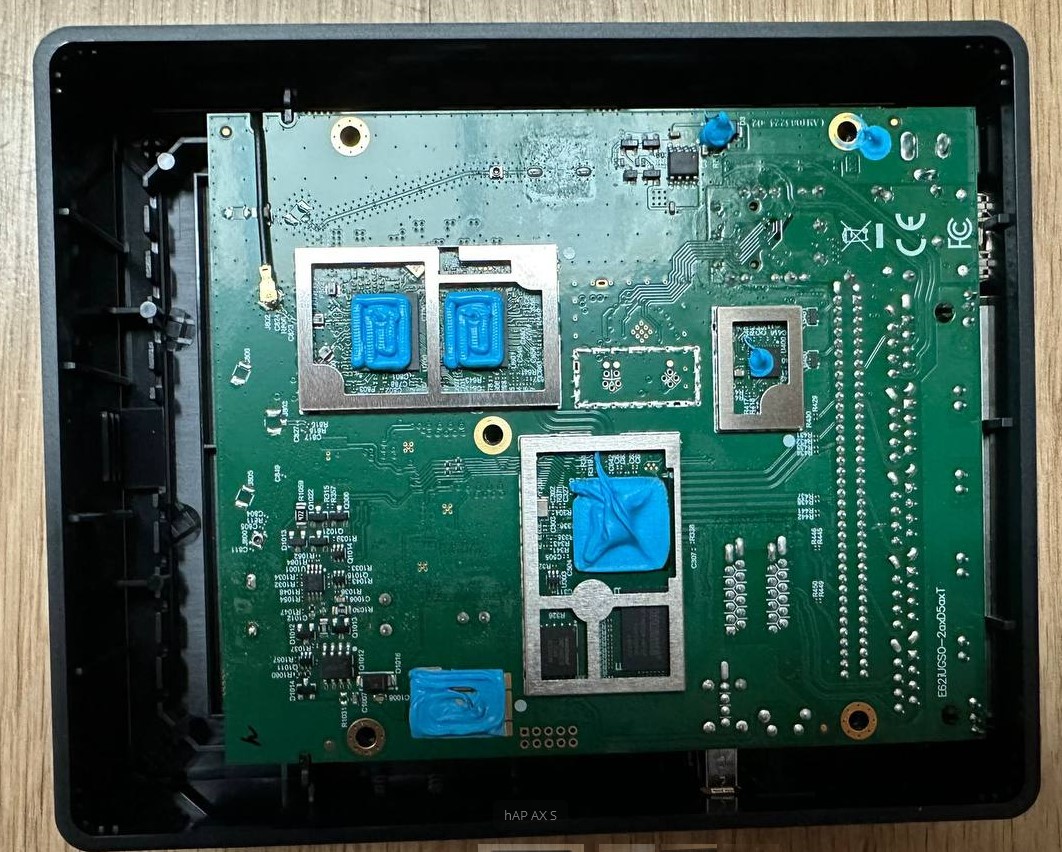
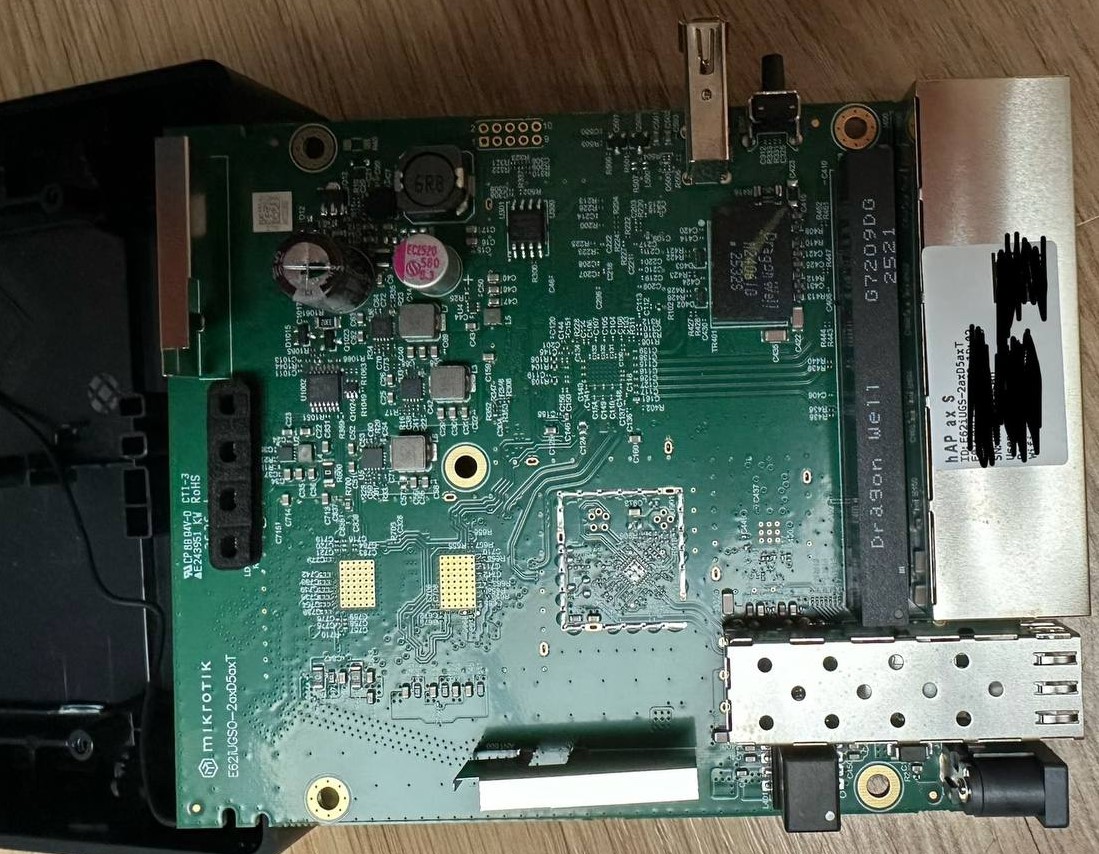
Can anyone perform a speed test, preferably using a locally deployed OpenSpeedTest or something similar?
I am receiving information that the CPU is too weak. The device stops at around 650Mbps when using 5GHz with an 80MHz channel width, reaching 100% CPU usage.
Actual references ?