Hello,
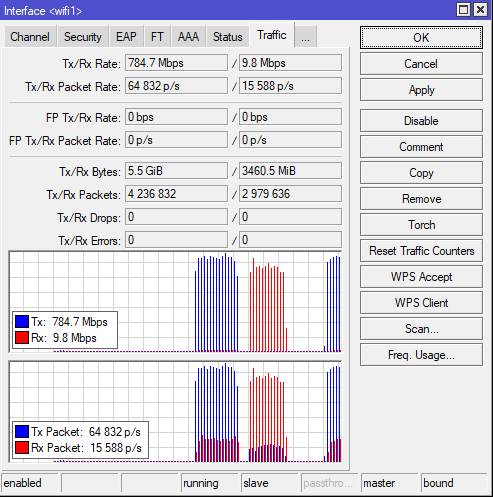
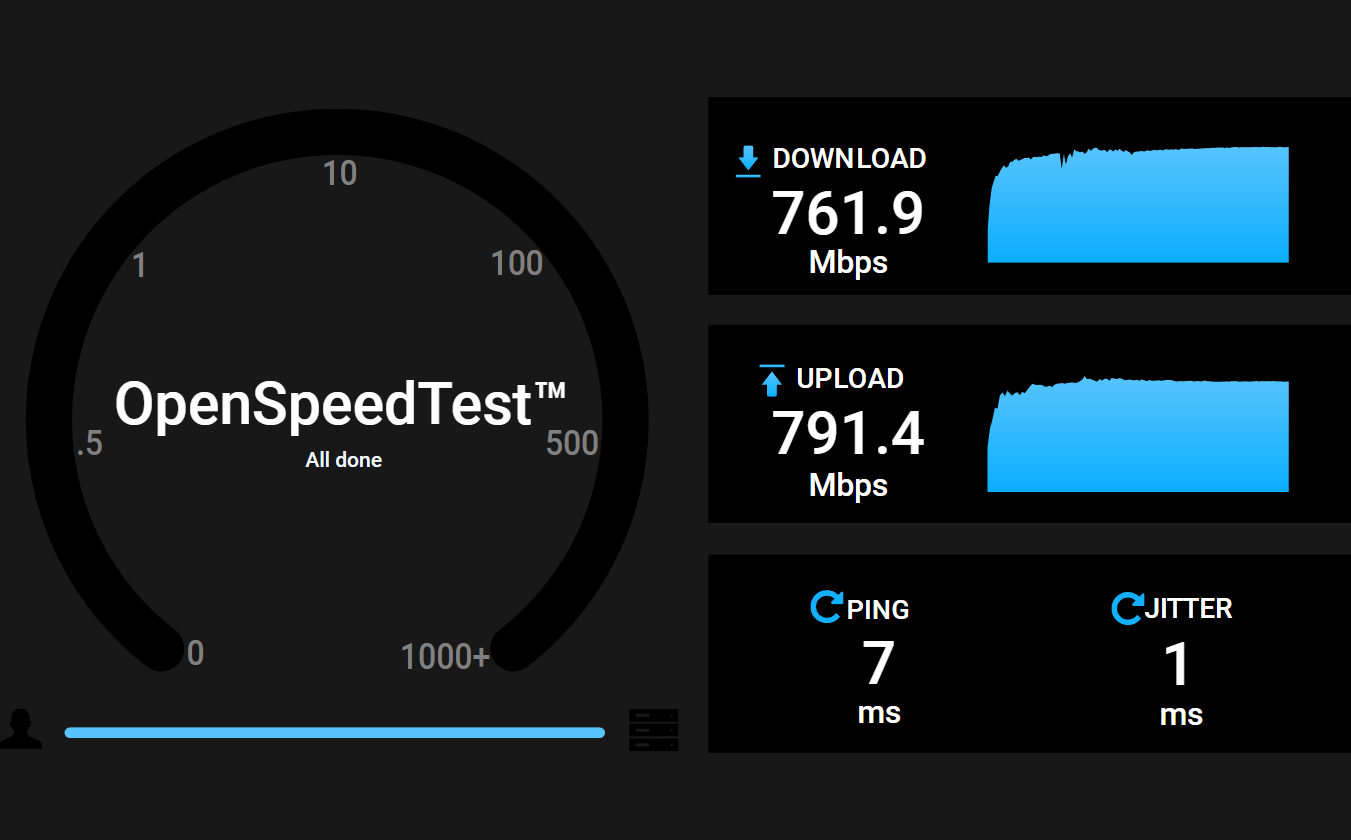
I just got my hAP ax², and finally Mikrotik has a fast WiFi!
Still no 160MHz, but it is a good start! specially on a device with modest specs like the hAP ax², in some cases I’ve noted that 80MHz can be faster in a crowded.
Hello,
I just got my hAP ax², and finally Mikrotik has a fast WiFi!
Still no 160MHz, but it is a good start! specially on a device with modest specs like the hAP ax², in some cases I’ve noted that 80MHz can be faster in a crowded.
Hi,
where did you buy him? 
Could you do more test? Some comparism vs hAP AC2 or AC3 procesor usage with cake, etc.?
I saw it on stock yesterday in a local distributor, did not thinked twice… they are all gone…
I dont have it setup as a router at the moment, just as an AP.
Edit:
I’ve done a quick and dirty setup with cake (I don’t use it everyday) set to 600M, did end up with just 230Mbps with one of the 4 cores at 100%
from which country are you?
Poland
what Wi-Fi client device are you using for that tests??
I’ve made the tests with a Windows PC with Intel AX200 WiFi card, I also have tested with my phone, Galaxy S21
Does current wifiwave2 driver support ATF (airtime fairness)?
Is WiFi1 the 2.4 radio?
in hap ax2 wifi1 is 5ghz and wifi2 is 2ghz
in hap ax3 wifi1 is 2ghz and wifi2 is 5ghz
dont ask me why 
I was gonna be real surprised at a speedtest like that in 2.4Ghz.
Also i think Mikrotik did that once before on some other board.
Edit: Didn’t the wireless on the RB4011 have the 5 and 2.4 reversed for wan1 and wan2 compared to everything else?
I can confirm: single stream performance and above UBNT Wifi 6 LR
700-800 MBit/s are possible
Could you do more test vs UBNT Wifi 6 LR? speed, WiFi range? WiFi speed through the wall?
Why do you care about through a wall?
Are walls suddenly standards?
Everything from materials to thickness blows that away.
How is hap ax2 performance with wifi5 (ac wave2) clients?
Highest 802.11ax datarate per spatial stream at 80mhz is 600mbps
I get more than 600 mbps on hap ax2…
Yup. But hAP ax2 has two spatial streams and if client also supports more than one, the theoretical datarate doubles, hence 700-800 Mbps is possible in real life.
All this is great but are there any proofs that ODFMA and MU-MIMO really work?
As far as I know non of vendors make this dreams come true though this are the main changes of AX generation
AC have promised MU-MIMO but steal it’s only dreams
So what is the real difference between AC\AX without that?
OFDMA is the easier part and doesn’t bring much in case there are few concurrently active clients of same WiFi AP … and the big difference will be mostly slightly better RTT with lower delay jitter … the difference between OFDM and OFDMA is that the later can service multiple clients at the exactly same time, during same transmission period. Radio-wise both are the same (same modulation), it’s signal processing which is more complex for OFDMA. Not something unheard of though, OFDMA is part of LTE since very beginning almost 15 years ago.
The MU-MIMO is a harder nut. The essence of MU is beam-forming and the more professional systems offering it (later releases of 4G and 5G) feature antenna arrays, e.g. 8x8 antenna array. Without antenna arrays beamforming is not effective and thus MU-MIMO can not work. Such antenna arrays are not small either, a well designed 8x8 array for 5GHz (and up) will be something like 1m x 1m panel with individual X-pol elements spaced 2 lambda apart. And add additional space for weatherproof case. Not-so-decent (and effective) indoor designs might come with 0.5m x 0.5m wall or ceiling mount antenna array. Anything smaller will have mediocre results at best.
My guess is that full-scale MU-MIMO deployment will be in point-to-multipoint deployments where the hub location will feature (large) antenna array while clients will keep using traditional (MIMO 2x2) directional antennae.