Hello Friends! I am wondering if the following architecture is possible with RouterOS.
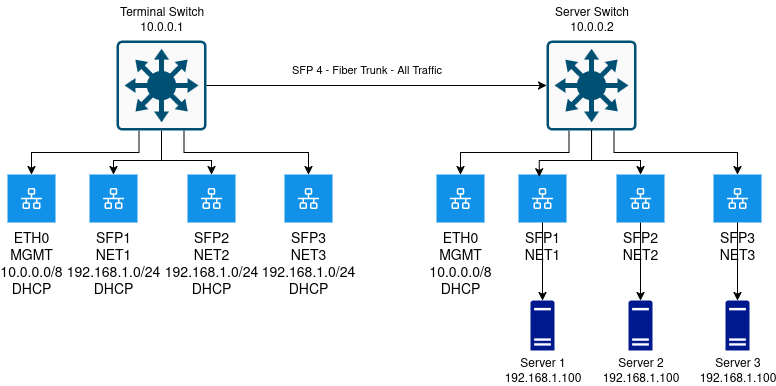
I purchased 2x CRS305 switches to use to interface with some specialized industrial equipment. The downside with this equipment is that every piece has a hard-coded and unchangeable static IP address.
The goal is to have 3 independent VLANS, that are all configured for a subnet of 192.168.1.0/24, and DHCP for the client device to connect to. The VLANs will use port assignments so that the end result is 3 independent networks with no cross-talk between them, and they are trunked over a single fiber line to the other switch.
In layman’s terms, an equipment operator would plug their human-machine interface into SFP1 on the terminal switch, get a DHCP address, and be able to contact the server on SFP1 on the other side, and only that server.
My question is: how would I set up DHCP for the clients on the terminal switch? Would I set up 1 server and a relay for each VLAN? Or should I set up multiple DHCP servers? Technically, they could all pull from the same pool, since the IP distributed only needs to be routable on the subnet. (in other words, I don’t care if the human machine interface plugged in to SFP1 gets 192.168.0.3 and the HMI plugged into SFP2 gets 192.168.0.4).
thanks @jaclaz@CGGXANNX and holvoetn (can’t tag more than 2 users!) , I guess I wasn’t hitting the right keywords in my searching to find these posts. I’ll read up on these and see if I can’t figure it out from there.
How many "human machine interfaces" are being used? If it is only a few, and they are only used for that specific purpose, you could just assign a unique static address in 192.168.1.0/24 to each "human machine interface" and then create 3 distinct vlans with no routing, with access ports for the "NET1", "NET2" and "NET3" vlans. This would essentially be like three long cables, one from each "specialized industrial equipment" server to a remote patch panel, with the ports labelled. Then you would connect the "human-machine interface" device into the patch panel port associated with the device you want to connect to at the other end.
It doesn't solve the stated requirements (that the ip addresses are obtained via dhcp), but it is a much "simpler" solution if the requirement for dhcp is not a "real requirement".

 .
.