I only need pure Line-Of-Sight solutions, and the Mikrotik product range already covers my needs
I’d like to see a Near-Line-Of-Site solution available (obstacles in the Fresnel zone)
I’d like to see a Non-Line-Of-Sight solution available (terrain and/or building fully obstructing the line of sight)
0voters
Are any of you looking for Point-to-Point Near- or Non-Line-Of-Sight products from Mikrotik? Or maybe you already managed to tweak the existing products to do so?
The usecase would be to connect 2 sites together (PTP) in non-ideal setups (no direct line-of-sight) without having to use public networks such as 4G/5G nor licenced RF bands.
ideal case, both endpoint can see each other directly, and the Fresnel zone is not obstructed): This is LoS (Line-Of-Sight).
both endpoints can see each other, but there is some objects in the Fresnel zone, which impacts RF transmission (even though both endpoints have visual contact)
both endpoints can’t see each other at all (forest, hill, building…). This is the worst case because the RF signal has to make use of reflections and/or travel through the obstacles, which is the worst case scenario (the higher the frequency, the more they are absorbed by virtually anything.
It all depends on the frequency you’re using. The higher the frequency, the more important it is to have a clear line of sight. LTE 800/900 works fine without for a long distance, higher bands somewhat shorter and 60Ghz PTP as well as 5G/NR FR2 (mmwave) needs a direct line of sight. Then it depends entirely on what is in the way between the endpoints..
Indeed. But on the other hand, the higher le frequency, the hither the throughput (Nyquist Law). This is where compromising in the hardware engineering comes in…
I’m not looking in the details of such solutions (yet), I was more thinking about an open discussion about if someone would need such products or not.
The usecase would be to connect 2 sites together (PTP) in non-ideal setups (no direct line-of-sight) without having to use public networks such as 4G/5G nor licenced RF bands.
It’s (almost) never a good idea to impose technical specs (e.g. Wifi or 60Ghz) when discussing user requirements.
So, to put it in terms of pure requirements, it would be something like:
“2 devices able to do NLOS PTP link using only license-free RF channels and not relying on public subscription such as 4G/5G contracts”
It’s impossible to have a meaningful discussion if you don’t clarify the purpose which can vary significantly when it comes to distance and speed. For low speed and long distance, there’s Lora-WAN at 433/868/915Mhz depending on location. Otherwise, there’s WiFi 2.4/5/6 Ghz and 60Ghz. That’s it.
802.11 (WiFi) => could be, but might be other options as well
Compromise with somewhat OK speed and somewhat bad visibility. => yes
Indeed that would be a good starting point for discussions I guess!
Larsa made a good point since the technology varies greatly depending on the scenario. Si let’s say a 2,5km NLOS link with at least 5Mbps throughput, just to have something to start with. But we could also discuss other needs, for instance high speed <500m links with full obstruction. Some people may have such usecases as well…
I absolutely agree, but unfortunately there are some situations where fiber links cannot be installed for various reasons, e.g. too far away from the public infrastructure, running through private or public property and so on.
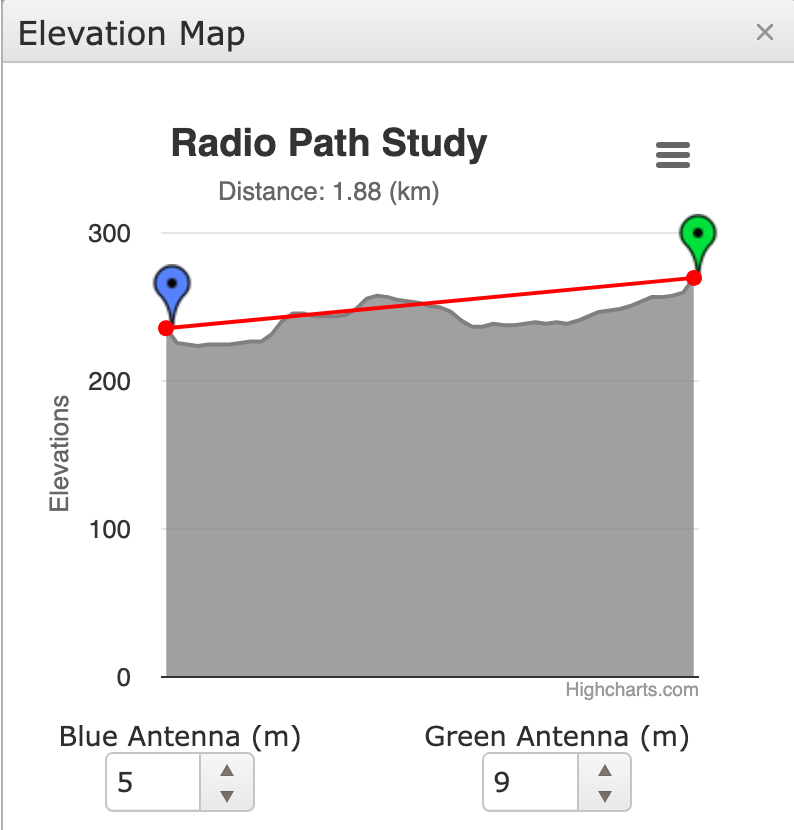
For instance, I have a site that had to be connected via LTE because FTTH-access would require us to pay 15+kEUR worth of roadworks in order to lay the fiber around a forest that is qualified as a protected eco zone. On the other hand, we have another site about 3km away, so a PTP link could be possible, but unfortunately there is no direct line-of-sight…
RF physics is tough to overcome, until we figure out how to harness quantum entanglement at economies of scale.
looking forward to it! I hope there will be some unlicensed quanta available!
For commercial operations to achieve a 3 km line of sight over treetops you will probably need at least two 100 foot (30m) lattice towers with foldable bases plus foundation casting and assembly which might be pretty expensive.
For private use there are much cheaper single-pipe masts with guy wire mounts for around 1000-1500 USD/EURO. You can get really good speeds with a 5Ghz directional antenna like the LHG XL 5 ac. Unfortunately Mikrotik doesn’t have an LHG “ax” version (yet?).
But the cheapest option IMO, if available, is probably to use 4G LTE/5G NR especially with the 800/900 MHz bands for better range. With 5G you can get really good speeds. But once again, Mikrotik doesn’t have a directional outdoor router for 5G (yet?).
EDIT:
There is a Mikrotik directional antenna called “LHG R” with a free miniPCI-e slot but I’m not aware of any existing miniPCI-e 5G modems that are compatible with RouterOS. Perhaps there are? IDK.. Alternatively, the Zyxel FWA710, D-Link DWP-1010 and Huawei 5G CPE WIN/CPE Pro 2 among several other brands are very capable and affordable outdoor 5G/NR devices powered with PoE.
I guess I could get a lattice tower for very little money, maybe even for free, but the main issue may be to get the approvals to install it.
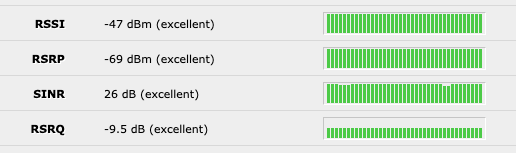
In the meantime, the current solution we have in place is the (now discontinued) LDF LTE6Kit installed on a professional offset dish and it works amazingly well as long as the WISP doesn’t have BGP peering issues, which happens quite regularly. Here are the signal details from the router:
I would hope that a PTP link to another site could be even more stable (no outages due to WISP peering) so we could cancel the mobile contract, or at least we could use both together for redundancy, which would be nice.
Here are the details for both locations. There is a bit of terrain in between, which is why I think wifi would not get through…
On the other hand, I still have hi-gain 120, 150 and 180cm satellite dishes available (the large ones have over 45dBi gain) that I could repurpose with Mikrotik LDF5 or LDF5ac routers in place of LNB’s…But it’s quite some time investment just for a test…not sure it’s worth it.
As others already wrote: you have an almost completely NLoS case (Fresnel zone heavily obstructed) in which case only low frequency wireless may do some good. With all of its drawbacks.
Or find some pretty good reflector(s) to bounce off your signal between the two points (in which case higher frequency would be preferable due to smaller Fresnel zone … you need reflector with size aproximately to the size of Fresnel zone at point of reflector to reflect as much energy as possible.
When you have an internet connection using whatever technology (LTE etc) but you need different functionality w.r.t. routing, fixed address, IPv6, etc you normally just setup a VPN to another location (L2TP/IPsec, wireguard) and handle everything yourself.
That’s what is already in place. The only part we have no control over is the public 4G network. That would be the point of setting up a PTP link we would control over. But as said it might be a lot of efforts for a very small benefit in addition to the huge data volume going over the 4G connection (several TB/month)
 looking forward to it! I hope there will be some unlicensed quanta available!