802.11bn DN1 was approved last year, and I see that several suppliers already have hardware supporting the new standard available, for example Broadcom’s BCM43109, BCM6718 and BCM43840/20 chips, with more release announcements from Qualcomm, Intel, MediaTek, and Marvell for this year.
The new standard focuses predominantly on reliability, and I am sure would be very helpful to network admins like myself, who deal with high-density environments.
Chinese consumer brand TP-Link successfully tested WiFi 8 in their Archer GE800 model a few months ago, and it seems the plan is to build hardware with the new chips initially supporting Wifi 7, and later adding support for WiFi 8 via firmware updated once the new standard is officially adopted (likely 2027).
That said, Mikrotik seems to have made a conscious decision to skip for WiFi 7 (be) and 6E (part of 802.11ax) in their hardware, so I wondering if there is a plan to go directly to offering bn hardware, and what the timelines for doing so might be?
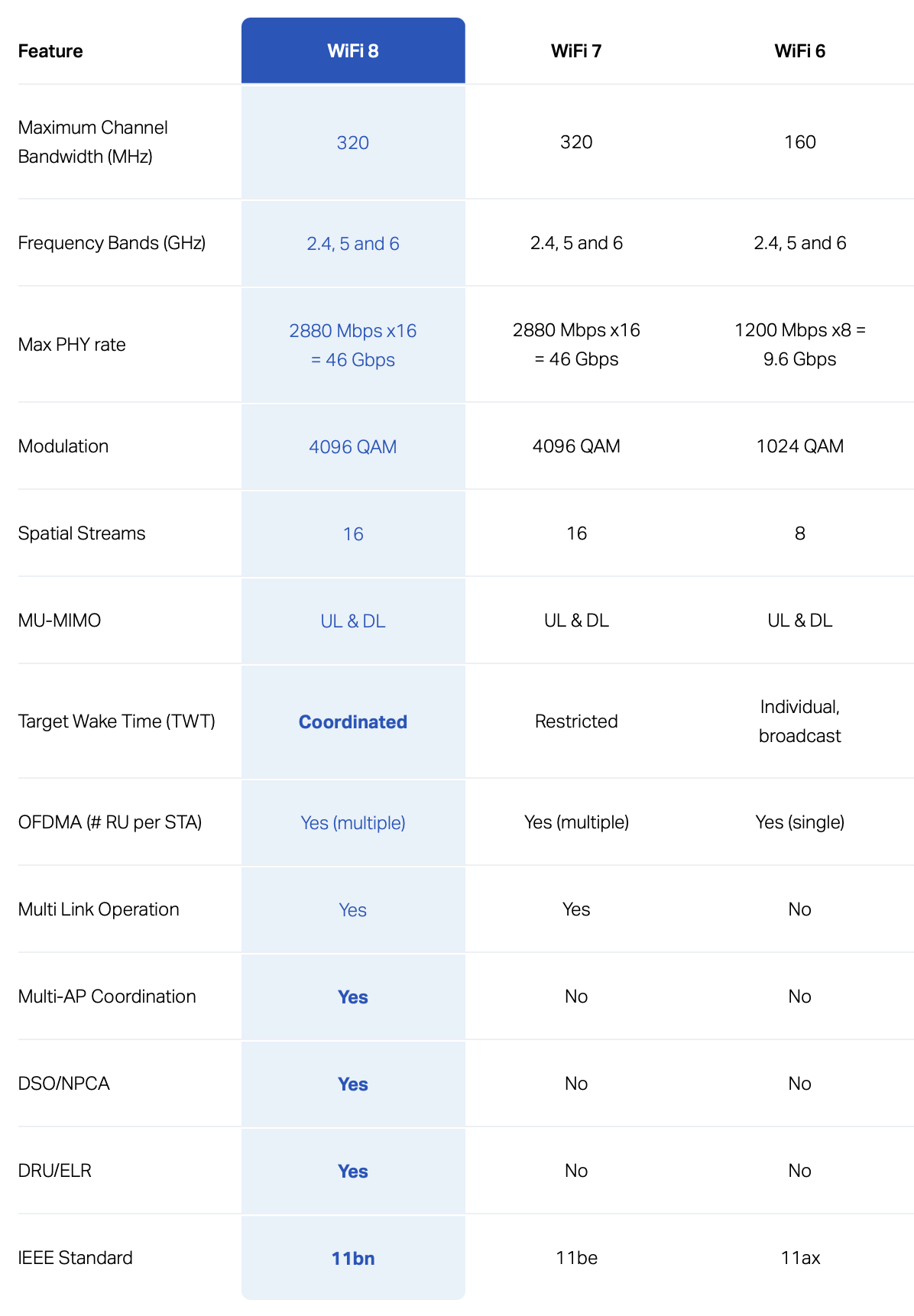
Here a handy little chart comparing the standards, including WiFi 6 (ax), which is the latest supported by Mikrotik:
Interesting - I had not!
I don't see any current FCC filings, so I assume the release of the hAP be3 is at least a year away (2027)?
Totally unrelated, I would personally much prefer a Zigbee 4.0 hub than Thread/Matter - I really don't buy into the idea that individual IOT devices should directly connect themselves to the Internet, and a Zigbee (or Z-Wave) set-up means you can build a home automation set-up that works entirely without Internet connectivity or a traditional IP-based network (which is exactly what Thread is).
To support my point, see this article, but that's a discussion for a different topic.
Fingers crossed - but where is the announcement?
It's not in the latest newsletter.
The YouTube video doesn't say anything about availability - it may just be a design concept.
Aha in there - thanks. Normis seems official, so there is hope.
Anyway, the hAP be3 is WiFi 7, this topic is asking about WiFi 8.
Details on WiFi 7, including more product details about the be3 (which I just discovered) are better discussed over here I think.
https://www.ieee802.org/11/email/stds-802-11-tgbn/msg03770.html - they started talks on standard expected in 2028.
IMHO so called "WiFi 8 products" are pure marketing as they only use WiFi8 capable chips obeying pre-draft standards. It is never ending chase.
Nowadays a lot of devices do eveen not comply with WiFi 6 WPA3 mode so why to complain about lack of WiFi8?
I'm not complaining, I simply wanted to start a post tracking developments for people to follow, similar to the above mentioned post regarding WiFi 7.
It sure seems like a never-ending chase.
It wasn't pointing you, my bad wording. It was about the rush. Zylions of devices still use pure "b" standard killing any more "smarter" configurations. Many do not go for more than WPA and so many complain that their IoT device, cleaning robots, fridges do not "cooperate" well. Marketing hype is made to persuade us that "the next standard/version/model/..." is needed.
WiFi 7 goals, accepted 2/3 years ago, promised the new better land:
WiFi 7 is the upcoming WiFi standard, also known as IEEE 802.11be Extremely High Throughput (EHT). It works across all three bands (2.4 GHz, 5 GHz, and 6 GHz) to fully utilize spectrum resources. While WiFi 6 was built in response to the growing number of devices in the world, WiFi 7's goal is to deliver astounding speeds for every device with greater efficiency. If you're struggling with constant buffering, lag, or congestion, a WiFi 7 router may be your best solution.
Buy and you will feel better. Almost noone will see the difference. WiFi spectrum in blocks of flats, rural environment is so crowded that 320Mhz bands for highest speeds would be chocked all the time killing any promised advantages.
No offense taken - I should have checked for updates on be before concluding Mikrotik will skip it.
I am hopeful that the adoption of bn will be a lot smoother than be.
Firstly, be happened during the pandemic, and certainly hardware suppliers (who also form part of the standards committee) were pushing back on adoption due to supply chain constraints and issues getting the new chip designs through, as well as hurdles with regulatory approvals relating to the bundling of frequency bands. be -> bn doesn't propose any such changes, so I don't think that is going to cause a slowdown this time around.
Secondly, a lot of the be -> bn changes are not hardware related, and careful design will allow at least a subset of be devices to support bn via firmware updates.
As mentioned above the improvements in stability in busy environments are of particular interest to me due to working in busy environments. Currently, this usually means deploying a comparatively large number of low-powered APs, relying on 802.11r Fast Roaming / Zero Handoff (mostly using Ubiquiti ac APs).
Being able to reduce the number of APs would be welcomed by the number crunchers.
It's obvious but just let MT's WiFi6 mature and WiFi7 grow up before we jump into the WiFi8 train
IMHO one of the biggest MT's problem is backward compatibility and support for devices that were built when dinosaurs had been ruling the world
"Some" rock the boat for the new standards to be incorporated but "the others" rock the same boat for the old trusted NV2 protocol that is incompatibile with contemporary chips and 3rd party drivers. "Ones" want new shiny devices, "others" want to save rock solid devices and prevent climbing on towers to install new devices.
If we accept the fact that some instalations have to be sacrificed, then it would let technology to evolve faster.
As I observe the market, users of other brands just accept the fact that they have to "replace their clothes" if they want to follow the "IT Haute couture". Something for something. It's hard to eat a donut and to have it fresh and yummy all the time.
What about asking the IEEE commitee to kill the "b" standard at all for WiFi8 times?
Same question could be applied to 10Mb networks? We cry for 10Gb/25GB/../400Gb/... speeds at home so what is the need for 10Mb standard?
In wired world we have a blessing of moving from RJ45 (copper) ports towards SFP+/SFP28/QSFP/QSFP28/whatever (optical/DAC/AOC) ports which "naturally" drops legacy compatibility (there are no 10Mbps or 100Mbps only devices with SFP+ or newer ports).
Sadly the "layer 0" for wireless remains to be "free air". So we can only hope to see some new standard (WiFi 8?) to completely drop support for 2.4GHz band (which will naturally drop support for b/g). But we'll still drag on support for a ... which is better than b (DSSS) but anyway ...
I agree it would be easier not having to maintain backward compatibility for such a long time.
In the office environments, everything is ac or newer at this pont.
At home, I still have a device that is n, and a few that support 2.4GHz only.
I don't think I've ever seen 10Mbit/s Ethernet in the wild, probably too young to for that
Probably ... it was a thing in 90ies, around year 2000 100Mbps was already de-facto standard.
But: most if not all 1Gbps NICs (and some 10Gbps ones as well) still support it. And when device goes to sleep mode, it switches down to lowest supported speed (by both ends, so it depends on switch as well) because it's the lowest power state. Which means you can still see switch ports running at 10Mbps ...