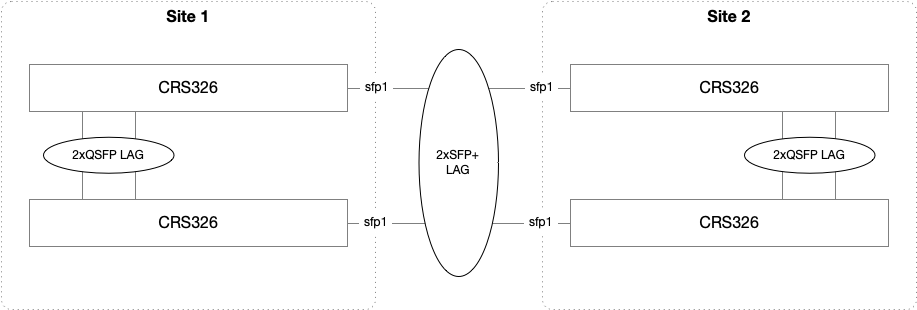
I’m in the process of designing for a stretch cluster across two sites with two independent fibre links between the sites and trying to figure out the implementation details required for the MLAG configuration. This is easy with stackable switches on each site as there’s just the one LAG to create, but here I think I need to create multiple ones. It’s a closed storage network so the LAGs can pass all VLANs so that I don’t need to touch them if I add VLANs to the other ports later on.
One of the things I’m fuzzy on is whether the peer-port configuration actually passes traffic or whether it’s just for state coordination. I.E. Do I need to use sfp2 for the peer-ports in addition to the existing interswitch LAG or can I consol
The servers are ESXi so I’ll be using the built-in load balancing and anything else I’ll just use active/passive aggregates so I won’t need to do any LACP/LAGs between the two switches on a given site.
L2 solution - The 2x fiber “LAG” link between the sites, you need “stackable” switches for that (one control-plane - multiple physical device ).
Mikrotik doesn’t have such product.
The documentation is just a little light on ancillary details like are the peer-ports also behaving as traffic ports? Is this just an additional role I add to my existing inter-switch link? Is VLAN filtering a hard requirement?
As your picture, this topology needs “stackable” switch to doing “redundancy” - this is not MLAG setup, just LAG in point of the switches.
If you have 4x fiber link between the sites, then you can do MLAG with your CRS326 swicthes,
this case no need “stacked swicthes”, because each switch has link to the another switch.
You misunderstand what is difference between the “MLAG” vs “stacked switch LAG”.
I am doing a config to hyperconvergence using servers Lenovo+nutanix and MK 312 10G cooper cables for high avaiability.. i would like two MK312, so i need to runn MLAG config to use one port in switch 1, and another server port in switch 2.
Question, i did this config in MK only in RouterOS, is there funcionality in SwOS