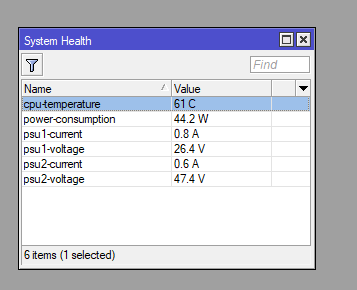
Netpower 16P Max Accepted Temprature Can Work Easly Like 60-70 or 75+ Concern
Can Anyone tell what is good temprature to run netpower16P, Min or MAX
Netpower 16P Max Accepted Temprature Can Work Easly Like 60-70 or 75+ Concern
Can Anyone tell what is good temprature to run netpower16P, Min or MAX
According to product page:
If the unit is mounted according to specifications (so that air flow is adequate and in right direction), then it should survive specified temperatures. Consider that direct sunshine is not accounted for in this temperature range.
But for longevity, I'd say operating it around middle of specced temperature range would be best (that's around 15°C). Any extreme can considerably shorten device's life, particularly affecting capacitors.
mine is arround in sun light max 60 or in night 47* after good airflow past without airflow 70+
Ambient temperature (from environmental specifications) will, obviously, always be lower than CPU temperature (or equal if device is powered off ... but in that case it'll be somehow harder to read CPU temperature). The idea of environment temperature range is that temperature of all internal components will fall into their respective temperature range at all times. The lower range usually means lowest temperature at which device can normally start up (from being powered off for prolonged periods of time) and upper range usually means highest environment temperature at which even if device is running at full power (and thus is producing maximum amount of heat), temperature of all internal components will still be lower than their respective maximum operating temperatures.
The complication is that by "environment temperature" producers mean "temperature of device case, including heat emitting surfaces, when device doesn't produce heat". And that, in turn, excludes any external radiating sources of heat, including (direct) sunlight ... because those heat surfaces of device (case, heat sink, etc.) and thus cause rise of internal temperature.
Now, CPU temperature, shown while device is running, is "intimate" temperature of CPU ... most often temperature sensor is built-in on (or close to) CPU's die which means shown temperature will be pretty much higher than environment ... and CPU's own temperature maximums are usually pretty high, somewhere between 90°C and 105°C. There's temperature step on contact between CPU case and cooling body (e.g. heat pipe pad or heat sink) and another (usually much bigger) temperature step between main body of heat sink and cooling air. There are additional temperature changes (usually gradual rather than steps), e.g. temperature difference along heat pipe between CPU "cap" and heat sink or between actual environmental temperature and temperature inside device (in case heat sink is internal) due to non-infinite ventilation of device.
The temperature gradients and steps have to be considered by device manufacturer (or rather: designer) when specifying environmental ranges. Meaning that specified max environmenral temperature of 70°C doesn't make CPU temperature higher than that "dangerous". Seeing CPU temperature rise without corresponding change in environment (either rise of temperature or direct sunlight episode) can indicate problems with cooling (e.g. degradation of thermal paste, heat sink disconnection, cooling fan failure if active cooling is used, etc.), so monitoring CPU temperature does make sense ... it's just that absolute values are not as important as unexplained changes.