You are right, v7 and v6 tests can’t be compared. We will update hEX and a few others. L009 is certainly not slower.
Yes, like you say, we already have RB4011 and RB5009. This is at the other end of the line up (the LOW COST model in similar form factor).
Thanks Normis, it would be very helpful to state which version was used for testing so we can compare and pick the right one.
except this isn’t that… it’s more expensive than both the hAP AC2 and hAP AC3 which is what it really competes with in performance, but has half the wireless interfaces of those devices. If it was dual band then the price premium would be fully justified for the AX and additional ethernet ports. Make a dual band version, even if you need to charge another $10-15 for it, and most of the critics will be silent.
@normis didn’t claim it was trying to compete with the “consumer” line. I am sure the case on the L009 is much more expensive to make than the hap cases.
My take is these are aimed at lab situations, and for that use case, they may make sense. In an open desktop rack, the wifi could even work. And they do sell a version without any wifi.
The addition of a real serial console makes more sense in a lab than a home in the living room.
In a lab situation, performance usually isn’t the primary factor.
These would good for training/learning with real hardware, which is hard to learn with something like GNS3 or EVE-NG. In those simulated routers, cables are always good, and you don’t get the experience of following a cable through a spaghetti wiring job, things you need to learn because you will encounter them in the wild.
Serious ? Not all racks are nicely wired with cable ducts etc ?
:lol:
correct he didn’t, but the truth is they really do since the product case doesn’t dictate the use case as much as the price and the performance and the features do. I think there’s definitely a gap transitioning from the standard hAP “Consumer” routers and the 4011/5009 “Professional” routers. That gap I would call the “Business Class” or “SOHO” devices.
Lets say there’s a flower shop that has 2 computers, 2 wired IP security cameras, a wired network printer, and a wired credit card terminal by their POS terminal. That’s 6 wired connections, a very modest but also extremely common size of small business found commonly all over this country. None of hAP line is going to work without also buying a swtich, and we can all agree that a 4011 is definitely both overkill and over priced for what they need, and the 5009 is even more so. A L009 would fill that need very nicely, but now you’re also limiting them to not have 5GHz wifi. The device now becomes a compromise between the ports you need and the wifi you might need, when instead it could so easily be, and should be, the obvious and easy choice that provides exactly what you need…
Maybe I’m wrong, but I expect this use case is likely at least 20 times more common than those that are worried about squeezing 4 L009 routers into a 1U rack space, and anyone who is putting 4 of them in a 1U rack probably isn’t even buying the wireless version, so I really just don’t get what the real world use case is for the wireless version without it being dual band. For what it’s worth, this was also the market segment that Netgear once built their ‘empire’ on with their Prosafe products, a step above regular consumer but a step below actual commercial focused hardware, focused on the “SOHO” market (but don’t ask me what happened to them since then as I haven’t touched their products in more than a decade)
I agree with you.
Hopefully MikroTik had a good reason for making this config. @normis said that the RB2011 was still a best seller, so there are still places that cost is a primary factor. Victors said that 100 Mb is still a good seller in some areas too.
If the base is really solid Aluminum, the router should do well in high ambient temperature areas, especially since the processor is low power. Probably the switch ASIC generates more heat than the CPU.
But I will be surprised if the L009 maintains its popularity for eleven years like the RB2011 has.
Yes, we are in Latvia, where you get either 1Gbit fiber or 5G with over 100Mbit basically anywhere except the forests. We often forget, that not all of the world is the same. This is why when we look at top sellers, there are mostly 100Mbit devices and low cost devices. This forum is for professionals, enthusiasts. I also love dual band AX and newest tech, but at the end of the day, most of the people outside the forum still happily use 2GHz and their primary concerns are cost/size/familiar form factor etc.
The issue is not only “internet speed”. When I do a scan on an indoor router here, I see about 100 APs on 2 GHz (and I only have 1-6-11 in my scanlist so there probably are more), and only 15 on 5 GHz. Almost any ISP provides a dual-band router these days, but of course the shielding is a lot more on 5 GHz so the range is less and there are less competing APs in range. So having 5 GHz is really necessary when you want to achieve some throughput. 2 GHz still required for IoT, so only-5 does not cut it either.
Also, several years ago we have argued about supporting VDSL on MikroTik routers (via an SFP) and it never happened, apparently “because everyone has fiber or will soon have it”.
Well, I STILL am on a VDSL line! In the meantime it has been upgraded to VVDSL2 profile 35b with 180/30 Mbps, but still VDSL and no fiber available here.
For many years we have been told “it will be deployed soon, probably next year” but all the time there is some reason to postpone it (you can probably guess the reasons used the past 3 years).
And this is in the Netherlands, a densely populated country in western Europe, not in some poor country in the middle of nowhere. I think in Germany it is largely the same.
So indeed, the world is different from what you see locally.
I see maybe 3 other APs in my apartment. It does depend on the country, on where you are (private homes will see even less interference, compared to small apartments in densely packed buildings).
(We had DSL in previous generation of population  I remember DSL 20 years ago, but younger people have no idea what it is)
Fiber is a commercial operation here. The places where it was deployed early were subsidized or at least guaranteed by some authority like a municipality or a housing agency.
In most places, there is a cold calculation of “what will it cost to deploy it, how many customers will we get, and what will they bring in”. I know in some other countries the state has done such subsidizing (or at least a guarantee to the fiber company that they will recoup their costs), but here it does not happen.
In my quarters, years ago a petition was held where everyone who wanted to have fiber could sign up, and when some percentage of total households would sign up it would be deployed soon. But at that time there already was DSL and cable internet, and just like you indicate “This forum is for professionals, enthusiasts”, such petitions are set up by enthusiasts who think that everyone wants fiber internet. In reality, it is not true. Most people want (cheap) internet but they really cannot be bothered if it is over DSL or cable or fiber, as long as it sort of works. In fact, when they are offered another solution that is slightly more expensive than what they have, they are likely to reject it.
I have many individual apartment complex buildings that have 700-900+ different hAP AC Lite or AC2 routers installed in them, it’s one per apartment. The high-density residential market simply cannot operate without 5GHz support.
Here are two wireless scans just both from the same device a few minutes ago. This device is in a building that we have nearly 700 other devices, note that even though we have supply service to 75% of the tenants inside this building, the majority of the 2.4GHz APs you see are spectrum, because they turn up their xmit strength to the max, where we actually turn the radios DOWN as to reduce interference and noise.

On the otherhand, this same device scanned just moments later, can see only 3 other devices on 5GHz.
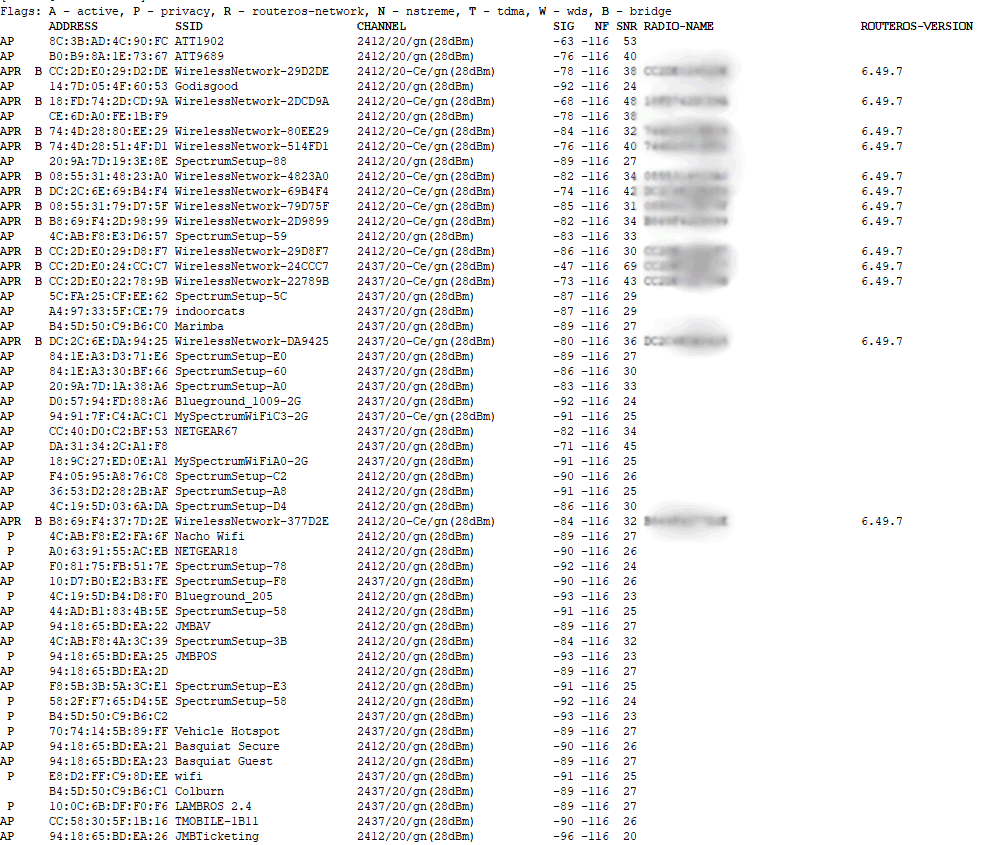
Hope someone is sending out the “40mbit intolerant bit”, with all those 40MHz wide channels (Ce) . 28dBm is indeed possible for FCC (US), not for ETSI (EU).
All together in channel 1 and 6 (40 mbit wide) , no one in channel 11 ?
How does one count/deal the weak (<-86dBm) signal? The noise floor is very low (-116dBm) so most still have a reasonable interface rate.
“noise-floor-threshold” disappeared from the possible wifi settings, but we still have “adaptive-noise-immunity” for some in WLAN driver
We all know the limitations of the 2.4GHz band. But all newly added IOT devces in my house all demand 2.4GHz.
Adding a 5GHz AP in the room with the client devices, is mostly the way to extend this overall wifi exerience.
PS: Air-time is the important limitation, not the number of devices. Turning down TX power may reduce the interface rate, and increase the consumed air-time.
MT does not broadcast it’s QBSS
Since we don’t have control where the devices are placed in the building by the property owner / manager other than “in the unit”, and devices are often swapped around and reassigned as people move in or out, the only real option is to leave frequency and extension channel selection in auto, though they certainly seems to prefer ch1. I do wish it would automatically adjust the channel selection every so often.
/interface wireless {
	set wlan1 mode=ap-bridge band=2ghz-g/n disabled=no wireless-protocol=802.11 distance=indoors installation=indoor
	set wlan1 frequency=auto scan-list=2412,2437,2762 country="united states3" rate-set=configured supported-rates-b="" basic-rates-b=""
	set wlan1 wmm-support=enabled
	set wlan1 channel-width=20/40mhz-XX
	set wlan1 antenna-gain=$antennagain2ghz
}
Well, when you use 40 MHz channel width you effectively have only one channel anyway, so it does not matter if it always uses channel 1…
IMHO the max width on 2 GHz is 20 MHz, which gives you 3 channels.
I am not sure sure how attractive this device will be when compared with hAP ax2 for example which is cheaper, has twice the CPU power and much faster ethernet switch and 5Ghz ax wifi, or hAP ax3 that is 4 times as fast and only slightly more expensive and you can always add a coupe of inexpensive switches if you need more Ethernet ports and have way faster network overall.
People used to buy RB2011UiAS-2HnD-IN because they are used to it and used to have same configs on all devices for years, and never because they needed RACK mount option (which 2011 doesn't have at all, not that 4 slow wifi routers in a RACK makes much sense to me anyways), and as for drop in replacement this device isn't because it only supports ROS 7 and WifiWave2 which are not drop in replaceable for people not upgrading their ROS which are most of 2011 users...
When I saw in the newsletter that this was single band, I knew that was what would attract the most comment in this thread 
5GHz does seem like an omission to me, but despite all the comment, I do wonder what practical difference it would make to the use of the product - it seems to me at this point that lack of 5G will cost more sales due to perception of an issue, than any actual issue.
RB2011 without WiFi does have a rack model, we use several of those. There even are different models with/without LCD and more RAM.
People did not “used to” buy RB2011. They buy it today. A lot. L009 is similar, but better. At the same price.