Number of CPU cores on CRS3xx

Hello,
after upgrade of some CRS’s to 7.1+ I see output like this:

/system/resource/print 
                   uptime: 4d3h38m12s
                  version: 7.1.1 (stable)
               build-time: Dec/21/2021 11:53:05
         factory-software: 6.38.2
              free-memory: 448.6MiB
             total-memory: 512.0MiB
                      cpu: ARMv7
                cpu-count: 2
                 cpu-load: 2%
           free-hdd-space: 2380.0KiB
          total-hdd-space: 16.0MiB
  write-sect-since-reboot: 3113
         write-sect-total: 904955
               bad-blocks: 0%
        architecture-name: arm
               board-name: CRS326-24G-2S+
                 platform: MikroTik

or this

/system/resource/print 
                   uptime: 1w4d23h2m43s
                  version: 7.1.1 (stable)
               build-time: Dec/21/2021 11:53:05
         factory-software: 6.41.3
              free-memory: 440.4MiB
             total-memory: 512.0MiB
                      cpu: ARMv7
                cpu-count: 2
                 cpu-load: 8%
           free-hdd-space: 1516.0KiB
          total-hdd-space: 16.0MiB
  write-sect-since-reboot: 38339
         write-sect-total: 992844
               bad-blocks: 0%
        architecture-name: arm
               board-name: CRS328-24P-4S+
                 platform: MikroTik

here I would like to point your attention to field “cpu-count” above. Is number “2” there false positive or actual number of cores?
As far as I remember, in RouterOS 6.x was only one core there and documentation also says that those devices should be single-core …

Have a nice day
Martin

This seems like a bug unless CRS326 switches have been moved to a newer CPU

https://mikrotik.com/product/crs326_24g_2s_in#fndtn-specifications

They are dual core. RoS 6 could only see one of them, so they were sold as single core - but RoS 7 can see (and use) both of them.

According to the following PDF, they are dual core. I am guessing the updated kernel in v7 allowed for the use of both cores vs the v6 kernel.

https://wifimag.ro/pdf/Prestera_98DX3336_pb.pdf

Excellent! Sound like Christmas gift from MikroTik :wink:
M.

That would be somewhat strange, though I wonder if other 3236 devices are affected - CRS305 and various CRS328 devices?

If I remember correctly, the CRS328-24P-4S+RM is dual core too. Don’t know about the others.

Why do you find it strange? Back when linux kernel 3.3 was condidered modern, it was still sensible to build a kernel with minimum supported feature set … e.g. support for single CPU (core), support for 4GB RAM (take away address space for hardware and one ends up supporting 2GB RAM), … Specially so if support for SMP on ARM was not really stable at that time …

Keep in mind that ROS v7 ships with linux kernel which is 10 years younger than in ROS v6 … for any architecture actively supported in stock linux kernel except for x86 and x64 that’s difference between modern and stone age.

It seems it is - see second output in first post

Strange, since there are already other dual core devices within the CRS3xx lineup. I have one (CRS309), and it was a dual core under ROS6 as well. Why would some be offered as dual cores and others as single core, if many were dual core to begin with? I won’t tend to the other CRS3xx devices that have a switch chip, then an ancient Qualcomm WiFi SoC running as the “CPU,” attached via a 1Gbps Ethernet port.

Those with dual core support were a different chipset 98dx82xx series vs 98dx3236.

My guess is that kernel support for the 98dx3236 was not complete with the old kernel in 6x

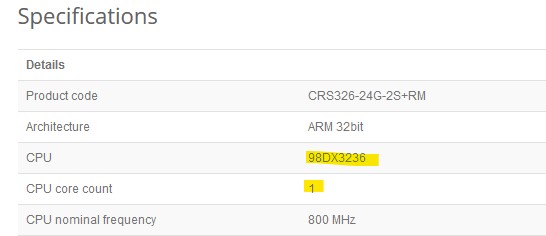
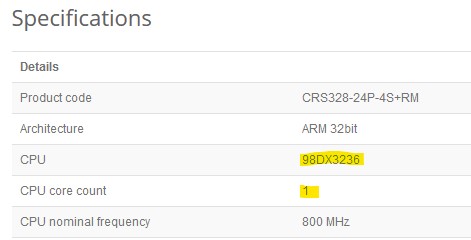
Interesting, same CPU (98DX3236) https://wifimag.ro/pdf/Prestera_98DX3336_pb.pdf
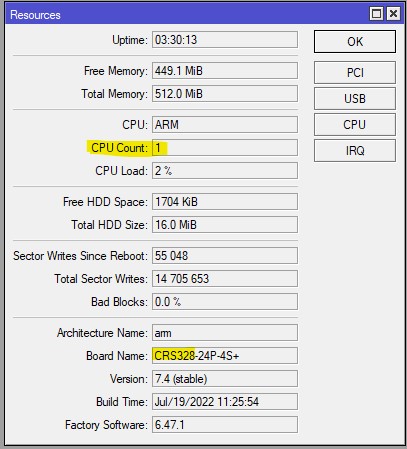
same ROS, different cores…

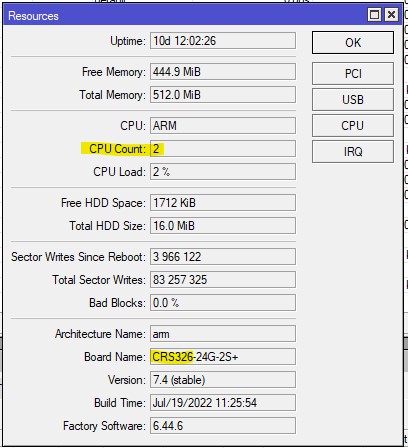
CRS326
326-2.jpg
326-1.jpg
CRS328
328-1.jpg
328-2.jpg

Running the CPU in 2-core mode caused SFP instability. (I saw it here.) They fixed it in 7.4: “disabled second CPU core for CRS328-24P-4S+ device in order to improve SFP+ link stability.”

MikroTik isn’t saying what the cause was, but the prevailing hypothesis in the relevant thread is that they’ve been buying 2-core processors that were binned as 1-core processors due to a manufacturing flaw. Enabling the broken second core caused the flaw to be hit, harming overall performance.

They now advertise a single core, regardless of whether the processor family has 2-core options, because that’s what RouterOS runs them as.

If you want to go back to the old versions of RouterOS that supported 2 cores, they’re still available, but watch out for that SFP+ instability! Starting from 7.1 and going to 7.3.1, you have 7 months of broken releases to pick from. Enjoy. :slight_smile:

http://forum.mikrotik.com/t/v7-4beta-testing-is-released/158543/1