Strictly speaking you can “set scope to 10 and forget” because in the background RouterOS silently increases the scope value of the route to become at least 1 more than the scope of the gateway IP Routing - RouterOS - MikroTik Documentation
So, if we want to be explicit, your example routes should be like this:
add dst-address=0.0.0.0/0 gateway=8.8.8.8 distance=1 scope=> 12 > target-scope=> 11 > check-gateway=ping comment=“Primary default route”
add dst-address=8.8.8.8/32 gateway=122.176.152.1 distance=1 scope=> 11 > target-scope=> 10 > comment=“Primary check IP via ether1”add dst-address=0.0.0.0/0 gateway=208.67.222.222 distance=2 scope=> 12 > target-scope=> 11 > check-gateway=ping comment=“Secondary default route”
add dst-address=208.67.222.222/32 gateway=192.168.100.1 distance=2 scope=> 11 > target-scope=> 10 > comment=“Secondary check IP via ether2”
The green target scope of 10 is enough because the routes for targets 192.168.100.1 and 122.176.152.1 are connected routes with default scope 10.
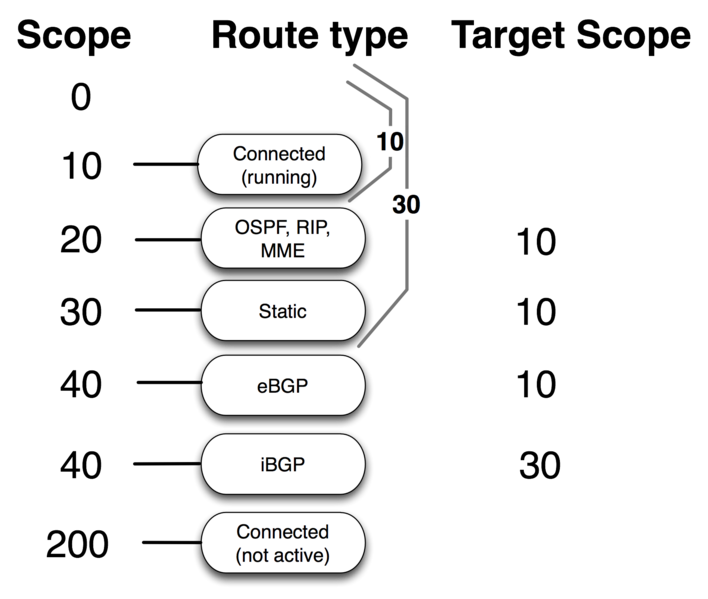
To be even more correct, we can give the two default routes, which are “static” routes, the default scope value 30:
add dst-address=0.0.0.0/0 gateway=8.8.8.8 distance=1 scope=> 30 > target-scope=> 11 > check-gateway=ping comment=“Primary default route”
add dst-address=8.8.8.8/32 gateway=122.176.152.1 distance=1 scope=> 11 > target-scope=> 10 > comment=“Primary check IP via ether1”add dst-address=0.0.0.0/0 gateway=208.67.222.222 distance=2 scope=> 30 > target-scope=> 11 > check-gateway=ping comment=“Secondary default route”
add dst-address=208.67.222.222/32 gateway=192.168.100.1 distance=2 scope=> 11 > target-scope=> 10 > comment=“Secondary check IP via ether2”