This unit is obviously intended to use in “habitable” places, such as offices and/or living rooms (the wireless model), both by its form factor and by its look. Possibility to mount it in 19" rack is a plan-B (which is also indicated by form factor - i.e. unit’s height which is much less than 1U). So it’s not intended for extreme places such as non-cooled racks or sun-lit closed enclosures on top of masts.
Likely nothing has changed in the actual capability but such specifications are made because of complaints about high internal temperature and/or short lifetimes of the caps.
Internal temperature of the router is not the same as ambient temperature! It usually is 10-20 degrees higher (depending on the cooling that model has).
I think lower cooling capacity is another segmentation factor separating it from CCR and RB1100AHx4. I don’t think this router is meant to run at continuous 100% load. It’s probably a bit “overprovisioned” cooling wise so that it performs well if load is not continuous or cooling is adequate but it doesn’t look like workhorse.
Also server rooms typically have external cooling solutions like AC.
Anybody else wondering why RB4011 CPU-throughput appears to be capped to 10Gbit/s?
Assuming both Realtek GbE switchgroups are connected at 2.5Gbit/s each to the CPU (like RB1100AHx4), this leaves only 5Gbit/s possible thoughput for the 10GbE SFP+ port!?
By ambient, I’m referring to “Temperature” on the models that distinguish between “Temperature” and “CPU Temperature”. Obviously CPU temperature is the highest, but I assume that temperature measures the internal non-CPU temperature (internal ambient). For CCR and other series with active fans, this is close to the actual ambient room temperature, but for passively cooled devices, the internal ambient temperature is often much higher than room temperature as the heat is not being actively removed.
The spec sheet is unclear as to which of these the maximum operating temperature refers to. If it’s anything other than room temperature I would be concerned.
Example CCR1009 (active cooling):

Example RB850 (passive cooling):

The spec sheet always refers to environment temperature the unit can work, not the ambient temperature measured inside the unit.
I wondered if maybe all ports are connected into giant switch like eg. in CRS switches and there’s 10G interconnect from switching complex to CPU
good question
i hope to see block diagram soon
Finally:
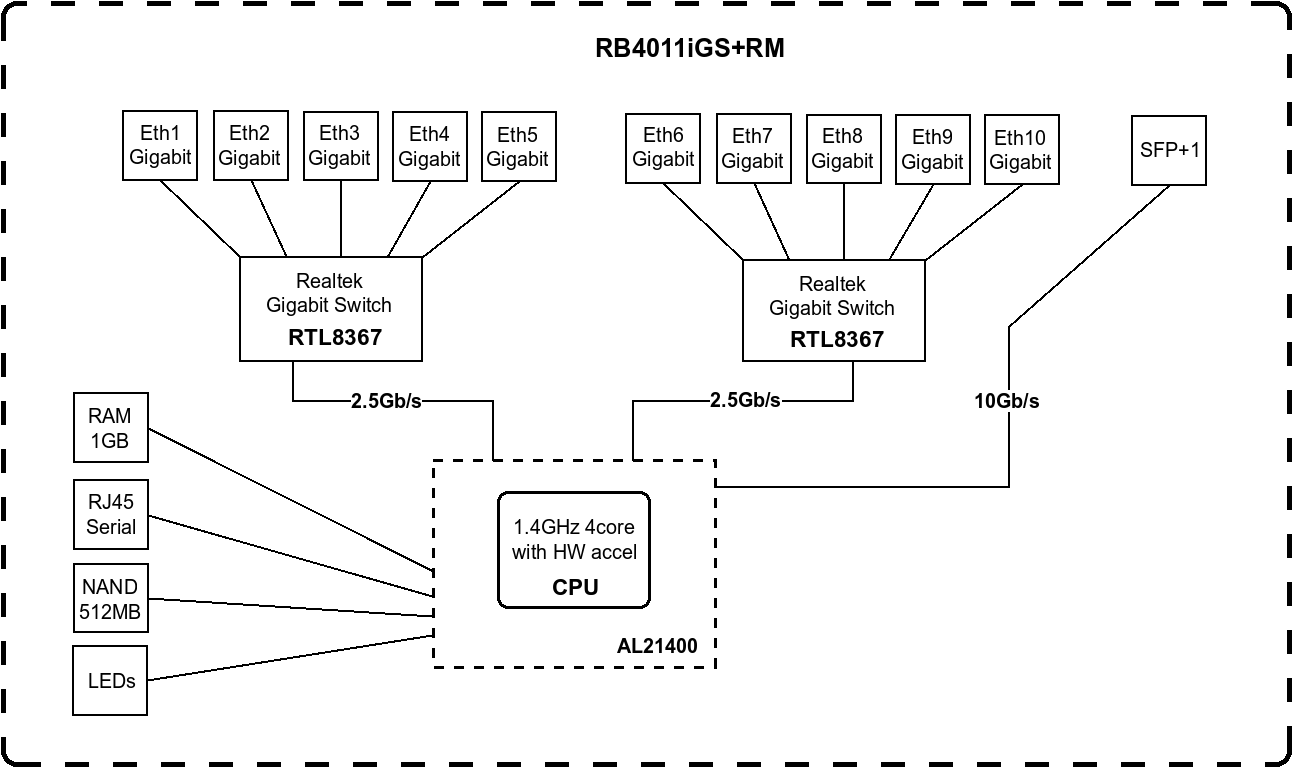
Looks like expected and will work fine for my intended use! Any info about when the router will be available for order?
That looks like beef, not gonna lie  I wonder where this 10G limit in charts comes from because it doesn’t really look like “natural” limit.
Regarding the lack of USB, as there are a miniPCI-slot for wifi. Russian site with pictures of the inside: https://weblance.com.ua/389-mikrotik-gotovit-platformu-rb4011-na-baze-processorov-alpine-zayavlena-podderzhka-dual-band-wi-fi-s-mimo-4x4.html
If Mikrotik could make a version of the R11e-LTE with integrated sim slot we could maybe use this as 4g backup.
Connect all wires and run max traffic - logical direction is from SFP to all ethernets and from all ethernets back - in each direction you can get 5gbps s0 10Gbps in total. That would be most typical use.
One can argue about “router on a stick” SFP+ setup to lift possible limit to 15Gbps total, but i think those will not be numbers anyone is looking for.
Why not? That 15Gbps is exactly the number I’d expected to see as achievable benchmark limit for this block diagram.
Could it be the cpu limiting the maximum throughput?
OK, just give me a real life application - combination of fastpath and “router on a stick”. As in real life average packet size will be closer to 512 than 1500, fastpath is only way to achieve 10Gbps+ speeds, but that requires no config, “router on a stick” requires at least some configuration, so the only thing i can imagine is to use this device as switch with trunk port, and for that CRS3xx will be much more better solution.
No, i don’t think so, looks like bench-marking setup limitation.
I’m using real world setup with router on the stick with fasttrack, full firewall and jumbo 9k on CCR1009 as inter-vlan router connected to CRS317 for servers and 2G LACP for users to CRS326. Though yes I’d argue if router on the stick is usable together with normal ports BUT you can easily imagine using 10G to some CRS317 and second 4G LACP “stick” to other switch eg. CRS326 for total 14G. It doesn’t really sound THAT abstract - lets say servers traffic over SFP+ and users over 4G LACP as single user won’t utilize above 1G anyways and then users traffic won’t disrupt servers communication.
Also nowadays fastrack has significantly less restrictions.
Routers on the stick are less common nowadays due to L3 switches that can do simple routing at wire-speed but mikrotik switches can’t do that and suck at routing in general so if we want to use CRS then router on the stick + directly attached gateway (so technically already 11G) will be probably one of more common scenarios. With more switches and more sticks - I believe 14-15G would be perfectly achievable. Please note that you need QoS and other stuff incompatible with fasttrack mostly for internet traffic which most likely won’t exceed 1G, otherwise if you can afford 1G symmetric ISP, you can afford better router. All internal traffic (between servers and users) can be fasttracked.
Just looked up good old CCR1009:
https://mikrotik.com/product/CCR1009-7G-1C-1Splus#fndtn-testresults
Same way of testing, same type of results, at least they are consistent, and these results also for previous model was around for years, nobody had any issues  and that was arguable more server room device than this. and i still think it might be down to testing method restriction
Yes, like the above poster points out, consistency is required to be able to compare devices. The test must be done in the same way, so you will know which product is better than others. Absolute numbers don’t even matter that much. It is the difference that matters.