All MT devices with more than on part can run fine as Switches. Just configure all part inn to one bridge group, and add IP if admin is needed.
Can not comment about the speed of it, but I think it should do well.
The hEX is a super router, but has a weaker switch chip than some other MKT devices.
If you have a spare hEX, that’s an easy choice. However if it has to be bought then something with a QCA8337 instead of the MT7621 would be a better switch, like the hEX PoE.
MT7621 is actually decent switch chip, just not when used in Mikrotik device. Even in MT it should do just fine (wirespeed switching) if VLAN is out of scope. When one needs to use VLANs, then indeed hEX is not a good switch.
I didn’t mean to say that the MT7621 is no good. Only as the RB260GS was mentioned as reference point, the MT7621 is not as versatile as the AR8327 in the RB260GS.
The hEX PoE (QCA8337) comes very close to the RB260GSP (PoE, AR8327). No block diagram found for the RB260GSP however.
The RB260GSP was in my whish list, but now I’m not so sure anymore, if all SwOS settings can be mastered in RouterOS. (Well there is a price difference, to begin the selection process)
Trust me BPewl, I have two 260GS, will not buy another.
They are too finicky to setup. Once setup they are solid.
a. Just to get a firmware update is like milking a donkey with sore teats.
b. Then if you touch, correction even just look at, any of the settings that purport to add security to the device, one is locked out and has to RESET from scratch including loading new firmware, see a. above.
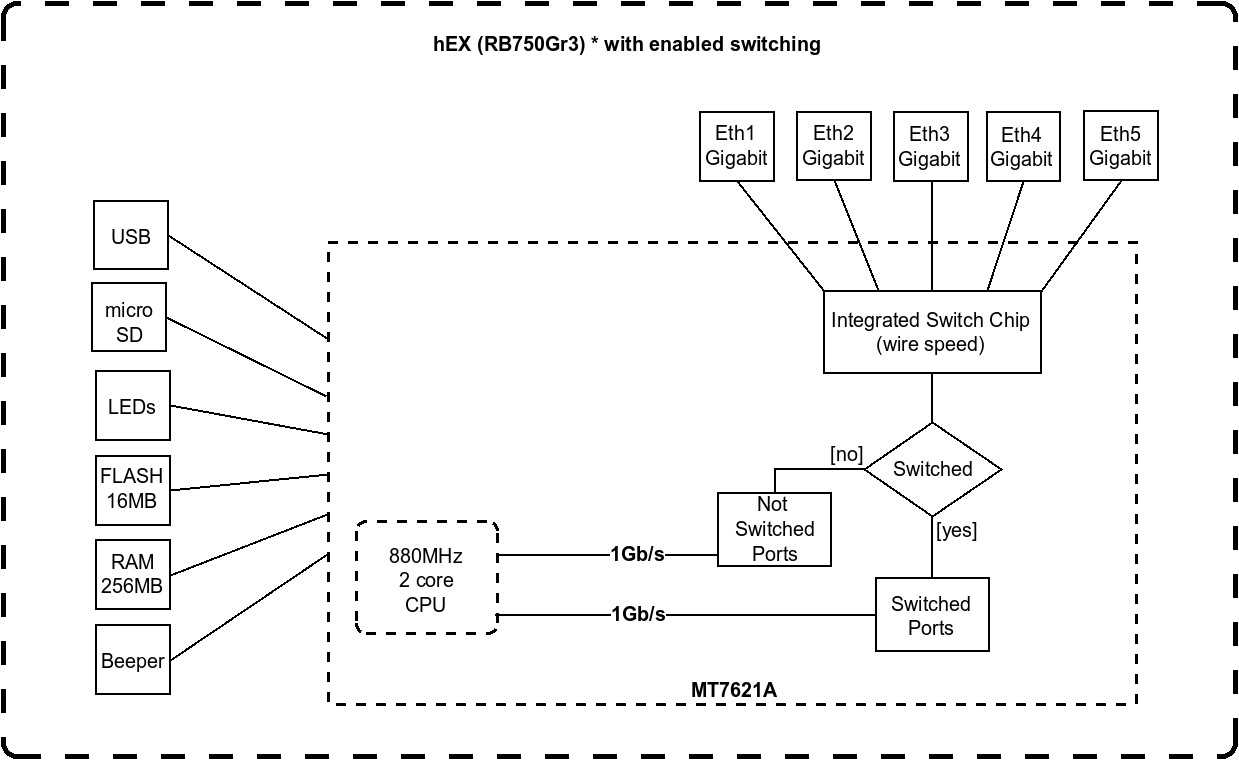
hEX RB750Gr3 with MT7621 chip can use simple bridge without vlans (and without stp and igmp-snooping). In this case hEX can switch untagged traffic beetwin all its ports on wire-speed with no impact on CPU (~900Mbit/sec between hosts in my case - the result could be limited by SSD perfomance).
Other option is using cpu-switching bridge with vlans like described here: https://wiki.mikrotik.com/wiki/Manual:Basic_VLAN_switching#Other_devices_without_a_built-in_switch_chip
Principle device schema shows 1G-link from switch chip to cpu: https://i.mt.lv/cdn/product_files/RB750Gr3-esw3_190642.png .
In my tests cpu-switching bridge setup demonstrates speeds beetwin two hosts about 900Mbit/s (like in switchchip bridge setup) with overoll cpu load up to 30% and single core load up to 50-60% (proccess “networking”).
So I can conclude, that CPU power is enoth for cpu-switching at full-duplex 1G-speed devided for all 5 device ports. Such traffic profile can be seen in a number of SOHO networks, so hEX with vlans in cpu-switching bridge could be sutible for them.