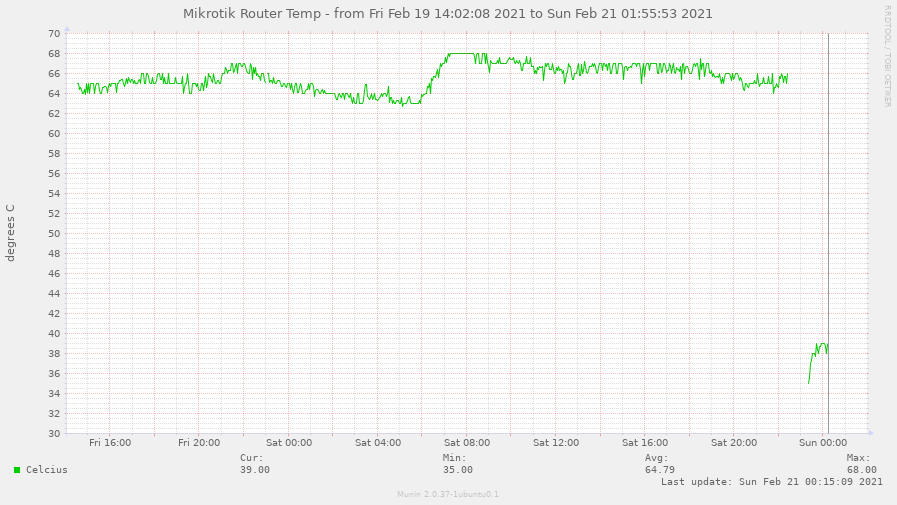
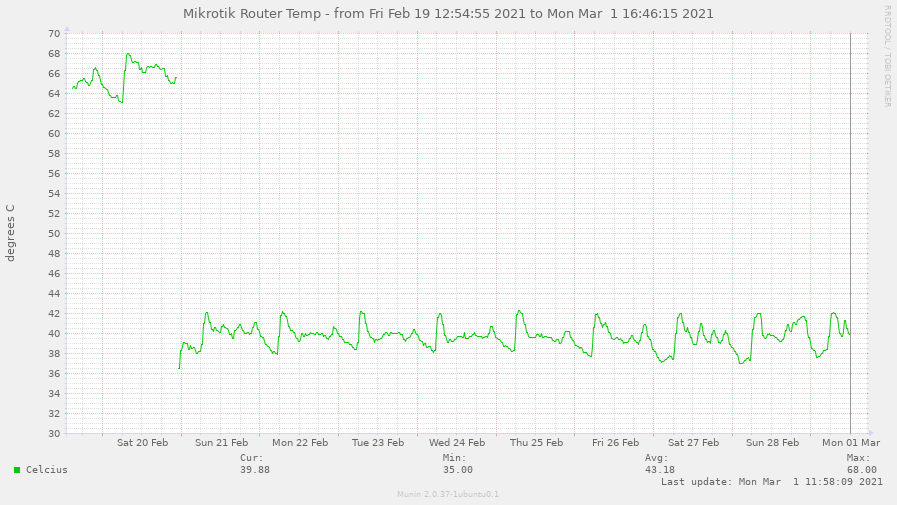
I’ve just installed my internal 12V power supply, stuck heatsinks on the SFP cages and mounted the Noctua FLX fan (with stock low noise adapter).
I’m glad to report that the CPU on my switch now reports 38-39degrees Celcius instead of 64-68 degrees.
For anyone who also want to monitor the temp with Munin, here is my dirty plugin:
#!/bin/sh

case $1 in
   config)
        cat <<'EOM'

update_rate 60
graph_data_size custom 1d, 1m for 1w, 5m for 1t, 15m for 1y

graph_title Mikrotik Router Temp
graph_vlabel degrees C

temp.label      Celcius
temp.warning 80

temp.draw       LINE1

EOM
        exit 0;;
esac

printf "temp.value "; ssh -o StrictHostKeyChecking=no admin@192.168.1.10 'system health print'|cut -d":" -f2|grep -o '[0-9]\+'
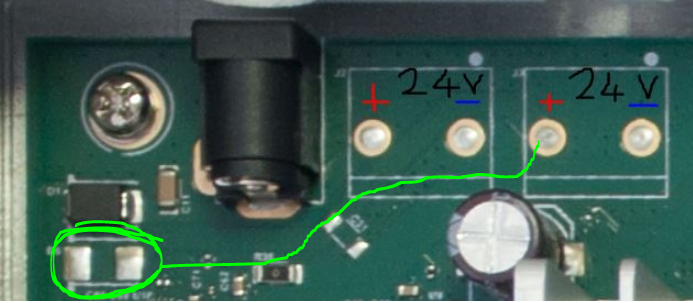
By the way, if you want to use the unpopulated redundant power connections/.The right pads miss the diode on the PCB. So connecting there will not work.
I just got a TP link switch with a fan. I noticed that is seems to suck air on one side and push air out the other side.
So… for the two small 3 Inch fans I bought for the exterior of the CCR1009, should I put one fan on one side blowing air into the unit and one on the other side reverse the fan to suck air out.
Would this be better or same as putting both fans at one end sucking air?? For those experts on the subject ;-PP
It’s the matter of controlling air flow. If there are only “suckers” at one side, then air will escape the unit everywhere. If you have a “sucker” and a “pusher”, then air will mostly flow between the two fans. If device case and device internals are designed to force air flow in certain direction, then dual fans are not necessary, a single fan somewhere inside device can do the job.
That’s good to know! So only the one on the left works? So you installed a 12V power supply JUST for the fans? You will have two power sources running to the switch then? One for the switch board and one just for the fans?
“There is more than one way to skin a cat”. This thread has offered 3 or 4 different ways to add active cooling to the CRS-326.
Forgive what might seem a silly question but this really isn’t my area.
Are we both talking about the CRS-326? So I see that it marks a voltage input range on the box at the back from 10V-30V but I was under the impression that it had to be powered with 24V, mainly because it ships with the AC 230V to DC 24V adaptor.
If it does accept a 12V power supply then of course it saves hassle adding a buck converter to step down to 12V for the fans I want to install. However, if the main board can run with a 12V power supply and we do that are we not just adding more heat to the whole board because lower voltage = higher amperage? Or perhaps that is not significant enough to create more heat.
If this can be run on a 12V supply then I will probably install a 12V internal power supply and use that to power the main box as well as the fans I add.
Would be good to know for sure.
If I analyse the PCB correctly the 10-30V is stepped down to a lower voltage with a switched mode power supply. These do normally not generate a lot of heat.
My switch, with the fan on a lower than stock speed and an internal 12V Meanwell supply runs nice and cool now.
The heat is the dissipated power, and power is a product of voltage and current (amps). So it doesn’t matter whether the device drains 2 A from 12 V or 1 A from 24 V. But the loss (and thus generated heat, although it is not noticeable under normal circumstances) on the feeding wires depends only on the current and the cross-section of the wires (which determines their resistance), so using higher voltage and thus lower current makes sense when using the thin wires in Ethernet cables to deliver power, which explains why the adaptor bundled with most Mikrotik models is a 24 V one.