mAP Lite to act as a "Wireless RJ45 cable"

Hello, I'm new to the forum, hoping to learn from your suggestions!

I would need to connect to a device, having static IP address (for example 172.16.16.xx), using the WiFi of my PC/Laptop. However, the device doesn't a have WiFi, just an RJ45 ethernet port.

I would like to use a mAP lite to interact with the device wirelessly. In other words, I would like to connect my mAP lite to the Ethernet port of the device, power the mAP lite via micro-USB, connect my laptop/PC to the mAP lite’s Wi-Fi network, and get the same result on my laptop/PC as if I had connected it to the device via an Ethernet cable.

My laptop/PC will have their WiFi card setted with an IP in the same subnet of the aforementioned device (for example 172.16.16.yy).

My use case call for a "Level 2 bridge", and is similar to other cases I found searching on internet:

https://forum.mikrotik.com/t/map-lite-as-a-wireless-rj45-cable/166725

https://www.reddit.com/r/mikrotik/comments/9kiitf/maplite_how_can_i_configure_it_to_use_the/

I already tried the suggestions described there without success.

For brevity, this is, in order, what I did:

-Reset/backupLoad the mAP lite
-System->Reset configuration->No default configuration->ok->reboot->I have a "clean" mAP lite
-Create a "bridge1"
-Add Ether1 and Wlan1 to Bridge1
-Enable Wlan1
-Put Wlan1 mode to "Ap-bridge", assigned a name for the SSID (for example "MyDeviceAP")
-Set my laptop/pc WiFi card with a static IP (172.16.16.yy)
-Device has static IP (172.16.16.xx)

Now, I connect my laptop/pc to mAP lite WiFi "MyDeviceAP", try from Windows 10 prompt ping 172.16.16.xx and....no response/timeout
Strangely, if I try to ping just right after connecting the ethernet cable, sometimes I receive a couple of response to my ping, then, after some seconds, nothing again...

The device is working perfectly for sure, beacuse if I connect using an ethernet cable from my pc directly to the device, it always responds to the ping correctly.

Some ideas/suggestions? Am I doing anything conceptually wrong?
Hi and welcome

Can you post current config of that map lite, please ?
Probably something minor but easier to spot when config is available.

hello, thank you for the very quick feedback!
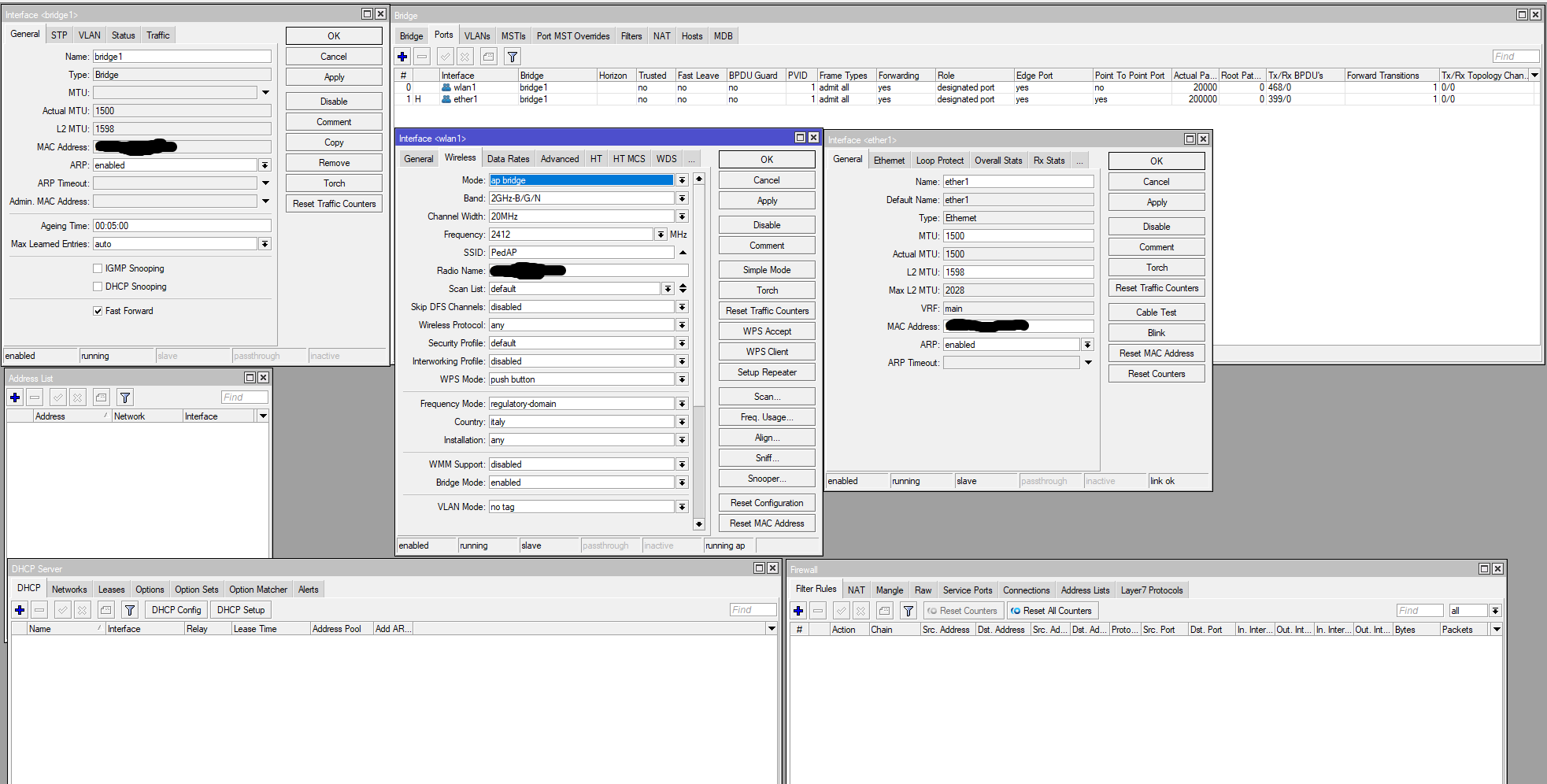
This is the config as screenshot:

This is as text:

# 2025-07-27 10:16:20 by RouterOS 7.19.4
# software id = FIFY-2L1Q
#
# model = RBmAPL-2nD
# serial number = <edit>
/interface bridge
add name=bridge1
/interface wireless
set [ find default-name=wlan1 ] band=2ghz-b/g/n country=italy disabled=no \
    mode=ap-bridge ssid=PedAP
/interface wireless security-profiles
set [ find default=yes ] supplicant-identity=MikroTik
/interface bridge port
add bridge=bridge1 interface=wlan1
add bridge=bridge1 interface=ether1

I would try (temporarily) to add an IP address to the bridge1 in the same 172.16.16.xx range, and check that you can ping the map lite from PC and the device from the map lite.
There Is nothing suspect in your configuration that I can see.
Have you tried rebooting the map lite?
You sure that the issue Is not in Windows 10 firewall/network settings?

Windows is known to be very restrictive for incoming ping traffic...

Hello, thank you for the support, very appreciated!

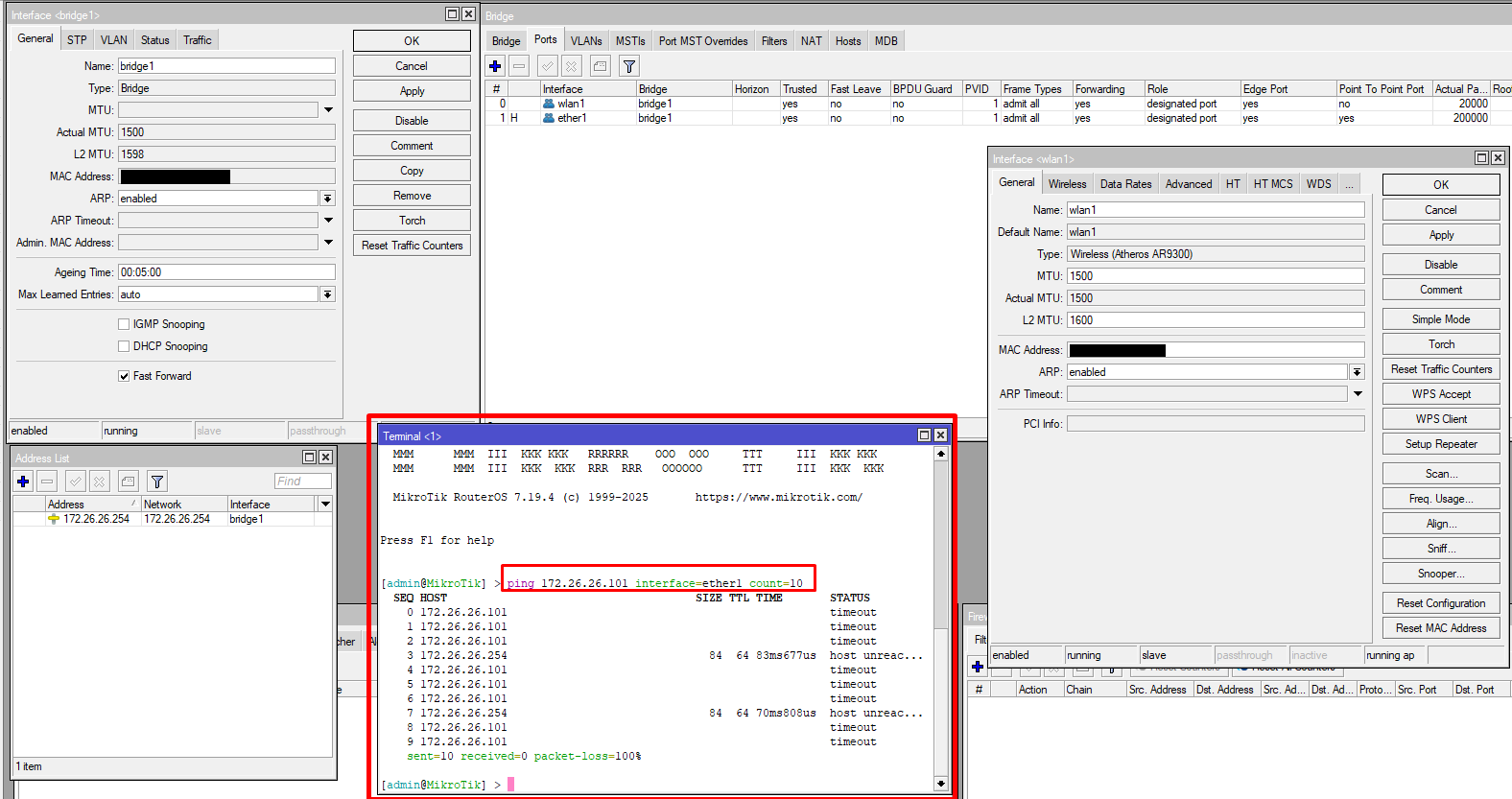
Now, starting from the configuration of my previous post, I added an IP address to the bridge, as visible in the following screenshot:

Just for clarification, these are all the involved IP addresses:

-PC WiFicard: 172.26.26.100
-Bridge1(mAPLite): 172.26.26.254
-Device: 172.26.26.101

The device is connected, using a cat5E ethernet cable, to the mAP Lite ethernet port.
As visible from the screenshot above, I tried to ping, from a terminal whitin WinBox/RouterOS, the device 172.26.26.101, using the mAPLite ether1 interface: it fails responding "timeout".

I tried also, from a command prompt in Win10, to ping the bridge1(mAPLite) IP, 172.26.26.254: it fails responding timeout. As on this PC I have also an ethernet card (not WiFi, cabled), I disabled it to be sure that Windows10 was using the WiFi for the ping.

Windows10 firewall is totally disabled on all nets, publics and privates.

Just to be completely sure that the device (172.26.26.101) was fully functioning when I was performing the tests, after the tests, whit the device still up and running, I detached the ethernet cable from the mAP Lite ethernet port, re-enabled the etherned card on my PC (ethernet card IP configured as static IP 172.26.26.99), attached the ethernet cable to it, disabled the WiFi card, and tried, from the command prompt in Win10, to ping the device IP 172.26.26.101: the ping responds flawlessly.

Honestly, I'm lost....

I was thinking it over a bit ...

Normally this sort of setup is done with map Lite used as an extender, connected to a normal network with another router doing routing, DHCP, DNS, etc etc

I am assuming that somehow one of the 3 involved parties in this setup have no clue where traffic needs to go to.
It works with a direct ethernet cable since both ends simply have no other way to go.
But with that map Lite in the middle, it becomes a bit different.

What I would try next:

  • add DHCP server on mAP Lite, on bridge
  • default route to "the device" on ether1
  • small pool avoiding IP address of "the device", same subnet
  • let your PC connect to wifi and obtain IP address from mAP Lite
  • let "the device" connect as before

This way mAP Lite will act as AP/router and communication going through it, will be tracked so it knows where the response needs to go.

Hi,
I modified the config following your suggestions:

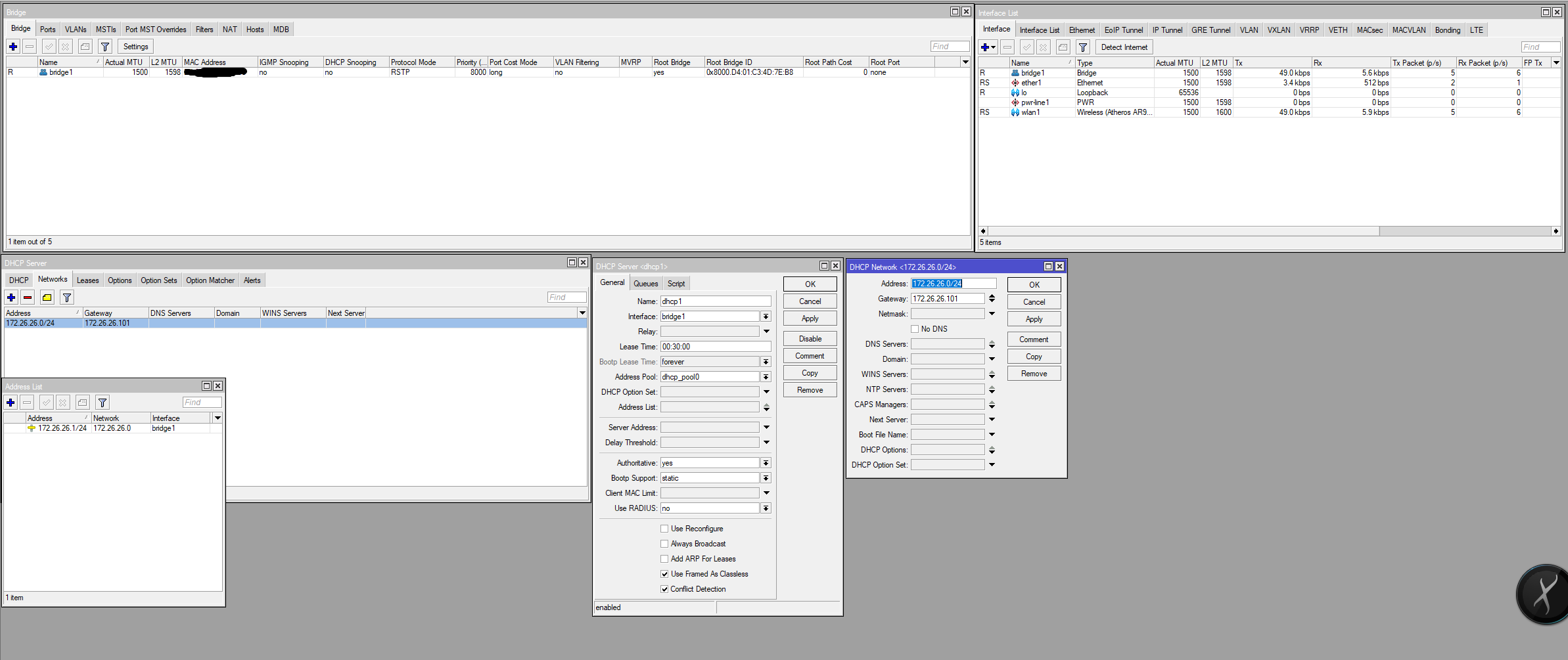
-Bridge1(mAPLite) IP: 172.26.26.1
-DHCP server on Bridge1 pool addresses: 172.26.26.2-172.26.26.50
-Default gateway for the DHCP server: 172.26.26.101(the device IP)

Find a screenshot below:

With this config, I setted my PC WiFi card for automatic IP, connected to the mAP Lite WiFi (PedAP) and my PC received, as hopefully expected, an IP, 172.26.26.50.

Now, trying to ping, from a command promt onb my PC, the IP 172.26.26.1 (Bridge1 IP on mAP Lite), I receive a correct response, good.
Unfortunately, trying to ping, from this same command prompt, the device IP, 172.26.26.101, I don't receive a response (timeout).

Moreover, trying to ping, this time from the terminal within WinBox/RouterOS, the IP of the device using:

ping 172.26.26.101 interface=ether1 count=5

I receive no response (timeout)

Same story (timeout) if I try:

ping 172.26.26.101 interface=bridge1 count=5

Same story (timeout) if I try:

pimg 172.26.26.50 interface=bridge1 count=5

Latter (172.26.26.50) is the IP of my PC WiFi card: In other words, it seems that, from within WinBox/RouterOS, I'm not able to ping an IP that:

-Has been assigned from the mAP lite itself
-Is able to ping the bridge1 IP, 172.26.26.1, from a Win10 cmd prompt

Honestly, this mAP lite is driving me crazy...3 days spent in trying to do something that should be conceptually very simple...

It's strange, I cannot see anything "wrong" in you configuration (with or without DHCP server enabled).
The only thing I can see is the different L2 MTU 1598 vs. 1600, but no idea if it can affect anything, likely no.
You should ping without specifying the interface, however, the map should know itself which interface to choose.

Could it be an issue of some kind with the "auto" setting for bridge1 MAC?
In any case it is recommended to assign one manually, see Rule #6

Another thing, have you tried rebooting the map, after having made configuration changes?

Probably not what you want to hear, but at this point I would try an older, surely working version of RoS, 7.19.4 - even if proposed as "stable" - may have some issues.
Another thing I would try is a routing setup (as opposed to a bridge one).
Something like:

/interface bridge
add name=bridge1
/interface ethernet
set [ find default-name=ether1 ] comment=WAN
/interface wireless
set [ find default-name=wlan1 ] band=2ghz-b/g/n country=italy disabled=no mode=ap-bridge ssid=PedAP
/interface wireless security-profiles
set [ find default=yes ] supplicant-identity=MikroTik
/interface list
add comment=defconf name=WAN
add comment=defconf name=LAN
add comment=testconf name=LANandWAN include=LAN,WAN
/ip pool
add name=dhcp ranges=192.168.88.10-192.168.88.254
/ip dhcp-server
add address-pool=dhcp interface=wlan1 name=testconf
/ip address
add address=192.168.88.1/24 comment=testconf interface=wlan1 network=192.168.88.0
add address= 172.26.26.1/24 comment=testconf interface=ether1 network= 172.26.26.0
/interface list member
add comment=testconf interface=wlan1 list=LAN
add comment=testconf interface=ether1 list=WAN
/ip dhcp-server network
add address=192.168.88.0/24 comment=defconf dns-server=192.168.88.1 gateway=192.168.88.1 netmask=24
/ip firewall nat
add action=masquerade chain=srcnat comment="defconf: masquerade" ipsec-policy=out,none out-interface-list=WAN
/tool mac-server
set allowed-interface-list=LANandWAN
/tool mac-server mac-winbox
set allowed-interface-list=LANandWAN

You need to use ROS tools to diagnose the network.

  1. IP/ARP will show IP addresses and their corresponding MAC addresses.
  2. Bridge/Host will show the MAC addresses of all connected devices.
  3. Tool/IP Scan can be used to scan all available devices.
  4. The interface properties include a TORCH tool that shows which packets are being sent and the addresses of the devices sending them. This sometimes allows you to view the address of an unknown device.