Thanks for sharing this, @mischa01101.
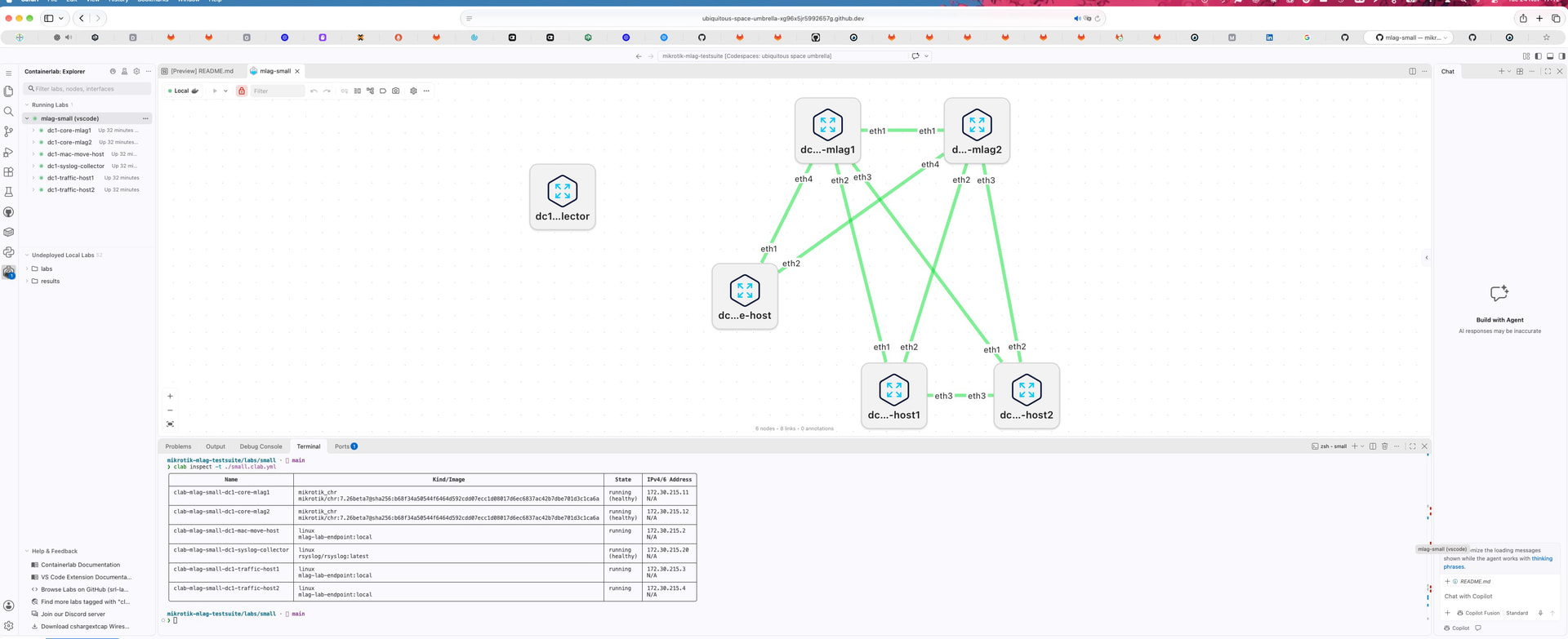
I checked the topology and device configs, and nothing in there jumps out that would explain the outage when the primary reboots with RSTP. Most of what follows is about how far the results carry over to real hardware.
Fair warning, this got a bit longer than I planned, but what the heck, I'm throwing in everything I can think of 
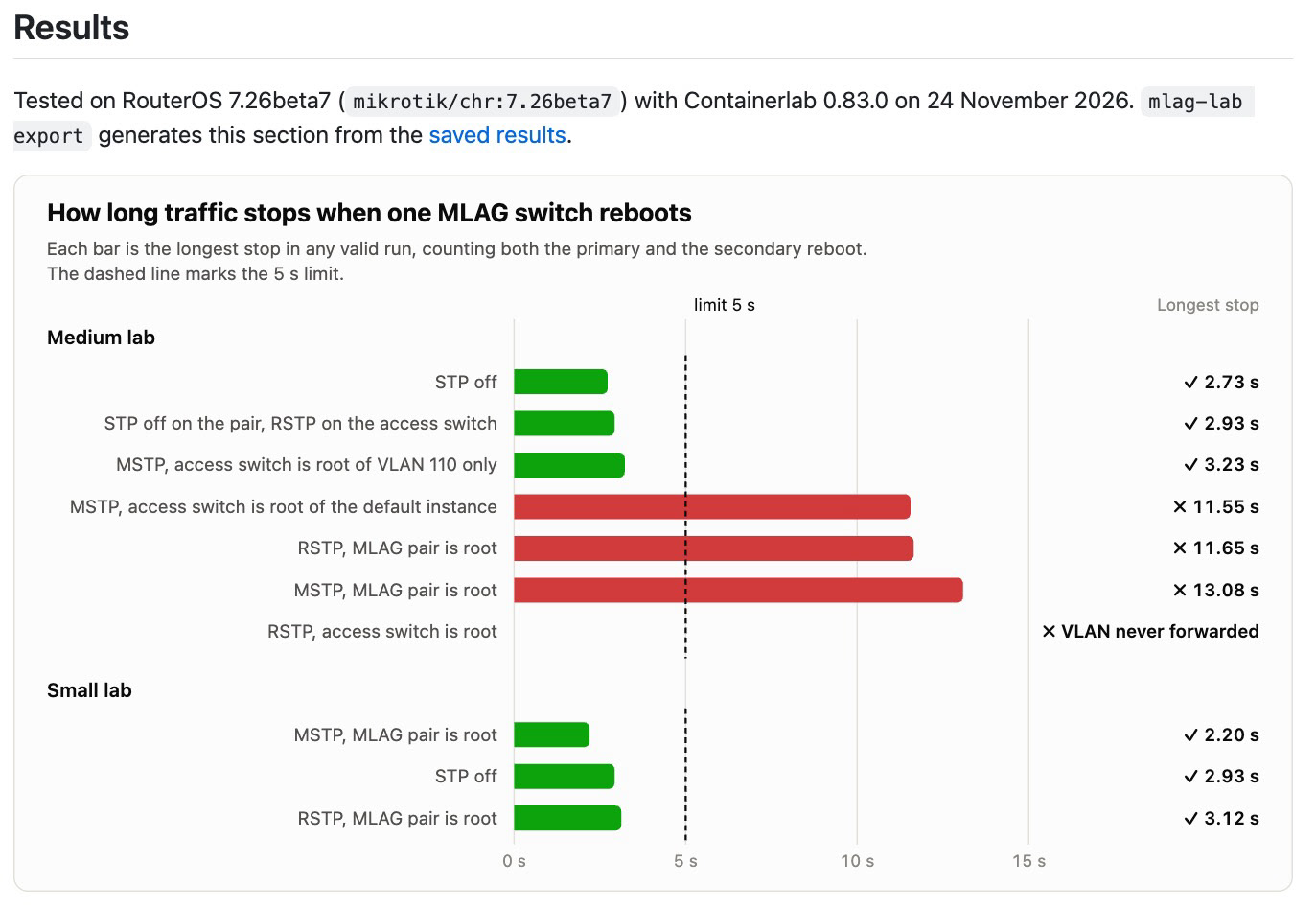
I dug a bit deeper, starting with your README. From what I can tell, you're building a repeatable way to catch MLAG failures and compare RouterOS releases. If that's the goal, permanent ARP entries and a single VLAN are fine since they keep the test focused. Personally, I'd want tests with normal ARP and tagged VLANs before recommending STP off for production, though.
Here's what I meant when I suggested a separate thread. There's a lot of stuff that works differently on hardware compared to CHR. CHR might reproduce real MLAG "logical" problems, but just because a test passes on CHR doesn't mean a CRS with hw offloading will behave the same.
For starters, even copying the config across doesn't guarantee the same behavior (sadly). The Prestera switch chip used in some CRS models ignores the configured bonding hash policy and uses its own built-in hw hash. Automatic STP costs also differ between software and offloaded bonds. So you can end up testing different traffic paths without changing a single setting(!) That's why I'd run the failing cases on the physical switches with offloading both disabled and enabled, and check the actual STP costs each time.
And finally, the lab side. You asked for results on other RouterOS versions. Pointing MLAG_CHR_IMAGE at another release is the easy part. The catch is that some of your test variants use settings older releases don't have. mlag-lacp-fallback, for example, only showed up in 7.25, so the fallback-off variants will just fail on anything older. It'd be worth flagging which cases need 7.25 or newer.
The virtual NICs matter too. Each vNIC type reports its own link speed (virtio only what the hypervisor sets, e1000 1G, vmxnet3 10G). That speed sets the auto STP costs, and it has to match within a LACP bond. Your lab forces 10G full duplex on virtio, which only sets the cost of plain ports like the peer link. The bonds get a fixed 20,000 either way. And on VMware or Hyper-V (maybe Proxmox too, though I haven't looked into that) the hypervisor has to allow promiscuous mode or MAC spoofing and pass the VLANs, or bridged traffic just gets dropped.
Then there's CHR licensing, which starts to matter once you add load tests. Free CHR caps upload at 1 Mbit/s per interface. A 60-day P-Unlimited trial removes the cap, but once it expires the CHR can't be upgraded or change packages. Not a big deal when each RouterOS version runs from its own image, though. The real catch is the admin overhead: every CHR needs its own trial registered to a MikroTik account, it has to reach the license server to stay valid (tricky on an isolated lab host), and once it runs out you're back to a fresh install.
Anyways, back to the actual MLAG problem. Your "Medium" topology (the MLAG pair plus a dual-connected access switch) already nails a real case: traffic drops when the primary reboots with RSTP enabled and the MLAG pair as root. That's the one I'd really like to see on real hardware, since Sledge's CRS326 numbers already match your simple case. One catch though: a CHR reboot keeps carrier up, and your own notes show traffic still following the LACP leg toward the rebooting peer. Your power-loss test drops carrier, but it only ran with STP off, so an RSTP power-loss run would show how much of the 10-13s is the virtual lab. Your captures also show the secondary sends no BPDUs while the primary reboots. Have you sent those to MikroTik support? To me that looks like the clearest bug candidate in the whole lab.
Separate question: you mentioned all the evidence is uploaded, and your results README says pair B in the two-pair lab did the same, but I couldn't find that lab or its results in the repo. Did they get left out? I'm curious, because that's the test that would back up or rule out the unique bridge ID tip from the other thread.
--
Phew, that's it for now. I'll be back if I think of anything else. Have a nice evening!
 I've added