I like the "half-rack" form factors, so +1 on that.
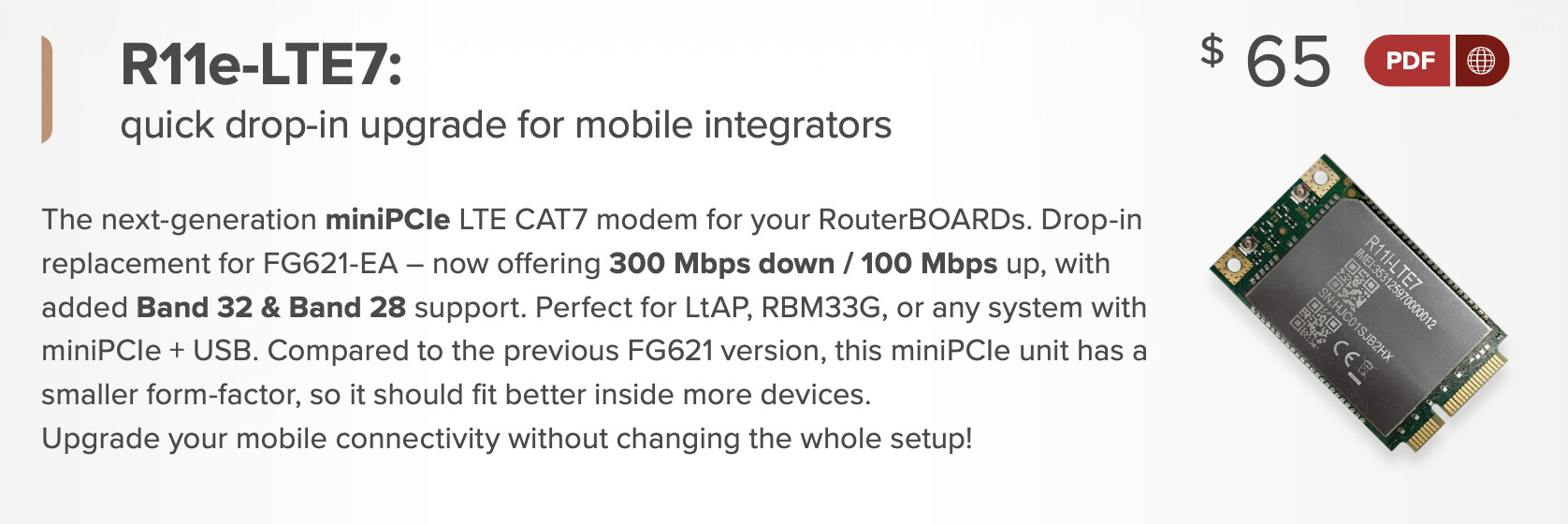
But how about a "drop-in upgrade" with the North American LTE bands? There is not a single LTE/5G with Band 2/4/12/etc., beyond the now slower and older devices. It's been years now.
Yes true, but as many times there is a stable version (7.20.6) and then it is released as a long-term version but some quick fixes are added (see 7.20.7 release notes). That version has not been widely tested in the field, and people find new issues that were maybe caused by the quick fixes.
It seems better to first release a 7.20.7 as “stable”, wait a couple of weeks, and then release the same version (no changes except the version name) as “long-term”. People expect a long-term version to be a riskless upgrade, although of course it has been discussed many times that these names refer to maintenance/release cycles, not to stability or bugs. You will not get that changed.
Well, people report a problem in the 7.20.7 release topic and claim it works on 7.20.6.
It may be caused by specific config of course, but I do not think that would have happened when 7.20.6 had been released as long-term.
Sometimes even minor changes can cause issues, even if it is a bug fix that changes behavior that people relied on. For example (I don’t think this change is in 7.20.7) I had to do quite some work to solve an issue caused by the seemingly innocent “ippool6 - take into account "subnet-id" when specified on address;” change in 7.21/7.22. I opened SUP-208174 for it, but to keep my network usable wihout downgrading I had to redesign my address layout, change firewall settings, update DNS entries at my provider, and re-configure tunnels at some peers. While that change would normally have been only an improvement in stability.
it’s not proof though. no software is bug-proof, but the best thing there is, is the long-term release. maybe there is a specific combination of configuration that causes a problem for one person out of a million. that person will come to the forum. it is not an indication of widespread problems.
I don’t claim that. But what will likely happen is a lot of users will upgrade either within v7 or from v6 because of that announcement in the newsletter, and there will be more postings about problems they experience. It would maybe have been better to save part of that by using a version that is a bit more tested.
I think the main point behind long-term is the longer support period. Which should mean that point releases that fix only particular bugs without introducing new features are issued.
This decreases (not eliminates) the chance of breakage. But what is much more important: if something does need patching, a new lts point version will be released instead of pointing users to upgrade to the next version that contains the fix, but along with other modifications.
Altogether, I think this is a nice sort of commitment.
It can be used as a reference exercise in both English and Network classes, it could be used as an example of the "most gratuitous use of coniferous and deciduous" and to practically teach the difficulties in precisely aligning two 60° beam wide wireless devices at 50 m distance.
Apart from the above it seems to me a breakthrough in ethology, clearly foxes in the North are much more educated than the common ones we have here in Southern Europe, as:
The visible camera surveillance has already had a deterrent effect on wild animals ...
(our ones can be sometimes scared with firing a gun, nothing less)
What is left unanswered is the procedures to be implemented WHEN the motion sensor cameras actually detect a fox, what do you suggest?
dress yourself, put your boots on, grab the gun, load it, run with the loaded gun through 50 meters of woods, get to the barn by the time the fox is already at your neighbour's chicken coop or anyway not less than 1 Km away [1]
watch the video of the fox stealing your poultry
trigger the firing of the decent amount of (AI driven) machine guns you placed covering the outside of the fence
something else ...
[1] a quick brown fox attack usually lasts 5-10 seconds, maybe a particularly slow one, will take 15-20 seconds to get the hen and run away
Where is the LtAP ax ? I remember a while ago at an exhibition, Mikrotik showcased a LtAP ax , which has 2 nano sim slot and 3 ethernet port, and support eSIM. Waiting for too long for that product !
Firstly, the newlsetter has not been ported to the Home Web page of Mikrotik. It still shows DEC!!
Secondly, I had to look to find it, whereas it should be prominently displayed on the first page ( meaning the latest newsletter). Please fix.


 .
.
 and to practically teach the difficulties in precisely aligning two 60° beam wide wireless devices at 50 m distance.
 fox attack usually lasts 5-10 seconds, maybe a particularly slow one, will take 15-20 seconds to get the hen and run away