Hi everyone,
I am managing a multi-vendor network consisting of Cisco, Huawei, and MikroTik devices. The core uses IS-IS and MPLS across most of the infrastructure. We still have several MikroTik units running ROS v6 using OSPF and MPLS, most of which terminate on a Huawei PE/P router.
The issue arises when we upgrade these ROS v6 devices to ROS v7. We immediately experience reachability issues, suggesting a conflict or interoperability problem between MPLS and the IGP (we tested both OSPF and IS-IS, but the result is the same).
The problem specifically occurs in the following topology:
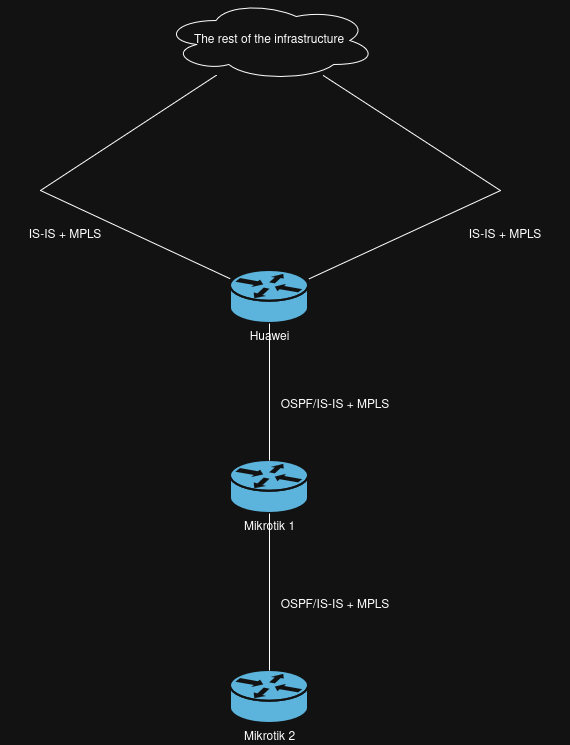
The first MikroTik directly connected to the Huawei router appears stable. However, the second MikroTik connected in series (daisy-chained) to the first one loses reachability. If we disable MPLS, routing recovers and the device becomes reachable again.
One anomaly I’ve noticed on the first MikroTik is that the monitoring route is flagged as invalid in /mpls ldp local-mapping. This is the only technical detail that seems out of place. Below is an example from a lab environment reproducing the issue:
[networkers@test-MK1] /mpls/ldp/local-mapping> print where dst-address=172.25.255.240/28
Flags: I - INACTIVE; D - DYNAMIC; G - GATEWAY
Columns: VRF, DST-ADDRESS, LABEL, PEERS
  #      VRF   DST-ADDRESS        LABEL  PEERS
138 IDG main  172.25.255.240/28    151   172.25.1.112:0
                                         172.25.0.10:0
[networkers@test-MK1] /mpls/ldp/local-mapping>
P.S. This issue does not occur when the MikroTik is connected to a Cisco device instead of a Huawei.
P.P.S. The issue is also observable from other devices within the network.
However, everything becomes reachable again if I specify the Loopback IP as the source IP when performing connectivity checks (pings/traceroutes).