My hAP ax2 on v7.16.2 shows bridge ports are hardware-offloaded:
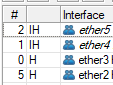
It is buggy though, plugging in a 100Mbps ethernet device on any of the ports reduces the max switch capacity to 100Mbps.
My hAP ax2 on v7.16.2 shows bridge ports are hardware-offloaded:
It is buggy though, plugging in a 100Mbps ethernet device on any of the ports reduces the max switch capacity to 100Mbps.
This does not solve my problem with RB450Gx4. After that that madness with polishing device-mode I start to feel somewhat reluctant to be unpaid outsourced beta tester of “stable” releases.
MT should be using enterprise software development practices which includes for each function module, in parallel they write a unit test that covers every code path in the function module. The unit tests run late in the build cycle to catch regressions without manual testing which is where the payback occurs to offset the unit test development time. Without unit tests and as features grow the manual regression testing coverage becomes sparse (what we see today) and eventually the user base collapse death spiral occurs.
Don’t excuse MT; pressure them to fix their testing process to keep their user base and business alive.
They do pretty good but testing is their weak point and it’s a fixable issue.
You know if MT (A) goes open source with a closed proprietary license, and (B) adds unit testing frame work to the build, then the user community could contribute to unit testing. IMO reliability and manual testing time saving leverage would be tremendous compared to the hell hole we are stuck in today.
I’m not making excuses for Mikrotik, and I know there are better ways to approach some of these problems in software development. But the issues being discussed here—like kernel image space and hardware offloading, and similar—aren’t something unit tests can handle. These are integration issues that involve hardware and need automated integration tests, not unit tests.
Unit tests are small, focused, and usually test pure functions. When external dependencies, like hardware, are involved, it’s no longer a unit test. For example, wifi-qcom client disconnection issues can’t be tested this way. It’d be nice if we could just add tests and make all interoperability issues disappear, but it’s not that simple. Something like BGP protocol handling or DNS server implementation might work well for unit testing, though.
Let’s get back on topic. Share your experience with version 7.17, and report any issues to Mikrotik support with a supout.rif.
I must agree @infabo.
I use 17 MT devices in my home and I participate in nearly every beta or RC to find problems and give MT feedback.
As I use automatic backups any problem is fixed fast 
But I´m also an IT professional and a new ROS should be handled as all software updates, it should be testet in your environment before you roll it out in the productive environment.
In that case MT is nothing special, it´s the same story for ALL vendors (Microsoft, Red Hat, F5, aso.)
I guess you would never make an inplace upgrade of a MS Server 2019 to 2025 without testing, right?
You probably have protocol-mode=none configured on your bridge. The Wiki page referenced states:
Currently, HW offloaded bridge support for the IPQ-PPE switch chip is still a work in progress. We recommend using, the default, non-HW offloaded bridge (enabled RSTP).
For curiosity, what is your wifi1 and wifi2 configuration? In my case quite basic one SSID with fast roaming on between 2,4 GHz and 5GHz bands. Allowed WPA2 and WPA3. No any interAP roaming. Nothing special. Mixed IPv4 and IPv6 traffic with majority of IPv6.
/interface wifi steering
add disabled=no name=steering1 neighbor-group=dynamic-ABC-6754ca15 rrm=yes wnm=yes
/interface wifi
set [ find default-name=wifi1 ] channel.band=2ghz-n .width=20/40mhz configuration.country=Czech .mode=ap .multicast-enhance=enabled .qos-classifier=\
    priority .ssid=ABC disabled=no mtu=1500 security.authentication-types=wpa2-psk,wpa3-psk .ft=yes .ft-over-ds=yes .ft-preserve-vlanid=no .wps=\
    disable steering=steering1
set [ find default-name=wifi2 ] channel.band=5ghz-ac .frequency=5500 .width=20/40/80mhz configuration.country=Czech .mode=ap .multicast-enhance=enabled \
    .qos-classifier=priority .ssid=ABC disabled=no security.authentication-types=wpa2-psk,wpa3-psk .ft=yes .ft-over-ds=yes .ft-preserve-vlanid=no \
    .wps=disable steering=steering1
Where do you get dhcp from? I have tried several models/scenarios and I don’t see this problem.
Updated devices and noticed that haps (RB951Ui-2nD) does brick whit my custom config. Tried to apply config line by line and:
/ip neighbor discovery-settings
set discover-interface-list=L2_neighbor_discovery
is at fault. That list contains vxlans. Reported to sup. Updated also my hap ax lite whit similar config and it was fine, so this does not affect all architectures.
Hi,
Upgraded RBLtAP-2HnD from 7.16.2 to v7.17 this morning.
These comments I want to add / ask after the upgrade:
1., not used LTE APNs can’t be deleted - even if LTE1 interface is disabled. I have 3 created for test purpose. One will stay as a tested/working one. Other two APN profiles (test) can’t be deleted. Any restriction for the deletion of them?
2., LTE1 interface is used as passthrough via VLANxx interface. 4GInternet works fine. The status on the top says: “Running”, “Not Slave” “Not Passthrough”, Not Inactive".So the message “Not Passthrough” is confusing in this case.
3., As the devide is used as a passthrough device from 4G WAN to the main router CCR1009 and configured according to the manual - strangely one DHCP Server entry appeared and can’t be deleted. Seems like dynamic entry…The name is equal to the working and used APN “name”. Is that with purpose? I read that DHCP server needs to be deleted in such case where device used as an LTE passthrough.
Prior thanks for the clarification.
Regards,
Pal
Have an rb450gx4 and was able to upgrade to 7.17 without issues from 7.16.2
Well, crap…
19:24:07 system,error upgrade failed, free 57 kB of disk space
> /system/package/print
Columns: NAME, VERSION, BUILD-TIME, SIZE
# NAME          VERSION  BUILD-TIME           SIZE
0 container     7.16.2   2024-11-26 12:09:40  96.1KiB
1 wifi-qcom-ac  7.16.2   2024-11-26 12:09:40  2676.1KiB
2 routeros      7.16.2   2024-11-26 12:09:40  11.1MiB

> /system/resource/print
                   uptime: 7m2s
                  version: 7.16.2 (stable)
               build-time: 2024-11-26 12:09:40
         factory-software: 6.99
              free-memory: 74.7MiB
             total-memory: 256.0MiB
                      cpu: ARM
                cpu-count: 4
            cpu-frequency: 448MHz
                 cpu-load: 3%
           free-hdd-space: 256.0KiB
          total-hdd-space: 16.0MiB
  write-sect-since-reboot: 891
         write-sect-total: 1243788
        architecture-name: arm
               board-name: D53G-5HacD2HnD
                 platform: MikroTik
Edit:
After 2nd attempt upgrade was successful, but disk space is very low:
> /system/resource/print
                   uptime: 1m58s
                  version: 7.17 (stable)
               build-time: 2025-01-16 08:19:28
         factory-software: 6.99
              free-memory: 57.9MiB
             total-memory: 256.0MiB
                      cpu: ARM
                cpu-count: 4
            cpu-frequency: 672MHz
                 cpu-load: 3%
           free-hdd-space: 68.0KiB
          total-hdd-space: 16.0MiB
  write-sect-since-reboot: 510
         write-sect-total: 1245818
        architecture-name: arm
               board-name: D53G-5HacD2HnD
                 platform: MikroTik
Going back to 7.16.2 until some future version will have less disk consumption…
What is your RB450Gx4’s factory version?
6.45.1
My theory is some of older versions creating too small partition for kernel. If you repartition your device for two partition with 7.16.2, and activate the part1 (second) partition and upgrade with part1 then you could upgrade. Or make full backup, netinstall with 7.16.2 then upgrade should be successful.
I have hap ac2 with factory version 6.44 and it updated with no issue. Same chip and older factory version…
I validated this, setting protocol-mode=none shows hw-offloaded ports on my hAP ax2. It’s a pitty that in 2024/25 we still have recent products without basic features like bridge hw-offload + R/MSTP…
Not stable!
had a bad upgrade experience. Upgrade to 7.17 - no name resolution for the router or lan clients, no helpful error message - receiving nxdomain, disable/enable, change dns servers for the internal service - nada. Downgrade to 7.16/7.15 - all works fine. Upgrade to 7.17 again - no workie. Again, no dns related messages in console except for tcp syn flood on port 53!.
Tried to disable all static entries - now clients get servfail instead of nxdomain. Disable and enable again - ok, now get resolution. Going on to enable static entries one-by-one - ah, a new error appears - a duplicate entry! What? That has never been the case, and second, why do you care - ignore it, if it is truly duplicate it does not cause any indeterminate state in the config (yes, they were truly duplicate). Why is that error not in console log when the system boots and service is brought up and chokes?
You can’t drop the ball like that Mikrotik. This is a simple situation your QAs should test. And not only that but if you roll service with such hairbrained changes it should be a parallel optional service that you ask the users to manually enable in place of the tried and true which should be the default - then the few that actually like to thinker with config will try it and provide feedback and give you the missing test cases that you did not cover, and only that you change what is the default. And at least put some error messages in the console. This is simply not how you produce quality!
Platform: arm32
Nice update! I just love how it bricked my RB450Gx4 <3 <3
Factory reset got it back to life, reverted to 7.16.2, guess I’m not updating for a while.
*) dhcpv6-server - added IPv6 address delegation support;
this not work. When i select a pool on ADDRESS POOL in the dhcpv6 server, i obtain in log: pool6 refused acquire: bad preferred prefix length! (1) and the pool is properly configured