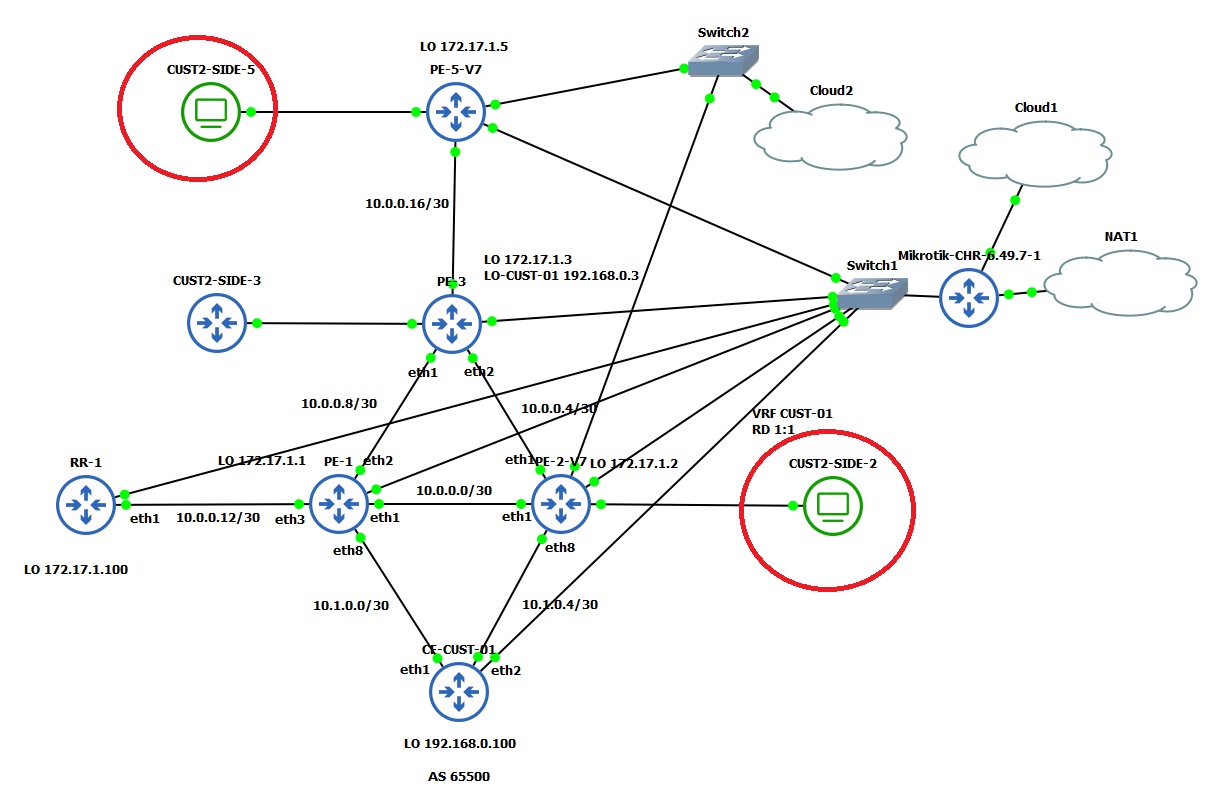
I’ve been able to use 1500 bytes with ROSv7 and VPLS for quite a while with no issues. It’ actually how my home network is built which has been running VPLS on ROSv7 for more than a year. We’ve also got some ISP clients using it in prod.
What hardware is this running on? The image looks like GNS3/CHR
Also, if you’re exceeding the size, you should get this message and not a timeout.
[adminhome@rtr-ap-2.kit.myersfam.net] > ping 8.8.8.8 do-not-fragment size=1501
  SEQ HOST                                     SIZE TTL TIME       STATUS
    0                                                              packet too large and cannot be fragmented
    1                                                              packet too large and cannot be fragmented
    2                                                              packet too large and cannot be fragmented
    3                                                              packet too large and cannot be fragmented
    4                                                              packet too large and cannot be fragmented
Yes problem happen in gns3/chr labs.
In real production i just find out it works for 1500 mtu.
And also in real production, i find out that vpls with jumbo frame mtu were problem, for example vpls for mtu 3000 maximum mtu reached is 1540
Can u try create vpls with mtu bigger than 1540 with v7?
Based on the information provided, it seems that the issue with the VPLS MTU size is related to the version of PE being used. If both PE are using v6, everything runs smoothly, but if one or both of them are using v7, the VPLS cannot reach MTU more than 1490.
This could be due to a compatibility issue between the different versions of PE. It’s possible that v7 has a different way of handling VPLS MTU sizes, which could result in the issue that you are facing.
To resolve this issue, you may need to consider upgrading the PE to a version that is compatible with VPLS MTU sizes greater than 1490. Alternatively, you could try adjusting the MTU settings on the PE to ensure that they are configured correctly for the VPLS network.
I would suggest consulting with your network provider or an expert in the field to get a more detailed analysis of the issue and to explore potential solutions to resolve it.