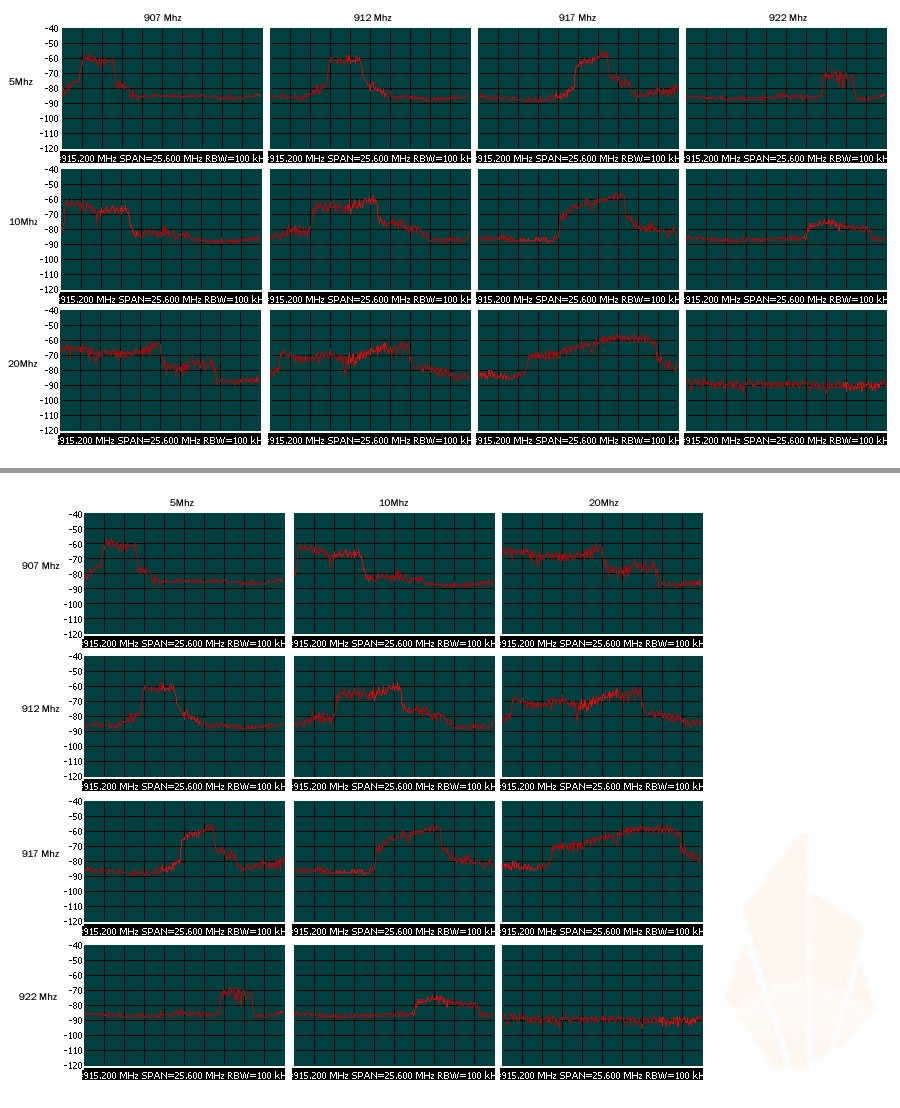
This goes along with the testing I posted earlier today, but instead from the point of view of co-locating multiple radios near each other and how significant adjacent channel interference will be. You can find the earlier info here: http://forum.mikrotik.com/t/sr9-and-motorola/16457/1
I took readings of power outputs on all 4 channels, after documenting all possible frequency/channel width combinations I arranged them by frequency, and by channel, to easily compare received power levels on each channel width and frequency selection, as well as actual frequency utilization. The charts are below, so you can review them and come to your own conclusions, but here are mine.
output power levels are most even across channels 907 and 912 in any channel width, while 917 seems to output the power on average, it seems to go from roughly 5db weaker at the bottom of the channel, to a 5db stronger at the top half of the channel in all channel widths leaving a (roughly) 10db difference in power output across the width of the channel, and at least on my test radio, 922 seems to have power output problems at any channel width, it is probably best to avoid this channel in any mode (I will try to test with another radio at a later date to confirm if this is isolated to the radio, or common across the product line)
Channels you can safely co-locate / operate near each other:
Using 5 MHz channels: any non-adjacent channel can safely exist in the same area, adjacent channels will receive interference roughly -20db weaker then the received signal strength, recommend different antenna polarities if using two adjacent 5 MHz channels in the same area.
Using 10 MHz channels: any non-adjacent channel can safely exist in the same area with minimal effect from other channel, recommend different antenna polarities if using two non-adjacent 10 MHz channels in the same area. Adjacent channels will cause significant interference and should not be used near each other.
Using 20 MHz channels: no combination can co-exist in nearby areas without causing significant interference
20 MHz channel modes are not supported at 907 MHz, yet it appears to function, but below the ISM band lower boundary. At 922 MHz 20 MHz channels do not function at all (this is not un-expected as it is an unsupported frequency. channel width combination).