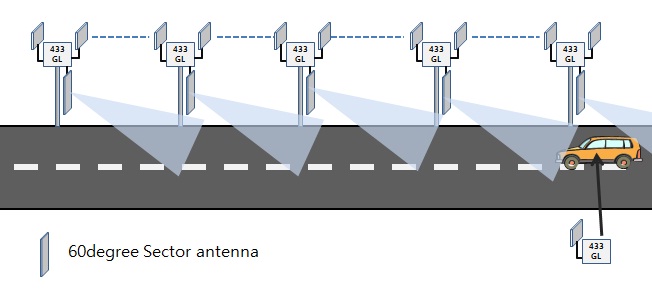
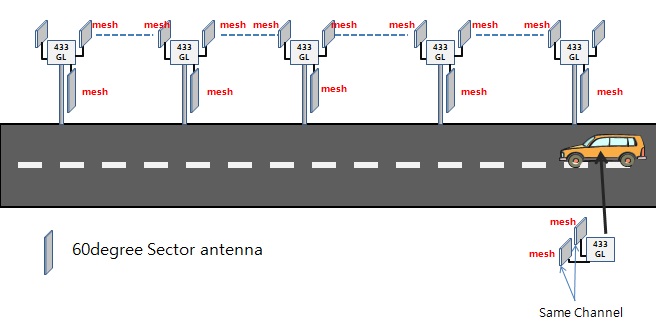
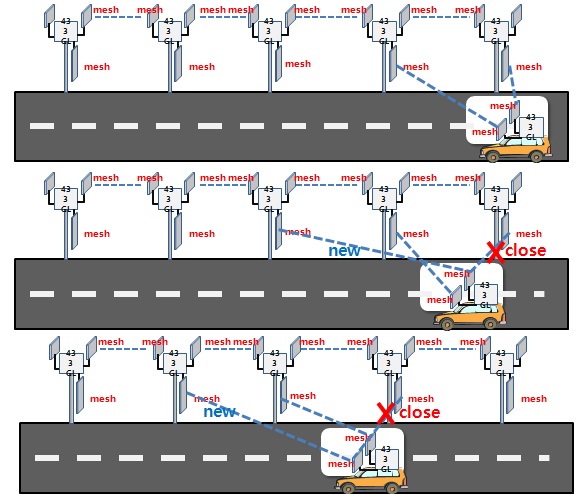
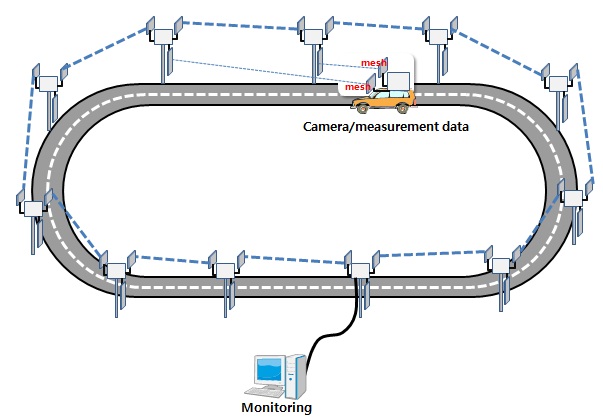
I’m planning to build mesh handover network with 433GL in the vehicle track as attached file.
Questions.
In the forum say latency time is around one ping lost.
is not means one second of latency time. Do you know how to test the latency time and what’s Mikrotik’s result?
Config of RSE(Road Side Equipment) and OBE(On Board Equipment) must be different?
Each AP link between RSE and OBE must be same frequency to reduce latency time?
(Currently I’m testing with 2.4GHz for RSE and OBE Link)
My idea is… TWO RF of OBE have different channel, and Each RSE have different channel.
for example OBE have 2412, 2472. and half of RSE have 2412, half of RSE have 2472.
So RSE is located 2412…2472…2412…2472… and each channel have different SSID.
How do you think?
If set OBE as mesh node, RSE and OBE can be connected triangle structure. in this case, no latency time or no packet loss is possible? if OBE have three mesh interface, is it more efficient?
Client(OBE) must get Static IP for Quick hand over? Or DHCP Client also same hand off delay time?
Our field, OBE is around 60 node.
There are Six to twelve RSE node. One of them must be DHCP server and other mesh nodes are DHCP relay?
Can I set Maximum and Minimum RSSI value? so, cannot connect long distance of RSE, instead of near RSE.
Any other tips for high performance of mesh hand over?
Among handover2, and handover3, which one is more efficient?
In all my experience, if you have a fast-moving target that will be switching constantly, then stock ospf if probably not the best choice, as the 10s hello timer means upwards of 30 seconds for some failover. You are able to turn the hello’s down to 1s each, which would need to be done on all radios, and then ospf may be viable (it’s not my strongest area, so I’m not sure).
RSTP should be an absolute max of 3-4s convergence time, and usually less than 1s. The only word of note would be to make sure you set the RSTP priority of the routerboard closest to the computer to 1, so the tree is built from there. This will keep your latency as low as possible, and prevent the board on the car from being the root node and causing all kinds of havoc as it moves around.
This does seem like a possible use for HWMP+, but I am have only used it in slower situations and am unfamiliar with the time it takes to work.
Whichever way you pick, make sure you create an access list on each AP that limits the low end of allowed signal strength. This helps with making sure the client is always connecting to the closest AP.
Edit:
Just after I hit Submit, I had a thought. Instead of alternating the channels as of the AP’s, what about alternating the SSID’s? This would ensure that the radios in the car would alternate which AP they are connected to. Combined with the SP signal strength limiting, it should ensure that always-connected stepping pattern you are looking for.
Set device that have connection to other network as MESH Portal. and use
“Re-optimize paths” in your MESH interface.
I have done some setup today with HWMP+ and found a huge regression in version 5.11. I’ve compared it to 4.17v and 4.x was working much better and covergence was much faster.
Today doing a MTCWE class i ask students to simulate simmiliar situaltion and sometime even did not dropped a PING.
Hi,
I tested with your suggestion.
I’m testing with Compex WLM200N-5-23 2X2 MIMO.
Problem is throughput is around 20Mbps.
I expected 150~200Mbps around.
Some good points made above,however it’s really a test of which is faster,OSPF calculating routes first or handing over between AP’s.Down here alot of guys have created mesh networks and although it sounds appealing,it just doesnt do well at all(from what i’ve seen).Quite a bit of my business is take over’s from such providers using that method.I’ve just done a test for you on my network and route calculation took 9 seconds to update from one router to the other,which has 4 hops between them.Possibly could make that faster as my OSPF is all on default.
Only way for sure is to get a couple routers and ap’s and do some bench testing
Infrastructure mesh is not going to get you the throughput you want. Thanks to WDS being limited in MT to only WEP, yet MIMO requiring AES for MCS speeds, you cannot achieve rates higher than 54Mbps. You could run in “turbo” 40MHz channel width and that would help.
If WDS could be implemented to support AES encryption, then you could run MIMO, but it seems that this is either against the IEEE spec or interpreted to be so. Although WDS is not very well defined anyway, so I don’t see what the big deal would be if you allowed AES encyption to be used.
Anyway, we have found that if you use HWMP in 40MHZ channel with MME or OSPF on top of it then it seems to behave the best. HWMP resolves loops and paths around the broadcast domain and MME or OSPF set your default gateways for you.
Not sure how fast it would fail over, but as others have indicated, if you set connect lists on your client with proper minimum signal levels, then you should flip over with only a packet or two loss.
First of all sorry to revive an old thread but I have some queries.
Did you find any documentation or methods on how to analyze to the latest ms the time the client took to move to the nearest AP? As I can confirm in my Mesh setup one ping is lost but I want a more accurate reading of the latency.