MPTCP runs on end-systems, not on routers. It would be like asking MikroTik to make QUIC available. It is already available.
Well, RouterOS can be client as well, so for example fetch command could benefit. It’s not a big win there, though.
But DoH over QUIC or HTTPS/3 could be worth adding one day… No idea if there are endpoints supporting it already.
It’s probably not only the RouterOS traffic alone that would benefit from MPTCP. If one uses a WAN uplink as client (with NAT etc) then all internet traffic is handled as RouterOS-client on that WAN interface. I have no idea if LAN based TCP could be converted to “aggregated WAN MPTCP”, it could just be wishful thinking. I only see improved connectivity with the web-proxy, which is using slightly different HTTP protocols than the clients. (Over satellite it makes quite a difference).
Can anyone please confirm wheather IPv6 accounting is added to ROS v7?
Waiting for that from a long time.
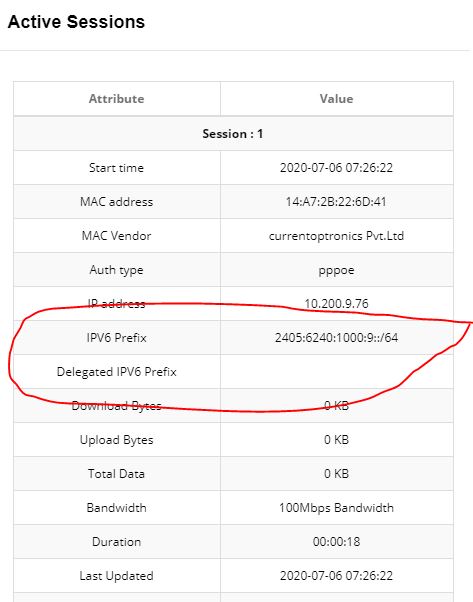
ISP need Delegation Prefix for IPDR and since ROS is not having IPv6 Accounting we are unable to fetch the Delegated IPv6 Prefix details…
Hope Mikrotik Team will take this in priority.
IP(v4) Accounting has been removed in RouterOS v7. So certainly there has been no IPv6 Accounting added.
Accounting should now be done using Netflow (IP->Traffic Flow) which already supports IPv6 in RouterOS v6.
In case of NAT router is only changing SRC or DST address of the packet, it does not make a connection. So it is still end-to-end system feature.
Thank You for the reply. But i was asking about radius accounting for IPv6.
Currently we are unable to get the information about DHCPv6 PD information in radius session log.
We are ISP and it is mandatory for us to log the following Parameters in our IPDR:
- Session Start Date & Time → Working
- Session End Date & Time → Working
- IPv4 Address Assigned → Working
- IPv6 Prefix Assigned → Working
5. IPv6 Delegation Assigned → NOT WORKING - MAC Address → Working
- User ID → Working
Because of this issue we are unable to implement IPv6 in our Network.
I Hope all major ISP in INDIA using Mikroitk Router is facing this issue and still we have received no Updates of improvements from the team.
It would be really great if anyone who is having some update/solutions regarding this problem may share here which will be very useful to everyone.
Of course it would be possible to use a socks proxy to make a bad TCP implementation work better over a difficult connection (e.g. one that delays or re-orders packets).
A web proxy is another case where that would work.
However, I’m not so sure if it is a good idea to cover up the problems this way, it will likely work better when the end-system TCP is improved.
(I know that some popular operating system has a terrible TCP implementation, but is it everyone-else’s problem to fix that?)
I see MPTCP implemented using OpenWRT on end Router, and a debian/ubuntu on datacenter vps
Creating some tunnel make real aggregation of multiple ISP with different bandwidth, latency instantly
See this example:
https://www.youtube.com/watch?v=YYDZ_8wc5HA
Anyone???
What we do is run a script every 5 minutes that converts all DHCPv6 dynamic bindings (leases) to static bindings. We backup the config of our PPPoE concentrator every hour, and keep the backups for a very long time period. So, every customer gets the same prefix lease the next time, and if we need to find which customer had a lease, we just need to check the backups of our concentrator. It is not as nice as having this info reported in the RADIUS accounting packets, but in the meantime, it works very well.
Hi, I’m a home user using MikroTik as my router. With BSNL FTTH as my ISP. I too have IPv6 problems on MikroTik. I found a hack, it’s probably violating some IPv6 specifications, but it works.
Link: IPv6 configuration on PPPoE interface
However it’s not just MikroTik, I’ve seen the exact same problems even with consumer brands like TP-Link, Netgear, D-Link and even some reports on pfSense.
Thank You so much for the reply @mducharme
It would be really helpful if you can share the script.
Thanks in Advance
OSPF doesn’t work. All routes learnt by ospf on v7 router is marked as invalid while other v6 routers are learning ospf networks via v7 but traffic is being dropped by v7 router.
I Really Appriciate MIKROTIK Team for their wonderful hardwork with ROS v7 
But Please add the IPv6 Radius accounting as all ISP are looking for the same from very long time.
ISP’s are unable to deploy the IPv6 due to No Radius Accounting for IPv6 and it is really SAD  that Mikrotik team is not taking any actions towards this issue.
Expecting the Feature at the earliest.
nithin kumar
What’s new in 6.45.1 (2019-Jun-27 10:23):
*) dhcpv6-server - added RADIUS accounting support with queue based statistics;
It’s already in RouterOS.
It is Still Not Working Normis.
We are getting only Remote Prefix but Not the Delegated IPv6 Prefix
Schedule this to run every 5 minutes:
/ipv6 dhcp-server binding;
:foreach i in=[find server~"pppoe"] do={
  make-static $i;
  set $i comment=[get $i server];
  set $i server=all;
}
This is because they only added support for DHCPv6 RADIUS accounting in that version where PPPoE is not used. If PPPoE is used, it is still not supported.
Hi mducharme
Thank You so much for your response. 